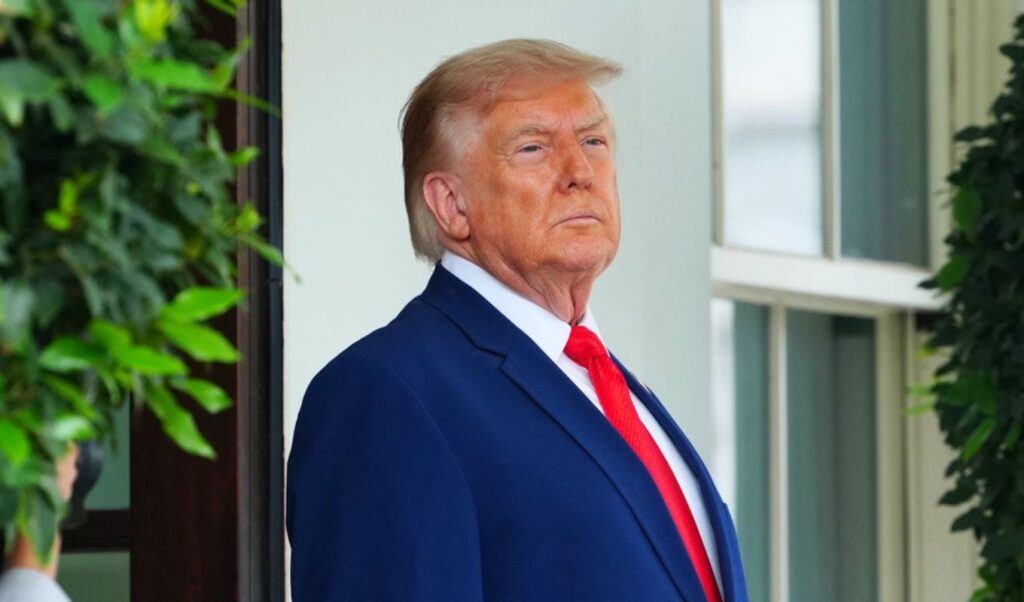
Donald Trump was emphatic that the United States faces no shortage of ammunition, stressing that his country holds larger stockpiles than any other nation in the world. And while a relative calm has settled over the Iran front — with Trump appearing to offer a second chance at a ceasefire agreement — he has not stopped issuing threats of bombardment and hostilities against Tehran.
In an interview with the Wall Street Journal, Donald Trump flatly denied reports of limited military stockpiles as a consequence of the war with Iran: “We have much more ammunition than anyone else in the world, and much more than we need,” he said.
Trump halts Iran strikes, but the threats keep coming
His remarks followed reports that senior American officials had expressed concern that any further escalation of the crisis could put pressure on US stocks of anti-aircraft missiles and interception systems. Trump’s statements come at a time when the US has refrained for a second consecutive night from launching airstrikes against Iran.
What Tehran is saying
On its side, Tehran announced that it would suspend its own attacks for as long as the American pause holds — though without any easing of underlying tensions, as both Washington and Israel have made clear they remain ready to resume military operations.
The social media posts
Trump proceeded to post a series of messages on Truth Social, accompanied by images with clear references to Iran’s energy and naval infrastructure. In one of them, AI-generated aircraft are shown striking an oil facility, accompanied by the caption “Attack on Kharg” — a reference to Kharg Island, Iran’s principal oil export hub.
In subsequent posts, captioned “Now we have the tanker,” Trump himself is depicted holding an American flag aboard a vessel resembling an Iranian oil tanker. Different versions of the image also feature American soldiers, as well as figures resembling Iranian religious leaders. Another image followed, captioned “Engines off,” showing a vessel resembling an Iranian ship being blown up.


It is worth noting that US strikes on Iran were suspended from Friday evening onward, after two weeks of unprecedented bombardment following the ceasefire that had been in place since April.
“We have suspended our operations”
For its part, Iran announced no attacks against American bases in Gulf monarchies allied with Washington. No overnight alerts were declared in those countries. “Since our strategy is essentially based on reciprocity, we have also suspended our operations,” commented Iranian military spokesman Mohammad Akraminiya.
Concerns over ammunition supplies
As the war approaches the five-month mark, the American press is reporting shortages of critical munitions. According to a New York Times report citing two informed sources, the Trump administration is concerned about declining stockpiles of ammunition for Patriot anti-aircraft systems and other missile defense systems protecting countries in the region. The US military has “everything it needs to conduct this campaign with full effectiveness,” countered Mike Waltz, adding that “additional resources” are being deployed to the Middle East. In Tehran’s view, the US finds itself in a “difficult and unstable” position and is likely seeking a “new strategy,” as Mohammad Akraminiya put it.
Netanyahu’s visit on the horizon
Two days before Israeli Prime Minister Benjamin Netanyahu’s visit to Washington — a leader who has consistently advocated a hard line against Tehran — Iran’s military spokesman issued a warning to the Americans: if they allow themselves to be “deceived again” by the Israeli prime minister and “insist on continuing the war, especially with airstrikes,” the conflict “will expand geographically.”
Netanyahu, for his part, said he “fully supports the efforts” of Donald Trump to put an end to Tehran’s alleged ambitions to acquire a nuclear arsenal — ambitions Iran has denied for decades. “If we could achieve this without high-intensity combat, that would be good,” he told Fox News.
In Tehran, which largely escaped bombardment after hostilities resumed in early July, life appeared to be returning to something closer to normal, with residents contending with the usual traffic jams and oppressive heat, according to an AFP team on the ground.
The Middle East war began on February 28th with US-Israeli strikes against Iran, and has claimed the lives of thousands of people, primarily in the Islamic Republic and in Lebanon. It has also rattled the global economy due to the disruption of shipping through the Strait of Hormuz — between Iran and the Arabian Peninsula — through which, under normal circumstances, one fifth of the world’s hydrocarbon supply passes.
What the US-Iran agreement had stipulated
Tehran, which has closed the strategically vital waterway and intends to press ahead with imposing transit fees despite Washington’s opposition, announced that it held fresh talks with Oman on Friday and Saturday — on the opposite shore of the strait — regarding its future management. The preliminary agreement — the “Islamabad Memorandum of Understanding” — signed on June 17th by Washington and Tehran, which had provided for a 60-day round of peace negotiations, fell apart before a single month of its implementation had elapsed.
The Strait of Hormuz, which had reopened for a few days thanks to the agreement, was announced by Iran to be closed once more. Six vessels that attempted to transit without Tehran’s permission were stopped in the previous 24 hours, according to Iranian state television. In retaliation, the US reimposed a blockade of Iranian ports in the Gulf.
On Sunday, the Iranian news agency Defa Press — which specializes in military affairs — reported, in a story picked up by other outlets, that an oil tanker had been struck by a mine after “deviating” from the only route Tehran permits, running along the Iranian coastline. The report has not been confirmed by independent sources as of this writing.
Why hostilities flared up again
Although a relative calm appeared to have returned to the Gulf for two days, hostilities intensified on a new front of the war: the one pitting Saudi Arabia against the Iran-aligned Houthi rebels of Yemen.
It was control of Yemeni airspace that served as the trigger, on July 13th: Tehran dispatched a plane carrying a rebel delegation to Sanaa without requesting permission from Riyadh — as has been customary over the past decade — prompting strikes attributed to the Sunni kingdom on the Yemeni capital’s airport.
In retaliation, the Houthis declared a naval blockade of Saudi Arabia, targeted its oil tankers, and for the first time since 2022, struck targets on Saudi territory itself — attacking, in particular, the kingdom’s oil facilities on Saturday.