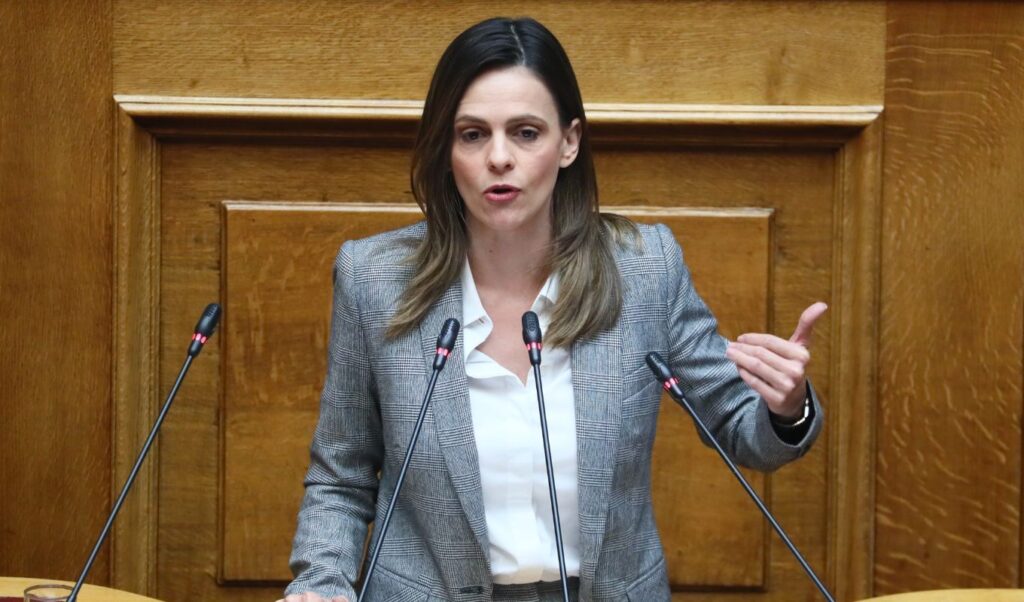
On Friday morning (05/06), Efi Ahtsioglou discussed Alexis Tsipras‘ return to the political scene and her own departure from the New Left. Speaking on SKAI, Ahtsioglou expressed the view that Alexis Tsipras’ return to active politics has “objectively” particular significance.
“From the moment the former prime minister chose to return to the forefront, he objectively creates momentum and will have a leading role. This is regardless of whether someone likes the political figure or not. It’s objective. You have a former prime minister who is getting back into things. He sparks mobilization,” Ahtsioglou noted.
Ahtsioglou: “Tsipras’ return creates momentum to challenge New Democracy’s dominance”
Efi Ahtsioglou argued that the main objective today is the formation of a broader political pole that can challenge New Democracy’s dominance and compete for governing the country.
“It appears that 8 out of 10 citizens demand political change”
As she said, what’s needed is a political force with majority characteristics, governmental prospects, and a clear progressive stance on major issues of the economy, welfare state, and rule of law. “It appears that 8 out of 10 citizens demand political change. So it’s important that this political change be expressed with two characteristics: programmatic opposition to New Democracy from a progressive perspective and governmental dynamics,” she emphasized.
The goal of the “Governing Left”
Speaking about Alexis Tsipras’ Greek Left Alliance, Ahtsioglou noted that the aspirations presented so far move in the direction she considers necessary. As she said, the “Governing Left” sets governmental prospects as its central goal and has presented programmatic commitments which, although still at a general level, constitute a basis for political opposition to the government.
“Alexis Tsipras’ party appears to have similar aspirations. It puts governmental prospects and programmatic issues in the seven commitments it announced. They are quite general at the moment, I’ll agree, but they move in that direction,” she stated.
Why she left the New Left
Efi Ahtsioglou also explained the reasons that led her to leave the New Left, citing deep strategic disagreement with the party’s current leadership. According to her, the difference concerns the basic political goal that the Left should serve today.
As she argued, the New Left leadership places greater emphasis on maintaining and protecting the political identity of the radical Left, while she considers the priority to be the formation of broader social and political coalitions that can lead to governmental change.
“We must work for a coalition of forces that will have governmental prospects”
“It’s not negligible to protect a political tradition, but I don’t think that’s what people need today. We believe we must work for a coalition of forces that will have governmental prospects,” she stated characteristically.
“We haven’t communicated with Alexis Tsipras for a long time”
Ahtsioglou also mentioned that there has been no recent communication with Alexis Tsipras, despite the mutual respect that exists from their shared political journey. “I’ve clarified that we haven’t communicated with Alexis Tsipras for a long time. We are people who have collaborated in the past and there is mutual respect, but that’s not the issue,” she said.
She also categorically denied scenarios according to which she had asked the former prime minister to step down from SYRIZA leadership in 2023. “Nothing like that ever happened,” she emphasized and defended the governmental work of the 2015-2019 period, in which she participated as minister, arguing that despite difficulties it left a positive social footprint.
As she mentioned, during that period there were measurable improvements in crucial social indicators, such as poverty and inequality reduction, wage increases, restoration of collective labor agreements, labor market regulation, and interventions to address child poverty. “I believe that government ultimately left a positive footprint on the country. These aren’t empty words, they’re measurable data. So I believe that governmental period is not to be condemned but to be defended,” she noted.