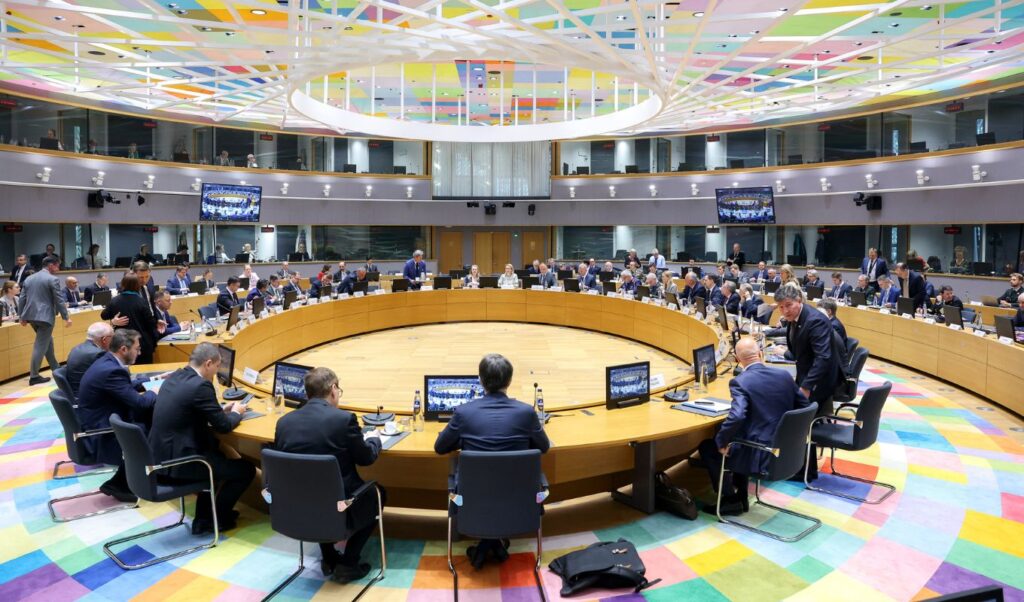
At a critical crossroads for the future of European security, Limassol is transforming these days into the diplomatic and defense “core” of the European Union. Within the framework of the Cypriot Presidency of the EU Council, European Union foreign ministers are called upon to examine ways to fortify Europe and seek a new security strategy and defense autonomy for the Old Continent.
Of particular interest is the presence of Ukraine’s Foreign Minister Andrii Sybiha, and the expected meeting with Greek Foreign Minister Giorgos Gerapetritis, which will be the first after the drone detection incident in Lefkada that became a point of friction in relations between the two countries.
EU Foreign Ministers Summit: Ukraine and Middle East on the discussion table
Additionally, the challenges posed by continued Russian aggression in Ukraine require a more coordinated and robust defense approach. In this context, the preparation of the new European Security Strategy and the need for a strong defense policy with the formation of a new European security architecture are expected to constitute central pillars of the consultations.
Beyond the issue of war in Ukraine, the Informal Meeting of Foreign Ministers (Gymnich) in Limassol is conducted under the shadow of prolonged crises in Gaza and the broader Middle East. These developments concern European officials, as it proves that dependence in strategic sectors, such as defense and supply chains, constitutes a vulnerable point in the Union’s self-sufficiency and self-protection.
Greek Foreign Minister Giorgos Gerapetritis, in his Wednesday meeting with his Finnish counterpart Elina Valtonen, argued that “the transition to strategic autonomy, while maintaining Europe’s strong geopolitical role in the world, constitutes a necessary condition and it is also necessary that we can ensure substantial diversification so that there is no over-dependence in any sector among those that constitute critical infrastructure for the future of Europe and the world.”
EU’s new security architecture remains a question
The European Union appears to recognize that its security is inextricably linked to stability in its broader neighborhood and is forged through cooperation with countries that are critical to its strategic plans. For this reason, discussions include not only strengthening defense programs, but also deepening relations with key players, such as India and Saudi Arabia. This is why ministers from these two countries were also invited and participate in the Summit.
What is certain is that in yet another Informal Summit, Europe’s foreign ministers are seeking ways for Europe to transform into a genuine geopolitical union. However, final decisions and the common course of action are expected to be announced by Cypriot Foreign Minister Konstantinos Kombos and EU High Representative for Foreign Affairs and Security Policy Kaja Kallas today, after the conclusion of the Summit’s proceedings.