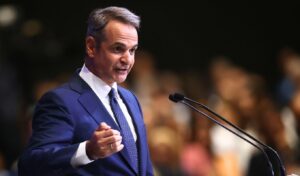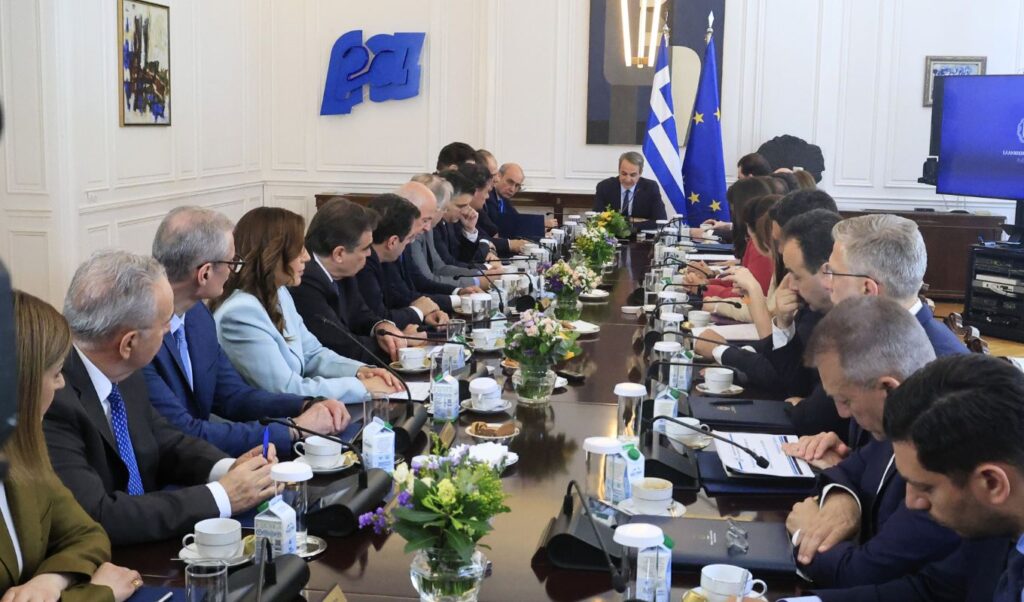
The Deputy Minister to the Prime Minister and Government Spokesperson, Pavlos Marinakis, announced the topics discussed in today’s cabinet meeting, following the presentation by Prime Minister Kyriakos Mitsotakis.
Detailed overview of topics discussed in the cabinet meeting
Labor and Social Security Minister Niki Kerameus presented to the cabinet the draft law on strengthening the application of equal pay between men and women for similar work or work of equal value and the inclusion of specific categories of NHS and EKAB workers in the heavy and unhealthy work category.
The new draft law introduces for the first time a comprehensive transparency framework for compensation, both before hiring and during the employment relationship, incorporating relevant EU legislation. During the personnel selection process, the employer will be required to inform the candidate about the salary or salary range of the position, as well as the relevant collective agreement, where one exists. Compensation includes not only the salary, but also all benefits, such as bonuses, allowances, overtime, benefits in kind and occupational pensions. At the same time, the hiring process must be gender-neutral and without discrimination.
The new framework is also linked to efforts to strengthen collective labor agreements as it provides
– that when a collective labor agreement is applied, it is presumed that there are no unjustified wage discriminations and
– that collective labor agreements can be used as a basis for creating wage structures in companies.
The employer continues to be required to adapt job categories so that the value of work in the organization is properly reflected. Procedures are simplified for companies that apply collective labor agreements and incentives are provided for signing more collective agreements.
The draft law also includes, among others, provisions that provide for:
* Inclusion of specific categories of NHS and EKAB workers in heavy and unhealthy work (nurses, nurse assistants, ambulance drivers and paramedics) – with the possibility of retirement at age 62 with at least 15 years of insurance, of which 12 years in the specific specialties, while providing the possibility of recognition and purchase of previous employment time to complete the required insurance prerequisites. The retirement conditions are equalized with those in force for corresponding specialties of the former IKA-ETAM.
* Recognition of apprenticeship time in DYPA Apprenticeship vocational schools as practical training/prior service for obtaining, upgrading or extending professional licenses and certification.
* Possibility of remote participation in the labor dispute resolution process at the Labor Inspectorate.
* Establishment of a Digital Registry of Collective Labor Agreements so that organizations can submit collective arrangements electronically to facilitate easier citizen access to collective agreement content and monitor worker coverage by collective agreements.
Papathanasis: Implementation progress of the Recovery and Resilience Fund
Deputy Minister of National Economy and Finance Nikolaos Papathanasis briefed the Cabinet on the implementation progress of the Recovery and Resilience Fund, specifically the full contracting of all loan programs totaling 17.7 billion in investments, which mobilizes financing exceeding 40 billion euros, as well as the submission of the 8th payment request for grants and loans totaling 1.63 billion euros. The Deputy Minister noted that we are now in the final and most demanding phase of implementing the Recovery Fund and analyzed in detail the timeline and steps required for submitting the final payment requests of the Recovery Fund.
Schinas: Common Agricultural Policy 2028-2034
Minister of Agricultural Development and Food Margaritis Schinas presented to the Cabinet the new Common Agricultural Policy 2028-2034.
Minister of Agricultural Development and Food Margaritis Schinas presented the framework of the new Common Agricultural Policy 2028-2034, as shaped through the European Commission’s proposals for the new Multi-annual Financial Framework of the European Union. As he emphasized, the new CAP is called to respond to a complex environment of challenges that includes climate change, geopolitical and food crises, the need to strengthen primary sector competitiveness, as well as the transition to a more digital and resilient production model.
During the presentation, the minister highlighted the key priorities of the new CAP, emphasizing fair support for producer income, generational renewal in the agricultural sector, strengthening investments, resilience against crises and natural disasters, as well as supporting rural areas. At the same time, he focused on the new CAP financing architecture, which, as he noted, gives member states greater responsibility and more tools for national planning and utilization of available European resources.
Special reference was made to Greek positions in the negotiation for the new CAP, with the Ministry seeking, among others, maintaining current co-financing rates, greater flexibility in direct subsidies, a two-year transitional adjustment period to the new model and incorporation of processing in CAP interventions.
Kyriakos Pierrakakis: Draft law on financial sector supervision
Minister of National Economy and Finance and Eurogroup President Kyriakos Pierrakakis presented to the Cabinet the draft law on financial sector supervision, the European Single Access Point, financial risk management, the transposition of Directives 2024/1619, 2024/2994, 2024/927 and 2023/2864 and the implementation of Regulations 2023/2859 and 2023/2869.
Responding to modern supervisory and regulatory challenges, this draft law includes the necessary transpositions and adaptations of Union legislation, particularly recent sectoral directives and regulations, combined with national regulations to strengthen systemic stability and ensure an increased level of transparency for the benefit of investors and market participants in general. Specifically, through the transposition of the four Directives and two Regulations, it aims to address identified weaknesses in the national framework: eliminating divergences in the supervisory treatment of banks and investment firms, strengthening supervision of concentration risks and transactions with central counterparties, and regulating activities such as lending by AIFM. At the same time, it seeks to clarify delegation and custody rules, reduce overlaps in supervisory reporting and create unified access to financial data, improving the functionality, transparency and supervisory effectiveness of the Greek market.
In the long term, the regulation aims to create a more resilient and stable banking system through stricter and more harmonized supervision, enhanced capital requirements and consistent rules for the entire financial sector. At the same time, it aims:
a) at the sustainable transition of the financial sector to address environmental, social and governance risks,
b) at the further development of the capital market, to ensure more options for institutional investors and strengthen the competitiveness of the capital markets union,
c) at enhancing transparency and comparability of information in European capital markets, improving access to investment information and strengthening investor confidence.
d) at supporting cross-border financing and more effective functioning of the Capital Markets Union through unified digital access to publicly available data.
Panagiotis Theodorikakos: Draft law on new incentive framework for foreign direct investment
Development Minister Panagiotis Theodorikakos presented to the Cabinet the draft law on the new incentive framework for foreign direct investment.
The draft law establishes a comprehensive mechanism for enhancing Foreign Direct Investment in key sectors of the Greek economy through the provision of additional incentives to existing ones.
Specifically, it provides for the establishment of an incentive consisting of: a) the provision of tax exemptions, b) the fast-track licensing incentive, and c) the provision of financial tools for investment projects up to 50 million euros financed by non-domestic capital and belonging to specific economic sectors.
The main objectives of the draft law are:
- Increasing Foreign Direct Investment inflows and strengthening the country’s economic development by granting incentives in strategic sectors, such as:
o Manufacturing/industry,
o R&D and Technology/Artificial Intelligence, supply chain,
o Industrialized primary production,
o Defense industry/aerospace,
o Biotechnology, health and social welfare, for investment projects up to 50 million euros.
- Providing incentives for investment projects to be implemented in the above sectors. The amount of granted incentives can be differentiated based on the region where the investment is implemented and the incentives consist of:
o Tax exemption or accelerated depreciation of fixed assets,
o Fast-track licensing, strict deadlines for licensing authorities with the possibility of the Development Minister assuming responsibility in case of inaction.
o Provision of financing tools through loans guaranteed by the Hellenic Development Bank.
o Facilitation of residence permits.
o Fair distribution through FIFO: Inclusion of investment projects in the regime through the First In First Out procedure.
The implementation of investments in the above economic sectors will contribute to significant capital leverage, the arrival and integration of advanced business culture into the Greek business community, digital transformation, the creation of quality employment positions and the reduction of regional inequalities within the country.
Georgios Floridis: Draft law on Alternative Dispute Resolution Code
Justice Minister Georgios Floridis and Deputy Minister Ioannis Bougas presented to the Cabinet the draft law on the Alternative Dispute Resolution Code.
The proposed regulations comprehensively reform the institutional framework of Alternative Dispute Resolution (ADR). For the first time, an Alternative Dispute Resolution Code is established, which is not a simple codification, but a comprehensive regulation of named forms of alternative dispute resolution (arbitration, mediation, judicial mediation) and simultaneously establishes general principles of regulatory content for any other form of alternative dispute resolution. Specifically, the Code incorporates and modernizes arbitration (currently domestic arbitration is regulated in articles 867-903 of the Code of Civil Procedure and international arbitration in Law 5016/2023) adopting a monistic system, replaces Law 4640/2019 on mediation, develops judicial mediation into a comprehensive institutional framework, and concentrates, updates and rationalizes scattered provisions of related legislation. At the same time, general principles for all methods are provided, correlation between them and mandatory pre-trial procedure.
The objective of the draft law is to establish a modern, coherent and reliable Alternative Dispute Resolution framework, enhancing trust of citizens and businesses and adapting Greek law to international practices. Specifically:
Regarding arbitration: modernization through the monistic system for domestic and international arbitration, with innovations such as third-party funding and multiparty arbitration.
Regarding mediation: expanding the scope of covered disputes and expanding disputes subject to mandatory pre-trial procedure. Upgrading mediator quality through a three-tier system, enhanced basic training with a legal component so mediators can respond in practice, continuing biennial post-training, demanding accreditation examinations and a comprehensive disciplinary framework. Regulation of legal representative fees, corresponding to those of judicial procedure and establishment of higher minimum mediator fees. Legislative regulation of special forms (family, cadastral, commercial, school, university) that operate in practice without adequate institutional framework. Introduction of mediator settlement proposals, with the possibility of apportioning court costs against a party that refused a proposal that essentially coincides with the judicial decision.
Regarding judicial mediation: its development into a comprehensive institutional framework, with detailed regulation of the procedure and establishment of Judicial Mediation Offices in the Court of Appeal Districts of Athens, Thessaloniki and Piraeus.
Regarding mandatory pre-trial procedure: its substantial upgrade, with the possibility of joint choice between mediation and judicial mediation, mediation as the default method in the absence of agreement and mandatory party memoranda.
Regarding digital upgrade: the Unified Digital Mediation Portal, electronic registries, digital posting of minutes with unique identification and automated submission of activity reports.
Draft law on Artificial Intelligence
Digital Governance Minister Dimitrios Papastergiou and Deputy Minister Christos Dermentzopoulos presented to the Cabinet the legislative initiatives: a) Implementation measures of the Artificial Intelligence Regulation (Regulation (EU) 2024/1689 of the European Parliament and of the Council of 13 June 2024), b) Establishment of Unified Real Estate Hub.
The draft law on Artificial Intelligence creates a comprehensive national framework of rules and supervision for the use of AI systems, adapting the country to the requirements of the European AI Act. It determines which authorities will have the responsibility for control and supervision, with a central role for the Personal Data Protection Authority and the Hellenic Telecommunications and Post Commission, while establishing mechanisms for complaints, controls and sanctions for cases of rule violations. At the same time, it creates a safe and controlled testing environment for Artificial Intelligence applications, so that startups and research organizations can develop new tools without innovation being hindered by complex compliance procedures. In the Public Sector, a Unified AI Systems Registry is established, to ensure transparency for algorithmic tools used by state agencies, while the AI Observatory is strengthened for monitoring the National Artificial Intelligence Strategy. Essentially, the draft law attempts to set clear rules for AI use, protecting citizens’ rights and personal data, without hindering development and technological progress.
Draft law on Unified Real Estate Hub
The draft law on the Unified Real Estate Hub creates a new unified digital platform through which all basic information concerning a property will be concentrated, regardless of the entity that maintains it today. Until now, citizens and professionals have been forced to contact different services — such as the Land Registry, urban planning offices, Municipalities, AADE, DEDDIE or forest maps — in order to collect the necessary information for a transfer, a sale or any other procedure related to real estate. With the new “Hub”, this data will be digitally connected through interoperability of entities and will appear concentrated in a unified environment. This way, bureaucracy is significantly reduced, delays are minimized and transactions are facilitated for citizens, notaries, engineers and lawyers. At the same time, the state acquires a clearer and more reliable picture of public and private real estate, which contributes to better organization of services and enhanced transparency. The objective of the draft law is to move real estate management into a new digital era, with less hassle and faster, safer and more effective procedures for everyone.
Minister of National Economy and Finance and Eurogroup President Kyriakos Pierrakakis proposed the issuance of a Cabinet Act for co-signing by the Greek State of the Concession Agreement for the right to administer, manage, operate, develop, extend, maintain and exploit Kalamata International Airport “Captain Vas. Konstantakopoulos”.
Kalamata International Airport “Captain Vas. Konstantakopoulos”
Kalamata International Airport “Captain Vas. Konstantakopoulos” serves as a gateway for air tourism to southern