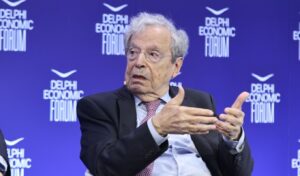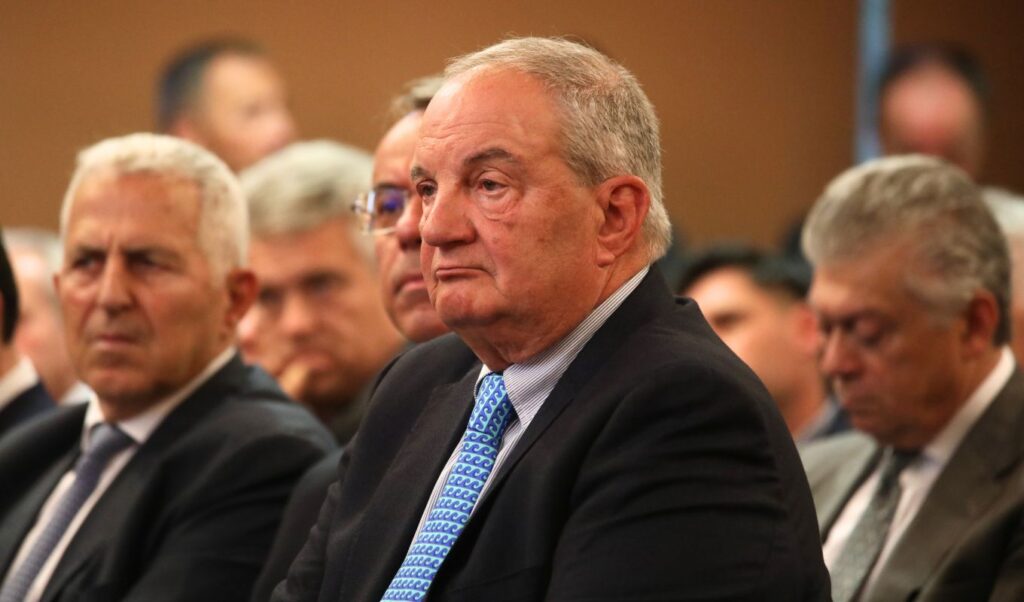
Former Prime Minister Kostas Karamanlis chose his public appearance at the Athens Concert Hall to send strong political messages regarding Greek-Turkish relations and the country’s stance against Ankara’s revisionist ambitions. His presence as the main speaker at the book launch event by Konstantinos Arvanitopoulos and Konstantinos Filis, with Antonis Samaras in the front row, immediately sparked political interest. In his speech, Karamanlis focused on the rapid geopolitical developments that mark our times. He referred to the transition from bipolarity to multipolarity, the downgrading of International Law and the prevalence of the Law of Force. He made special mention of Europe’s marginalization on the international stage, while referring to the wars in the Middle East and Ukraine as examples of the uncharted international waters we are navigating.
The Turkish bill on the Blue Homeland
The central point of the former Prime Minister’s intervention concerned the issue of Greek-Turkish relations and specifically the Turkish bill on maritime zones. Karamanlis characterized the Blue Homeland Doctrine as inconceivable and warned that Ankara is preparing to disrupt the balance in the region. He emphasized that this particular doctrine, which many considered destined for domestic consumption, is now being taught in Turkish schools, nurturing, misleading and fanatizing the new generations. Its legislative consolidation means it acquires official character and binds not only the current but all future governments of Turkey.
Criticism of the calm waters policy
Kostas Karamanlis leveled substantial criticism at the “calm waters” policy followed by the government. Although he acknowledged that the effort to avoid tensions is understandable, he argued that when this behavior is misinterpreted as submissiveness, the cost becomes disproportionately greater than the intended benefit. According to the former Prime Minister, this stance may absolve Turkey of the burden of its aggressive behavior in the eyes of third countries, which hypocritically tolerate it because it suits them. He emphasized that there should be no submissiveness in exercising even the slightest right of Greece, even in the heart of the Aegean.
Proposals for new approach to Greek-Turkish relations
Karamanlis argued that while strengthening the country’s defensive and deterrent capability is correct, the time has come for more active diplomacy. He proposed conducting a continuous public diplomacy campaign toward partners and allies, in a persistent and clear manner, to demonstrate the inconceivable nature of Turkish ambitions and the magnitude of Turkish expansionism. Toward Turkey, he called for the clear transmission of the message that no one in Greece offers discounts on issues of internationally guaranteed rights and prerogatives of the country. He underlined that the Turkish bill, although it has no legal value for imposing fait accompli, constitutes indisputable proof that Turkey methodically and systematically promotes its revisionist agenda and attempts to gradually shape conditions favorable to itself.
Illegal or formally legal surveillance also harms Democracy
Kostas Karamanlis clearly positioned himself on the issue of wiretapping, emphasizing the danger that Democracy faces from illegal surveillance. According to the former Prime Minister, seemingly legal or illegal wiretapping constitutes a direct threat to the democratic functioning of the state, while the loss of citizens’ trust in institutions constitutes perhaps the greatest blow. The greatest blow, according to Karamanlis, is the expanding certainty of the vast majority of citizens that institutions, primarily Justice as the foundation of free and democratic society, are being manipulated. “All these overturn the narrative of Western superiority. However, instead of a coherent effort to stem their negative consequences, we often see the insistence of those in power on these concessions. They easily resort to attempting to diminish and slander those who dare to challenge their own narrative. Often, indeed, with guided but anonymous internet pens. How can one wonder, then, at the explosive strengthening of anti-systemic tendencies,” the former Prime Minister noted.
Read the full speech
Ladies and Gentlemen,
The book by Arvanitopoulos and Filis is an accurate depiction of the new reality we are now experiencing in the international system, the “New World Order,” as characteristically stated in the title, euphemistically, in reality DISORDER, and a very apt investigation of the elements that interpret it. The authors delve into all the parameters that differentiate this situation from the post-war international system and crystallize the new parameters we now face. As a resultant of the data characterizing this new reality, the authors define “The Law of Force,” in contrast to the liberal democratic rule of law that, declaratively at least, identified the post-war Western world. This codification is by definition a very useful tool for understanding the new international system that is emerging.
Today’s world is definitively moving away from the post-war order. Both the bipolar world of the Cold War era and the hegemony of the sole superpower in the years following the collapse of the Soviet bloc offered a significant degree of stability. Certainly the world was not idyllic, there were tensions, conflicts, regional wars, but the system was relatively stable. Today, however, this stability factor is changing rapidly and in depth. A new multipolar world is emerging. Certainly the US continues to be the leading power in the world, mainly in some sectors (military), however they struggle to impose their will, as has often been proven in recent years. This, combined with the disappointing inability of the EU to assume an international role proportional to its real potential, leads to the West gradually sliding into a position of helplessness. Meanwhile, the traditional cohesion of the West is under collapse. In the past, the US and EU always had differences, but now these appear unbridgeable. This reality allows other powers to fill the void or at least exploit it. Increasingly challenging the primacy of the West and the rules-based order it has imposed on the international system, China, Russia, but also smaller players, such as Iran, Turkey and others, demonstrate continuously increasing activity and interventionism in their effort to promote their interests and influence. After all, this supposed order is verbally and practically nullified by its own post-war architect, namely the US.
The international scene is much more unstable compared to any other phase after World War II. We have entered a phase of increasing uncertainty. In this context, the international system returns to a realpolitik of spheres of influence and raw violence as a means of resolving international disputes, with complete indifference to the rule of law and international treaties and organizations. As characteristically stated in the book, even the UN is being attempted to be dismantled by the West itself, as the US looks to replace it with a personalized body of leaders and friends with power and similar revisionist ambitions, the so-called Peace Council. Therefore, this is a world sliding into a state of international anarchy, with violence imposing the law of the stronger and being characterized by fragmentation, revisionism and hegemonic ambitions. It is characteristic that the war in Ukraine has brought back to the heart of Europe a war of great intensity and duration. This, combined with the protracted war in the Middle East and the conflict with Iran, leads to persistent global instability and long-term economic and social upheavals within Western countries.
The authors aptly argue that the emerging scenario will operate on the basis of spheres of influence and increasing use of blatant violence, or threat of its use, with ever greater depreciation of the institutions and rules of the post-war world and International Law. The US is trying to maintain its primacy, relying also on its overwhelming military superiority, but not with particular success. The other protagonists of the international scene attempt to upgrade their role, increase their influence and gradually overturn the post-war regime built by the West, according to their own assessment for their own benefit. Medium players feel they have the margin for greater initiatives and freedom of movement to serve their interests, especially those with revisionist ambitions (such as Turkey). The EU is unable to play a substantial role, not only due to reluctance or lack of serious leadership, but also due to its weaknesses regarding rapid decision-making and forming unified strategy among member states.
The unfortunately prolonged and bloody war in Ukraine highlights many of the contradictions of international life. Russia wrongly and illegally invades Ukraine. The behavior of the collective West previously is not blameless, since it variously attempted to incorporate Ukraine into the Western camp. With the invasion, the West, under US leadership, supports Ukraine in every way, until the change of government in the US, when a complete reversal of the data occurs. The US approaches Russia, pressures Ukraine to accept a painful settlement for it, and the Europeans remain stunned in the cold bath.
One of perhaps the most significant findings of the book is that China’s emergence will balance or even surpass the US in the long term. For now, China uses economic diplomacy to establish its influence in the world and builds regional economic organizations and alliances, investing in behavior characterized by consistency and adherence to the principle of non-interventionism. However, as its capabilities grow, so will its ambitions expand. The reference to the so-called “Thucydides trap” did not go unnoticed, with the obvious implication that changing correlations may lead to the reaction of today’s protagonist from fear that the rising power threatens its primacy.
On the Middle East front, the war has demonstrated, perhaps more than that in Ukraine, how the poles of this global multipolar system now interact with each other. The US still maintains the primary role, but struggles to impose its will, Russia, China, as well as other smaller actors, play their own role of influence on developments, while simultaneously talking with the US and interacting with it. At a time when, for perhaps the first time, no European state has stood by the US and the Euro-Atlantic gap appears as unbridgeable as ever. While again the EU, despite correctly not getting involved in the war, nevertheless fails to appear as a significant actor.
A crucial observation of the book is that the landscape for the West is heavily burdened by the negative effects of globalization, social inequalities and migration on Western societies. In Europe, Euroscepticism challenges the principles of the single market and economic integration and, in the US, the benefits of free trade are openly questioned. The fact that more and more wealth accumulates in the hands of fewer people and the gap between the haves and have-nots constantly widens is worrying regarding social cohesion, political stability and the quality of Western democracies. What makes social inequalities a major and pressing global challenge of our time, however, is the prospect that, due to economic developments and technological discoveries, they will probably escalate dramatically. It is a big question what percentage of the population will have the skills to actively participate in the production process, financial transactions and professional mobility in the near future. And which will be able to secure access to modern health services, medical-pharmaceutical coverage and education. Simultaneously, concessions to democratic values destabilize social cohesion and the value system of the post-war West. The role of mass media and the issue of accurate and impartial information is of decisive importance. When information serves established interests or becomes a blatant attempt at manipulation, Democracy is harmed. Illegal or formally seemingly legal surveillance also harms Democracy. Perhaps the greatest blow is the expanding certainty of the vast majority of citizens that institutions, primarily Justice as the foundation of free and democratic society, are being manipulated. All these overturn the narrative of Western superiority. However, instead of a coherent effort to stem their negative consequences, we often see the insistence of those in power on these concessions. They easily resort to attempting to diminish and slander those who dare to challenge their own narrative. Often, indeed, with guided but anonymous internet pens. How can one wonder, then, at the explosive strengthening of anti-systemic tendencies.
In this new scenario being formed, it is vital to see the affairs of our continent and mainly those of the EU. Today, the EU must understand that the grace period is over and that it cannot continue to rely on American forces for its security, nor, of course, expect that a change of government in the US will again secure the defensive coverage that Washington has provided it so far. It must accept that there is no going back and immediately promote the necessary initiatives that will allow it to be self-sufficient in the defense sector. And it must realize that the dangers in its region are many more than it perceives and do not come only from the east, but also from the south, namely from Turkey and other factors of instability at its southern borders.
Furthermore, European solidarity has not yet been fully achieved as perhaps the most critical concept of European integration. Solidarity in the sense not only of mutual aid, but also of treating the problems of all member states as common European problems. Solidarity, not necessarily only as a moral value, but as a realistic realization that everyone’s particular interests are better served when the entire edifice is strong. While the defense of the micro-interests of individual member states has prevailed over the defense of the overall interest.
However, for the EU’s defensive capability to be effective, it must avoid all kinds of dependencies. It is absolutely necessary for the EU to acquire autonomous defensive capability that will not depend on the US and NATO. The same applies to possible dependencies on so-called like-minded partners outside the EU. That is, the discussion about defense cooperation with Britain, Ukraine or Turkey shows the still stubborn refusal and inability of the EU to rely on its own forces.
Regarding Greece specifically, the contradictions of the EU on the issue of unified security and defense are glaring. At a time when Turkey has revisionist goals against a member state, Greece, threatens us continuously with war and often resorts to violence to support its ambitions, Ankara is considered a valuable partner and ally by most other member states. Especially regarding Cyprus, another EU member state, there is a provocative contradiction in the stance of most allies and partners. That is, while the Russian invasion of Ukraine is condemned, sanctions are imposed and the defender is strengthened in every way, Cyprus’s corresponding sufferings, which continue for almost half a century, are not addressed. Even worse, efforts are made to find solutions that place the aggressor and victim on equal footing or that legitimize the illegal occupation and put Cyprus in a hostage situation against Turkey, in complete disagreement with the European acquis. This discrepancy seriously exposes those who claim to fight for values and principles and raises suspicion that support for Ukraine is not dictated by principles but by geopolitical pursuits. In reality, it weakens the political, legal and moral superiority of the Western narrative.
Ladies and Gentlemen,
Within this new reality, Greece must correctly read the developments and chart the course that will maximize its benefits, place it in an advantageous position on the geopolitical map and protect it from the ambitions of others. The emerging multipolar system dictates a more complex and multidimensional foreign policy freed from the strict dividing lines of the past. Certainly Greece is aligned with the West, but the West itself is now transforming or even dividing and part of it is talking with Russia and China. Not only the US. Recently voices were heard within the EU encouraging talks with Russia. Certainly Greece is against violence and revisionism, but this doctrine should have universal application. We cannot align ourselves with all our forces on the side of the defender while the rest of Europe, but – pay attention – even this defender, does not align on our side when we are threatened! It should therefore be understood that Greece and Cyprus guard the southeastern borders of Europe from real and existential dangers that threaten the territorial integrity of the EU. Indeed, apart from Turkish expansionism, it recently became understood that the Greece-Cyprus arc constitutes the EU’s bulwark at its southeastern borders against threats coming from beyond the Eastern Mediterranean.
And here I would like to say a few words about an issue I consider very serious. The law Turkey is preparing, according to recent leaks, is outrageous. The inconceivable “Blue Homeland Doctrine” that many believe is intended for domestic consumption, since it is now taught in schools and nurtures, misleads and fanaticizes new generations, now takes the most official form and becomes state law, in order to bind all subsequent governments. To bind the state itself. Of course it has no legal value for imposing fait accompli, but it no longer leaves any doubt about Turkey’s unacceptable claims to half the Aegean