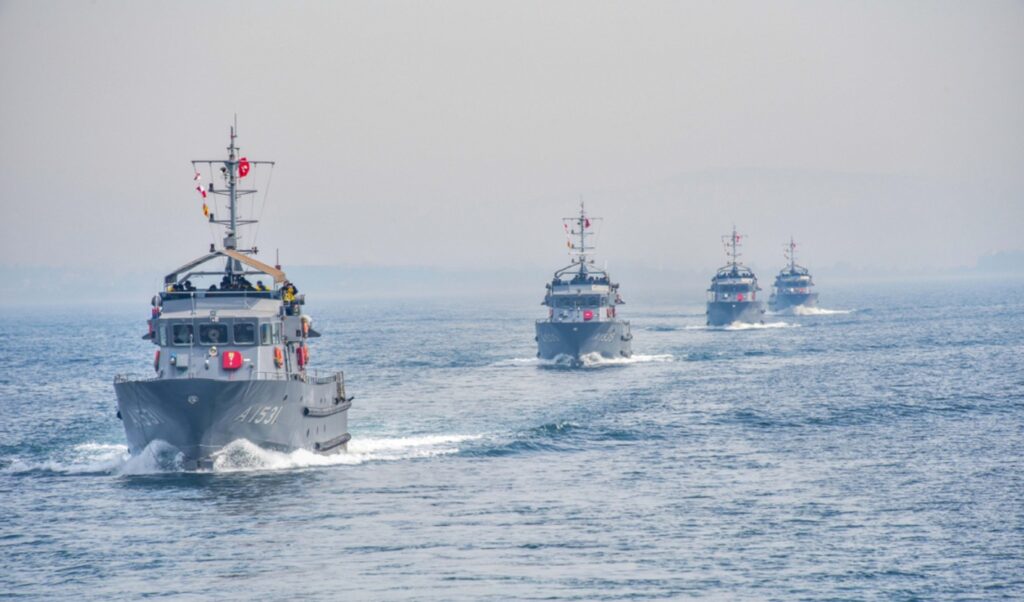
Athens is in a state of diplomatic readiness, closely monitoring Ankara’s moves regarding the legislative consolidation of the “Blue Homeland” doctrine, as well as the gradually increasing violations in the Aegean Sea. Although the Greek side has not yet obtained a clear picture of the law’s content, yesterday, through the Foreign Minister, it sent a clear message to Ankara.
Emphasizing that International Law must prevail over domestic intentions or visions, Mr. Gerapetritis stated that “unilateral measures, which should be regulated at bilateral or multilateral level, have only internal validity and do not produce international effects.” Defense Minister Nikos Dendias also sent his own message from Agathonisi, speaking of “revisionist aspirations, which are escalating lately, with the invocation of non-existent rights.”
“Danger signal” for the “Blue Homeland” and Turkey’s moves
According to assessments by experienced diplomatic sources, the Greek side’s concern does not focus on the possibility of international recognition of Turkish claims –something considered legally impossible– but on using the law as leverage for escalation in the field. The worrying aspect is that this law simultaneously serves the internal political needs of the Erdogan government. On one hand, it is called upon almost daily to address fierce opposition criticism following Athens’ strategic moves and, on the other, to rally nationalist audiences it needs due to its party’s polling decline.
For its part, Athens chooses the strategy of “action instead of reaction,” as George Gerapetritis emphasized yesterday, prioritizing its own initiatives, Marine Spatial Planning and the creation of environmental Marine Parks, in contrast to Turkey, which seeks to give institutional form to a narrative of questionable legitimacy, as it revises Greek sovereign rights, “grays” the Aegean and ignores the influence of islands on maritime zones, disregarding the principles of International Law of the Sea.
In this environment of escalating Greek-Turkish relations, criticism of the government focuses on its reluctance to proceed with extending territorial waters to 12 nautical miles, which has been a casus belli for Turkey since 1995.
Giannis Valinakis: “The hours are historically critical“
Former Deputy Foreign Minister of the New Democracy government, Giannis Valinakis, in a post on X, notes that legislating the “Blue Homeland” doctrine could prove a disastrous development. He characteristically noted: “If Turkey indeed ‘annexes’ through law islands/islets (until today ‘gray zones’) of the Eastern Aegean, we face an attempt at unilateral imposition of new Greek-Turkish borders! The hours are historically critical and do not allow unthinkably self-destructive reactions (‘does not produce legal effects’, ‘for domestic consumption’), instead of multilateral mobilization to prevent a potentially disastrous development.”
Mr. Valinakis, speaking to parapolitika.gr, argued that Greece should immediately raise the issue in European Union bodies and, specifically, at the next Summit, which will convene with the subject of Europe’s defense fortification. As the former deputy minister argues, Athens should ask our partners to “freeze” any EU relationship with Turkey, as its aspirations, based on the “Blue Homeland law,” do not simply target Greek territory, but also European territory. “This concerns border changes, which also constitute external European borders,” he characteristically emphasizes.
According to Mr. Valinakis, the European Union cannot ignore Turkey’s revisionist tactics, at a time when it stood by Ukraine, a non-member country, or even Greenland, also a non-member country. Greece’s goal should be preventing the law’s submission, which could lead to consolidating a situation in the Aegean. Such a law could be used as internal legal basis to justify moves by the Turkish navy, coast guard or research vessels, presenting Greece as “provocative” when it reacts in areas that Turkey will have “baptized” as its own.