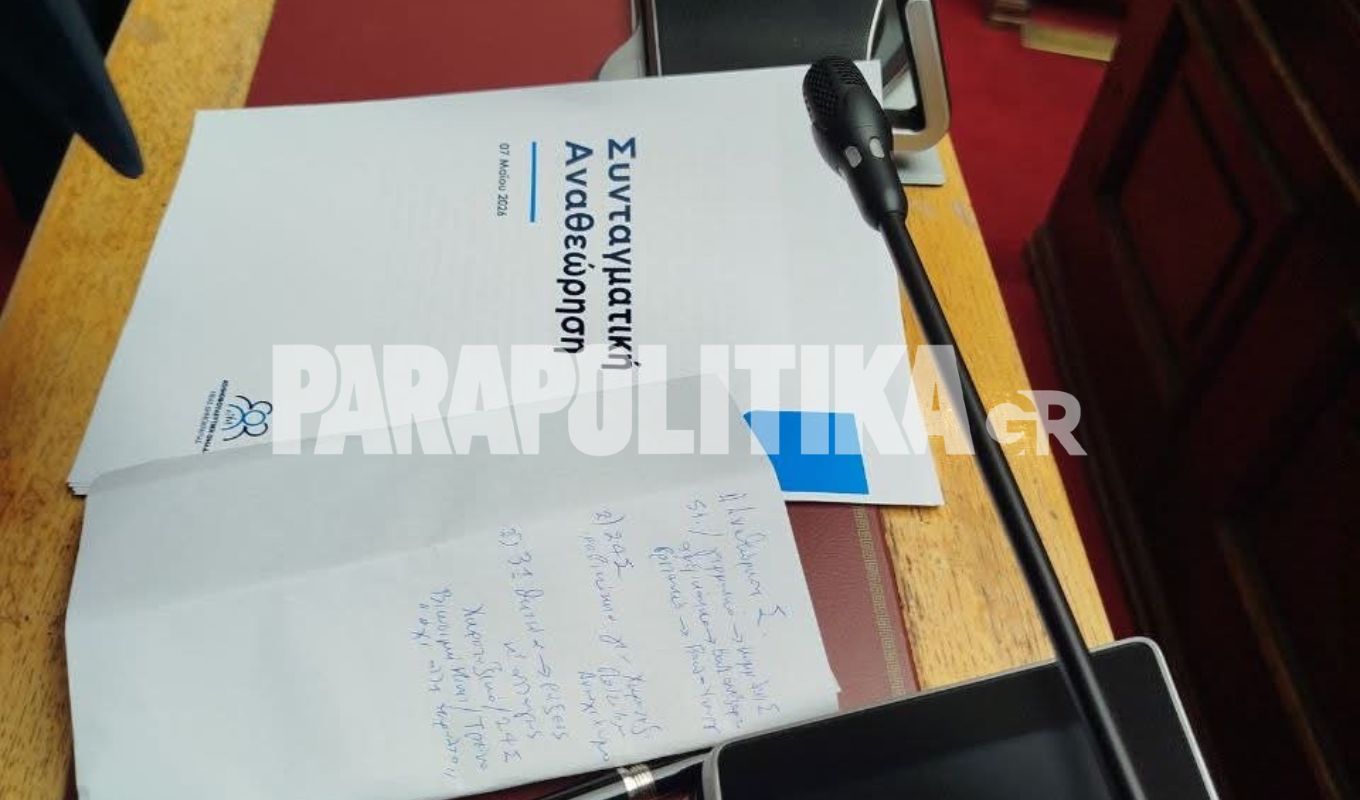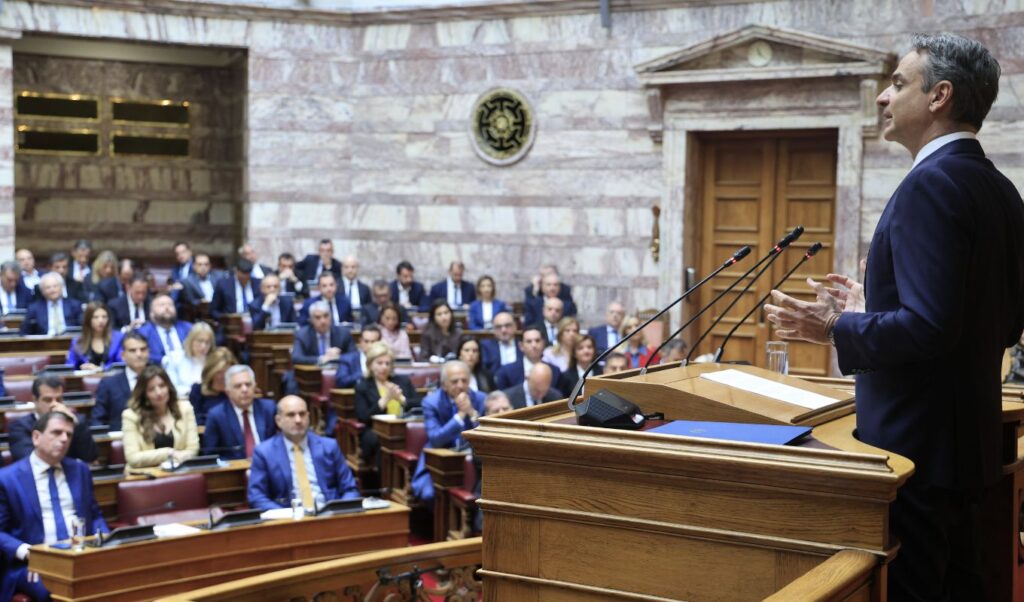
Through a letter to all members of the New Democracy parliamentary group, Kyriakos Mitsotakis presented the basic directions for discussions on constitutional reform. Specifically, New Democracy’s proposal for constitutional revision is structured around six concrete pillars.
Constitutional reform: The 6 pillars of New Democracy’s proposal
The 6 pillars in detail:
First, protecting rights and collective goods of the new era, with emphasis on recognizing challenges of artificial intelligence, reforming the higher education framework, climate protection and intergenerational justice.
Second, democratic participation, with emphasis on democratic organization and function of political parties, postal voting and constitutional connection of the electoral system with reasonable proportionality and governability.
Third, state and parliamentary function, with emphasis on strengthening the institutional role of Parliament and MPs, providing for a six-year term for the President of the Republic and constitutional guarantee of basic principles of good legislation.
Fourth, accountability, institutional independence and trust in Justice, with emphasis on reforming the framework for criminal responsibility of ministers, selecting Justice leadership without government intervention and strengthening the role of the Supreme Special Court in reviewing the constitutionality of laws.
Fifth, effective and merit-based functioning of the State and local government, with emphasis on ensuring equal access to public goods throughout the territory, modernizing the operational framework of local authorities and redefining the concept of permanence in the public sector.
Sixth, fiscal responsibility and tax security, with emphasis on prohibiting retroactive imposition of taxes or other economic burdens, the possibility of stable tax regimes for strategic investments and constitutional guarantee of fiscal balance.
The proposed articles for revision
- Article 5 or Article 5A or new Article 5B
- Artificial intelligence must serve individual freedom and social welfare to mitigate risks and exploit the advantages it offers.
- Articles 14, 15
- Clarification and rationalization of press, television, radio, internet.
- Protection of journalists including from their employers.
- Article 16
- State care for the protection, cultivation and dissemination of the Greek language.
- Protection of the Greek flag as a symbol of the Greek nation and Greek culture.
- Years of compulsory education cannot be less than eleven (instead of nine today).
- Possibility of providing higher education through university education legal entities that may have public or non-state/non-profit character with full self-governance, under supervision of an independent authority and under the condition of ensuring high-level studies.
- Article 17
- More concise formulation.
- Protection not only of property, but of assets (shares, bonds, intellectual and industrial property, trademarks).
- Compensation for restriction of use without expropriation.
- Possibility of transferring building coefficients (dynamic urban planning).
- Utilization of abandoned buildings for social purposes.
- Article 21
- State care for affordable housing.
- Taking into account intergenerational justice and solidarity.
- Article 24
- Taking measures to address climate change, effective water resource management, enhancing renewable energy sources, ensuring environmental balance in every state intervention and animal protection.
- Article 29
- Parties must organize and function democratically.
- Law defines the prerequisites for establishing and operating a political party.
- The Supreme Special Court of Article 100 controls the fulfillment of prerequisites for political party participation in elections.
- Article 30
- One six-year term for the President of the Republic (with transitional provisions for the serving President).
- Article 41 par. 2, 5
- Abolition of Parliament dissolution for national issues of exceptional importance. Dissolution with government proposal and Parliament decision for renewal of popular mandate (self-dissolution of Parliament).
- Article 44 par. 2
- Introduction of rules for good conduct of referendums: The question must be formulated in a clear and understandable way for citizens. Between the proclamation and conduct of the referendum there must be sufficient time of at least twenty days.
- Article 51 par. 4
- Possibility of exercising voting rights through postal voting for voters within the Territory.
- Article 54 par. 1, 3
- The electoral system should ensure reasonable proportionality and governability of the country.
- By law it may be provided that the territory is divided into smaller and larger regions.
- Article 55 par. 1
- Right to be elected at age 21.
- Suspension of military service obligation for the duration of parliamentary status.
- Articles 56, 57:
- Abolition of detailed list of impediments and incompatibilities. Establishment of general principles and authorization of law for implementation from subsequent elections or immediately with two-thirds majority.
- Article 60
- Safeguarding the institutional role of MPs in exercising their legislative and supervisory competence and in communication with their electoral constituency, according to the Constitution and Parliament’s Rules.
- Article 73 par. 1
- Constitutional guarantee of principles of good legislation: Adequate pre-legislative consultation, evaluation of law implementation and measures for legislative codification.
- Article 78 par. 2, 6
- Tax or any other economic burden cannot be imposed by retroactive law.
- Incentives may be provided for stable tax regime for strategic private investments for the national economy.
- Article 79
- The budget must ensure fiscal balance between revenues and expenditures and sustainable fiscal operation.
- Submission and publication of annual report by entities funded, directly or indirectly, from the state budget.
- Article 81 par. 2
- Possibility of providing by law functional incompatibility of MP/minister and temporary replacement.
- Possibility of appointing Vice Presidents of the Council of Ministers and non-ministers.
- Article 82
- Rules of good governmental function.
- Article 86
- Abolition of “immediately” and Parliament’s competence to conduct preliminary examination.
- Preliminary examination by Appeals Prosecutor and proposal for prosecution by Supreme Court Prosecutor. Alternatively, pre-assessment of Ministers’ criminal responsibility by mixed judicial-political body.
- Prosecution with Parliament decision, with absolute majority of total number of MPs, by roll-call vote.
- Article 89
- Assignment of special administrative duties to judicial officials with Parliament decision is permitted based on implementing law.
- Their participation in government in any capacity, placement in political positions or placement in independent authorities is not permitted for at least three years from their retirement.
- Article 90 par. 5
- Promotions to positions of supreme judges by special parliamentary committee among senior judges, without government intervention, from a list of three judges for each position proposed by relevant plenary sessions.
- Article 100
- Composition of Supreme Special Court with three-year term, consisting of nine judges (the 3 Presidents of Supreme Courts, 2 judges elected by Plenary Sessions of Council of State and Supreme Court, 2 regular Law Professors selected by other members).
- Competence for preventive control of constitutionality and compatibility with EU law for voted bills except those exclusively concerning ratification of international treaties, after request by President of Republic, Prime Minister or Parliament (up to twice per session).
- Decision on unconstitutionality or opposition to EU law prevents law issuance. Decision on constitutionality binds courts after law issuance.
- Article 101 par. 3, 5
- Decentralized system: Abolition of competence presumption in favor of decentralized administrations, implementation of decentralized system can be done either with existence of decentralized state structure and/or with existence of decentralized services of ministries and other public sector entities.
- State care for supporting primary sector and developing Greek periphery, to ensure equal access to public goods throughout the territory.
- Principles of good administration, transparency, accountability and meritocracy. Constitutional guarantee of National Transparency Authority.
- Article 101A
- Selection of Presidents and Members of independent authorities by parliamentary committee from list of three candidates proposed by Expert Council after public call for expression of interest. The Council includes ex officio the Administrator of National Transparency Authority, President of Supreme Council for Personnel Selection, Governor of Bank of Greece, President of Rectors’ Synod and head of collective body representing first or second degree local authorities.
- Article 102
- Law determines local government levels which are up to two (2).
- Local or special taxes or burdens of any nature may be imposed by decisions of competent bodies of Local Government Organizations.
- Budgets of Local Government Organizations are prepared after adequate public consultation with residents of respective areas and must ensure fiscal balance.
- Disciplinary penalties of suspension/removal for elected bodies of local authorities are imposed by decision of Supreme Special Court.
- Article 103
- Redefinition of the concept of permanence. Law defines procedure, criteria for evaluation of civil servants, rewards and penalties it may entail, including definitive dismissal, following decision of service council. Rewards are linked to qualifications and performance.
- Evaluation of civil servants, based on principles of impartiality, neutrality, professional competence and efficiency, with possible participation of ASEP.
- Evaluation is bidirectional, namely from subordinates to their superiors, as well as from citizens to all.