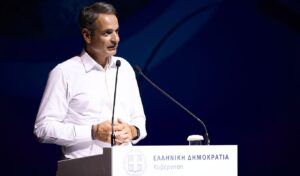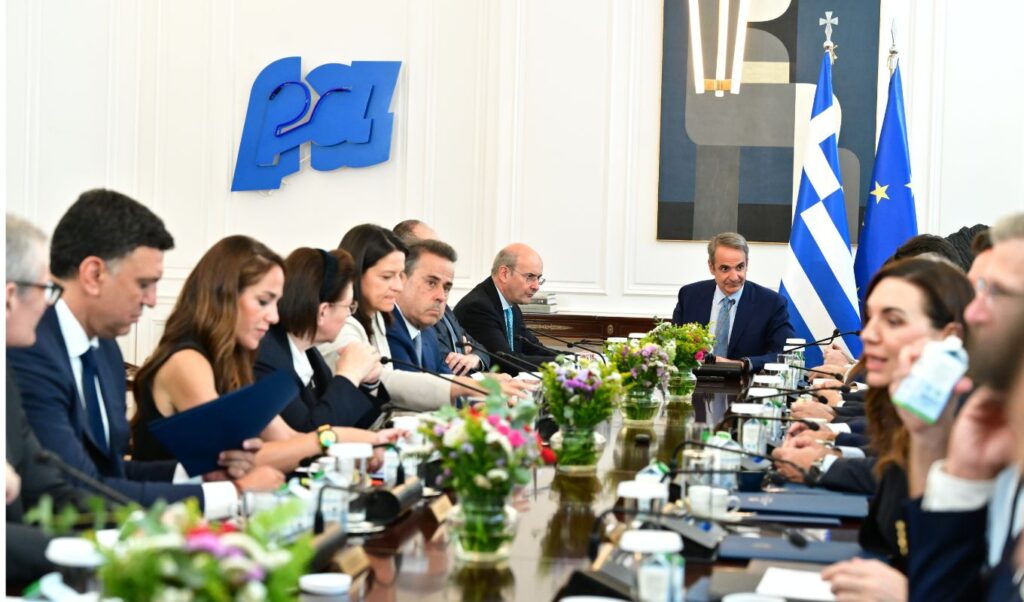
The Cabinet convened today (June 30) under the chairmanship of Prime Minister Kyriakos Mitsotakis, with the main focus being a review of the government’s work during the first half of 2026 and the planning of priorities for the second half of the year. The presentation was delivered by Deputy Prime Minister and Minister of State Kostis Hatzidakis, along with Minister of State Akis Skertsos.
Read also: Mitsotakis at Cabinet meeting on agricultural subsidies fraud: 2,900 cases under investigation, 1,151 prosecutions filed
The picture of the first half of 2026 reflects steady progress in delivering on government priorities, with significant results in reforms, infrastructure and social policies, alongside a clear focus on accelerating ongoing initiatives before the end of the four-year term.
Key legislative milestones were completed, including the passage of a law making the state more citizen- and business-friendly, a reform of Inheritance Law, and the institutionalization of a Social Agreement to strengthen collective labor agreements. In addition, a new Local Government Code was passed, representing a significant reform.
In the area of economic and social policy, the sixth consecutive increase to the minimum wage was implemented. In healthcare, the rollout of the National Electronic Health Record is progressing, while in education the “Marietta Giannakou” school renovation program is being expanded.
Significant progress was also made in infrastructure. The land registry reached a rights-posting rate of 99%, implementation of the E65 motorway (Trikala–Egnatia Odos) surpassed 95% and is being delivered in July, as is the extension of the Thessaloniki Metro with 5 new stations toward Kalamaria. Public consultation also advanced on Special Spatial Frameworks for Tourism, Industry and Renewable Energy Sources.
In the second half of the year, we continue with the same consistency and determination. Landmark projects such as the E65 and the Thessaloniki Metro extension to Kalamaria are being delivered, the largest renovation program in the history of the National Health System is being completed, and work is progressing on the institutionalization of the National School-Leaving Certificate, the reform of urban planning authorities and the completion of the Special Spatial Frameworks.
Papathanasiis briefs Cabinet on progress of the Recovery and Resilience Fund
Deputy Minister of National Economy and Finance Nikos Papathanasis briefed the Cabinet on the progress of the Recovery and Resilience Facility, with emphasis on the 9th and final payment request for grants. During his presentation, the Deputy Minister analyzed the current status by Ministry, recording progress toward the achievement of the required milestones and targets, as well as the steps needed to complete and certify the physical objectives set out in each milestone within the prescribed deadlines. He also underlined the need to maintain full readiness among all involved bodies to ensure the uninterrupted disbursement of European funds and the smooth completion of the “Greece 2.0” program.
Agricultural payments, subsidies and compensation
Deputy Prime Minister and Minister of State Kostis Hatzidakis and Minister of Rural Development and Food Margaritis Schinas briefed the Cabinet on agricultural payments, subsidies and compensation for June 2026, including a review of results and next steps. The payment process for the first half of the year is being completed in line with the plan and with better-than-expected results.
Specifically:
• Pillar I payments (May–June) reached €802.4 million, compared to the original projection of €701.3 million;
• Disbursements exceeded the initial plan by €101.2 million;
• Total payments for the first half of the year have already surpassed the target of €1.060 billion, before Pillar II payments (within IACS) have even been completed — these are estimated at approximately €65 million and are being finalized by today, June 30, 2026.
The government’s commitment to supporting livestock farmers, as well as grain and cotton producers, was fulfilled through the use of unallocated resources from the Basic Income Support scheme, in combination with interventions under Eco-schemes and Coupled Support.
The additional support was set at a total of €72.1 million for livestock farming and €83.4 million for cereals and cotton.
Following the completion of checks and the finalization of eligible land areas and animals, the plan was updated so that a larger share of the additional support would be disbursed through the Basic Income Support scheme, broadening the benefit to more producers.
The completion of cross-checks enabled the full use of the flexibility provided by the EU framework for reallocating available resources between interventions.
As a result:
• A horizontal increase of up to 15% in the Basic Income Support was applied for the first time;
• The highest-ever unit rates in Coupled Support were set;
• The highest-ever unit rates in Eco-schemes were set.
The same European funds were channeled to a greater extent toward actual beneficiaries, without any increase in the total available budget.
Compared to 2024, reductions in unit aid rates that had been applied in the previous year under most Eco-scheme interventions were reversed to zero.
The total value of planned de minimis support amounts to €148.3 million. At the same time, cases of fraud in the collection of agricultural subsidies are being investigated by the Organized Crime Division of the Hellenic Police and the Greek justice system.
Specifically:
• 2,900 cases are under investigation;
• 70 prosecutorial orders for preliminary examinations have been issued;
• The estimated damage amounts to €69 million.
In addition:
• Five criminal organizations have been dismantled;
• Prosecutions have been filed against 1,151 suspects/defendants;
• 94 arrests have been made;
• 52 asset-freezing orders have been issued.
The estimated damage linked to the five criminal organizations amounts to €14.1 million.
Bill introduced to reorganize and modernize the National Centre for Public Administration and Local Government
Minister of the Interior Thodoris Livanios and Deputy Minister Ms. Paraskevi Charalampogianni presented to the Cabinet a bill for the reorganization and modernization of the National Centre for Public Administration and Local Government (EKDDA). The proposed legislation aims to create a modern mechanism for systematic and targeted training, tailored to the needs of each civil servant, service and Ministry. In this way, EKDDA evolves into a modern human resource development organization for the Public Administration.
The key pillars of this reform are as follows:
1. Modernization of the National School of Public Administration
A new admissions system is being established, under the supervision of ASEP (the Supreme Council for Civil Personnel Selection), comprising three evaluation stages:
(a) electronic assessments of cognitive and analytical skills (verbal, numerical and inductive reasoning, situational judgment);
(b) online knowledge tests in Public Administration and Governance, Constitutional and Administrative Law or Data Analysis and Statistics, as well as in the English language; and
(c) a personality assessment and group oral discussion to evaluate competencies under the Unified Skills Framework.
The curriculum is being updated and practical placements are being strengthened at the Presidency of the Government and the Ministries of National Economy and Finance, the Interior, and Digital Governance, with guidance from certified mentors, so that graduates are better prepared for the needs of public services.
2. Academy for Professional Development
Training becomes a continuous process throughout the entire career of every civil servant. Educational programs will be designed based on appraisal outcomes, ministerial needs and Public Administration priorities.
3. Leadership Academy
The Leadership Academy is being established as a new specialized high-level training unit for senior Public Administration officials.
4. Policy Innovation Lab
The lab will function as a strategic policy arm, leveraging data, research and international best practices in collaboration with universities and research centers, so that public policies are grounded in evidence and impact assessment.
5. International presence and outreach
EKDDA’s participation in European networks and international programs is being strengthened.
6. New funding model
EKDDA’s sources of funding are being expanded (European and international programs, service provision, expertise sharing, etc.). Funding sources are being explicitly separated, so that each revenue stream is reinvested into EKDDA itself, for the upgrading of its services and infrastructure.
7. New governance model and quality certification
EKDDA’s organizational structure is being reformed, quality assurance systems are being introduced, and a comprehensive certification system is being established for training structures, continuing education programs, and the knowledge and skills of civil servants.
Through the proposed bill of the Ministry of the Interior, better-prepared Public Administration personnel will be ensured, enabling public policies to be implemented faster and more effectively.
Bill on occupational pension insurance
Minister of Labour and Social Insurance Niki Kerameus and Deputy Minister Anna Efthymiou presented to the Cabinet a bill to strengthen occupational insurance, improve the operational framework, and create incentives to attract participation in the second pillar of the insurance system.
The bill aims to improve the existing occupational insurance framework, making it simpler, more functional, more protective and more attractive for both workers and businesses.
The primary objective of the proposed legislation is to strengthen the second pillar of the insurance system — occupational insurance — by creating a modern and competitive framework for supplementary pension savings. The new framework will allow for greater flexibility, enhance the protection of the institution, and make occupational insurance more attractive for both insured individuals and businesses.
Strengthening the Equal Treatment Body
Minister of Social Cohesion and Family Domna Michailidou and Deputy Minister Elena Rapti presented to the Cabinet a bill to strengthen the Equal Treatment Body, ensure the effective application of the principle of equal treatment, and transpose EU Directives 2024/1499 and 2024/1500. The primary aim of the bill is to provide more effective protection of the principle of equal treatment and to combat all forms of discrimination in a substantive manner.
The specific objectives include:
• the full and correct transposition of EU Directives 2024/1499 and 2024/1500;
• strengthening the functionality and effectiveness of the Equal Treatment Body;
• improving access for citizens, particularly vulnerable groups and persons with disabilities, to protection and support mechanisms;
• accelerating and improving the investigation of discrimination cases;
• strengthening out-of-court dispute resolution;
• upgrading cooperation between public authorities, social partners, and academic and civil society organizations;
• developing prevention, awareness-raising and training activities on equal treatment;
• systematic collection and use of data for monitoring discrimination;
• promoting a culture of equality and inclusion in public administration, the labor market and society at large.
Through the provisions of the bill, citizens’ trust in rights protection institutions is strengthened and Greece’s compliance with the European acquis is ensured.
Kikilias presents omnibus bill from the Ministry of Shipping and Island Policy
Minister of Shipping and Island Policy Vassilis Kikilias presented to the Cabinet an omnibus bill from the Ministry. The proposed measures aim to modernize the operational framework of Port Authorities, more effectively promote investments and infrastructure projects, and resolve administrative backlogs that hinder the fullest possible use of port facilities. The bill also addresses issues of staffing, corporate governance and project financing, while regulating matters of administrative organization, revenue management and obligations, as well as provisions for Coast Guard personnel serving abroad.
In the short term, the measures target the immediate resolution of administrative inefficiencies within Port Authorities and the Ministry of Shipping and Island Policy. The institutional framework is being clarified, staffing and administrative organization are being improved, and financial pending matters are being addressed, such as the management of revenue from fees and the settlement of obligations arising from international agreements. In the long term, the aim is to create a modern, effective and competitive framework for Greek ports. Additional objectives include the financial sustainability of Port Authorities, equal competitiveness among ports operating under different management models, and enhanced capacity for the implementation of investments and infrastructure projects.
Cabinet unanimously selects Lymveropoulos as President of the Supreme Court
Minister of Justice Giorgos Floridis submitted a recommendation to the Cabinet regarding the selection of the President and Prosecutor of the Supreme Court (Areios Pagos). For the position of President of the Supreme Court, the Cabinet unanimously selected, in accordance with the Minister of Justice’s recommendation, Supreme Court Vice President Panagiotis Lymveropoulos, who had received the top ranking both in the vote at the Supreme Court Plenary and in the vote at the Conference of Parliamentary Speakers. Similarly, for the position of Supreme Court Prosecutor, the Cabinet unanimously selected, in accordance with the Minister of Justice’s recommendation, Deputy Supreme Court Prosecutor Evangelos Bakelas, who had received the top ranking in the votes at both the Supreme Court Plenary and the Plenary of the Supreme Court Prosecutor’s Office, as well as in the vote at the Conference of Parliamentary Speakers. Through these selections, the Cabinet fully endorses the opinion expressed by the Plenaries in their respective votes, in application of the relevant legislation that came into force in 2024 on the government’s initiative — a significant milestone for the rule of law in Greece.
Konstantinos Georgiadis appointed President of the Legal Council of the State
Minister of National Economy and Finance and President of the Eurogroup Kyriakos Pierrakakis submitted a recommendation to the Cabinet regarding the selection of the President and Vice Presidents of the Legal Council of the State. For the position of President of the Legal Council of the State, the Cabinet unanimously selected, in accordance with the Minister of National Economy and Finance’s recommendation, Vice President of the Legal Council of the State Konstantinos Georgiadis, and for the positions of Vice Presidents, Legal Counsellors of the State Maria Deligianni, Spyridon Mavrogianni, Emmanouela Panopoulou, Konstantinos Kyriopoulos, Dimitrios Farmakis and Alexandra Dimitrakopoulou.