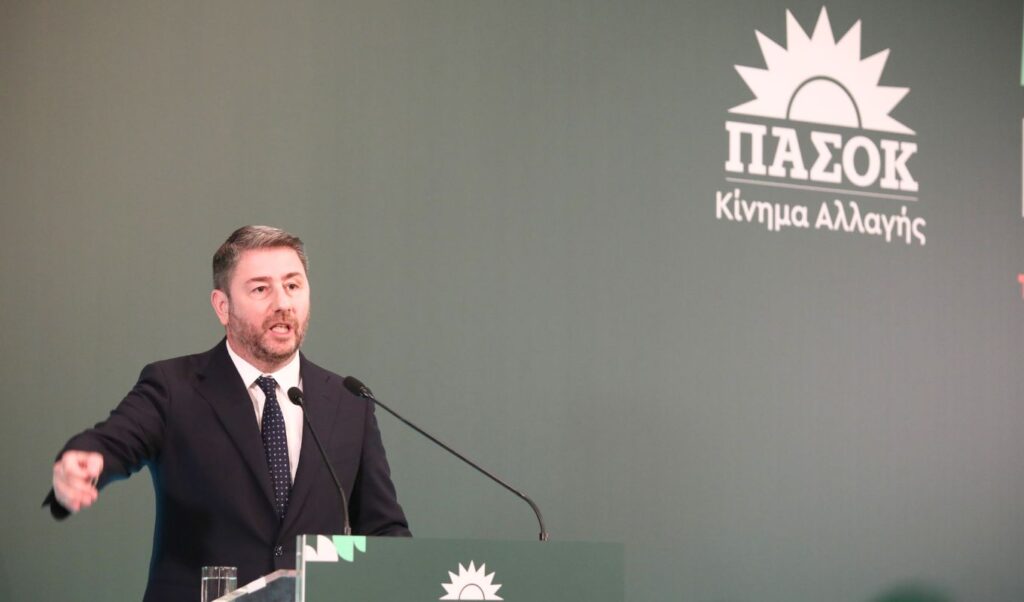
PASOK is working at a rapid pace to prepare its proposal for establishing an investigative committee on the wiretapping scandal, with discussions focusing on whether it’s feasible to gather the required 120 votes during the related parliamentary vote to proceed with its formation.
Wiretapping: PASOK’s preparation for the investigative committee proposal
According to all sources, the main opposition’s legal team will have their proposal ready within the next ten days. This timeline is necessary because the recent court decision from the Single-Member Misdemeanor Court spans 2,000 pages, requiring precise documentation. Working feverishly on the proposal are PASOK parliamentary group head Haris Dimakareas, Justice sector leader Christos Kaklamanis, and Manolis Velegraxis.
Meanwhile, from Charilaou Trikoupi street, they are institutionally studying Parliament’s Rules of Procedure to ensure there are no “loopholes” that could lead to the proposal’s rejection before it reaches the plenary session. According to Article 144 of Parliament’s Rules, the plenary can establish investigative committees from its members to examine special issues of public interest.
How an investigative committee is formed
The procedure followed is as follows:
- The proposal for establishing the investigative committee must be signed by 1/5 of the total number of MPs (i.e., at least 60 MPs) and must specify the reasons for requesting its establishment, as well as the specific issue it will address.
- After submission, the proposal is announced in Parliament, printed, distributed to MPs and entered into the agenda for parliamentary control sessions. Discussion of the proposal must conclude within one session and begins with a speech from one of the MPs who submitted the proposal.
- The decision to establish an investigative committee requires an absolute majority of those present, which cannot be less than 2/5 of the total number of MPs (i.e., no fewer than 120 MPs). The Rules also state that upon proposal by at least 10 MPs, Parliament may establish two investigative committees per parliamentary term. Since the 2023 elections, one other proposal for an investigative committee has been submitted – by the Communist Party – concerning the Tempe train tragedy.
Androulakis’ appeal and the “plan B” no-confidence motion
Nikos Androulakis has already appealed to other opposition parties to support the proposal. Currently, the total number of MPs amounts to 114. Therefore, to reach 120, the proposal must also be co-signed by independent MPs. Beyond the investigative committee proposal, PASOK also has a no-confidence motion against the government in its arsenal. Indeed, PASOK will decide to play this particular “card” if the government attempts to change the Penal Code to make Tal Dilian’s sentence commutable. In such a case, it’s considered certain that PASOK would have support from both SYRIZA and New Left.