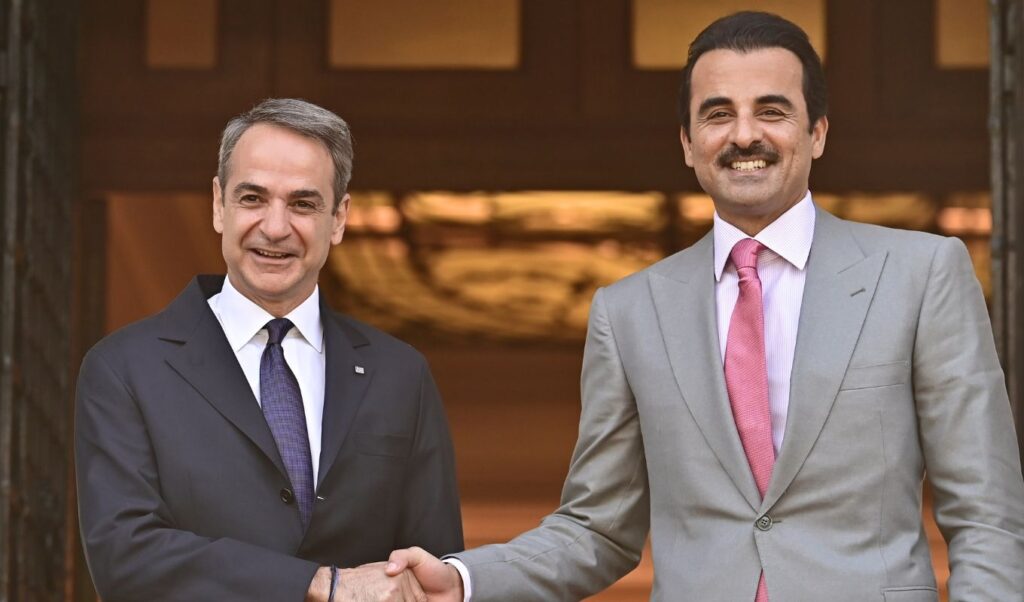
Athens “reads” the visit of the Emir of Qatar as confirmation of the trust relationship that Gulf countries show towards Greece. The timing, amid the military conflict in Iran, is considered particularly significant, as it highlights Doha’s turn towards Athens as an important strategic ally against the fluidity prevailing in the Middle East region.
Diplomatic sources: Greece stands with Gulf countries
Diplomatic sources speaking to parapolitika.gr maintain that “Greece has expressed repeatedly and in all forums, both multilaterally and bilaterally, its solidarity towards Gulf countries, which have been substantially affected by the Middle East crisis.”
Tasos Chatzivasileiou: Qatar Emir’s visit confirms Greece’s pivotal role in the Gulf
Government officials express their satisfaction in every way regarding the results of the meeting between Kyriakos Mitsotakis and Sheikh Al Thani. New Democracy MP for Serres and Secretary of International Relations Tasos Chatzivasileiou tells parapolitika.gr that “the Qatar Emir’s visit confirms Greece’s pivotal role in the Gulf. The Emir himself appears to be making his first trip since the war began. He chose Athens to thank Kyriakos Mitsotakis and our country for the responsible stance shown throughout this period of Iranian attacks on Arab monarchies in the region. Meanwhile, the message for further €1 billion investments in Greece means two things: that Qataris consider Greece a friendly country and that they recognize our economy’s progress. Qatar is one of the richest countries in the Middle East with high investments in every corner of the Earth. The vote of confidence in the Greek economy is recognition of government policy in the field. And new investments entail new and well-paid jobs.”
Turkey’s annoyance and the backstory in Qatar relations
The Middle East crisis has strengthened relations between the two countries, causing Turkey’s annoyance, which has maintained increased influence in Qatar in recent years, with strong diplomatic relations and military presence. Since 2015, Turkey has maintained a military base in Qatar. This fact had caused displeasure from Saudi Arabia, UAE, Bahrain and Egypt, leading to a rift with them. Additionally, recently Turkey turned to Qatar for acquiring used Eurofighter Typhoon aircraft, after Washington’s refusal to provide F-35s.
Within this climate, Greece manages to strengthen its relations with Doha, offering military assistance, leveraging its defense superiority, which was proven in the field with successful interception of Iranian ballistic missiles by Greek Patriots in Saudi Arabia.
Geopolitical upgrade: How Athens strengthens its Gulf position
Diplomatic sources place particular emphasis on the fact that “the Middle East crisis has further strengthened Greece’s relations with Gulf countries, mainly with UAE but also with Qatar.” Mr. Chatzivasileiou also highlights the geopolitical upgrade of relations between the two countries, undermining Turkey’s role in the region. As he notes “the strengthening of Athens-Doha relations has particular significance, as Qatar traditionally maintains close relations with Turkey. Our country’s foreign policy is not externally determined. But it’s important to remind ourselves of reality.”
LNG and energy: The common strategic goal of Greece-Qatar
Meanwhile, the visit of Qatar’s Emir, Tamim bin Hamad Al Thani, to Athens and his meeting with Greek Prime Minister Kyriakos Mitsotakis marks a new page in economic relations between the two countries. At the agenda’s center is establishing Greece as the central gateway for energy to Europe, while Qatar seeks to strengthen its strategic role in the region. A key pillar of the economic approach is liquefied natural gas (LNG). Qatar’s investment interest, reaching €1 billion, reflects its desire to acquire an active role in European energy architecture, with Athens taking on a pivotal role.