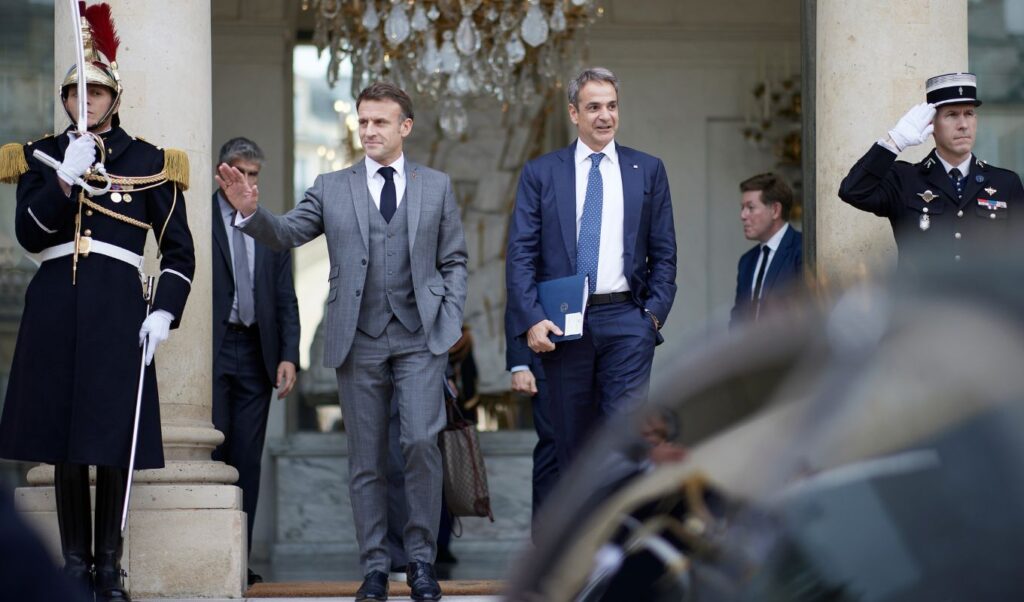
The presence of French President Emmanuel Macron in Athens on Friday and Saturday is both significant and multi-layered. Mr. Macron brings a broader shift in European defense policy that seeks ways of self-defense and disengagement from Western policies following the “unpredictable” politics of the American President, once a strong ally.
For the first time since 1954, France is returning and proposing anew a defense plan for the protection of the European Union modeled after the former European Defense Community (EDC). This plan envisioned the creation of a supranational European army and while it had been ambitiously proposed by then French Prime Minister René Pleven, it was never ratified by the Paris National Assembly in 1954, due to fears of losing national sovereignty.
Conditions have now changed and Europe’s defense armor is more necessary than ever. In this context, the French President, with his visit to Athens, seeks to strengthen Greek-French cooperation in defense and security to meet the challenges of new geopolitical uncertainties.
Former Greek Commissioner and former Foreign Minister Dimitris Avramopoulos, responding to questions from parapolitika.gr, explains that the extension of the France-Greece mutual defense assistance clause for five years, until 2031, in practice means that “a threat against Greece is no longer addressed only as a bilateral problem, but acquires a European dimension. The political and strategic significance of the clause lies precisely in the fact that it strengthens the deterrence message to any third actor.”
But how substantially does it strengthen Greek deterrence? According to Mr. Avramopoulos, “it enhances the credibility of Greece’s deterrent power because it adds the weight of a strong country like France. However, its practical strength remains limited by the absence of a fully established common European defense,” as he characteristically notes. The necessity of forming a unified and effective European defense policy leads many to speculate that this agreement could serve as a way to substitute NATO in Europe.
Dimitris Avramopoulos, with brief answers, clarifies to parapolitika.gr the significance and implications of Greek-French strategic cooperation for the security and defense of both Greece and Europe.
Can we say that the France-Greece mutual defense assistance clause until 2031 substitutes NATO?
“No. It does not substitute NATO, which remains the basic pillar of Western collective security. The clause operates complementarily, providing a more immediate framework of strategic solidarity between two European states. It does not weaken NATO. On the contrary, it operates complementarily where the Alliance struggles to act due to internal contradictions or different priorities among its members.”
What is the significance of the Greek-French agreement for the European Union?
“The agreement enhances the dynamic for European Union strategic autonomy and upgrades its role as a geopolitical actor. It shows that Europe is seeking ways to acquire greater self-protection capability and strategic presence.”
Can the Greek-French agreement serve as a model for European defense?
“Yes, it can function as a model. It indicates the path for individual cooperations within the European Union, which could gradually form a more cohesive core of common defense.”
Can a European defense alliance “NATO-style” be created soon?
“Not immediately. This prospect remains long-term, as it requires common political will, institutional deepening, and common strategic culture – elements that do not yet exist to the necessary degree today.”
Is there historical precedent for European defense integration?
“Certainly. Already from the 1950s, Europe attempted to proceed with defense emancipation through the European Defense Community. However, the plan did not proceed, as it was rejected by France at the time. It is significant that today Macron’s France leads the discussion on strategic autonomy, a fact with particular historical symbolism.”
How does the agreement affect balances in the Eastern Mediterranean?
“The agreement upgrades Greece’s geopolitical footprint and contributes to a more stable balance of forces in the region. It enhances Greece’s image as a factor of stability and security.”
How does it specifically affect relations with Turkey?
“Towards Turkey, the agreement operates deterrently and not aggressively. It creates greater predictability, strengthens Greece’s negotiating position, and makes dialogue more substantial because it is based on a stronger balance of forces.”
What is the specific strategic benefit for Greece?
“For Greece, the agreement enhances its deterrent capability, upgrades its regional and international role, and secures support from a strong European ally in a region of high geopolitical tension.”
What is the specific strategic benefit for France?
“For France, the agreement enhances its strategic presence in the Mediterranean, promotes its vision for European strategic autonomy, and confirms its leading role in European defense, while also serving economic and industrial interests.”
So the agreement is only an expression of solidarity?
“No. It is simultaneously an expression of European solidarity and a tool of national strategy for both countries. That’s why its significance is deeper than a simple bilateral partnership.”