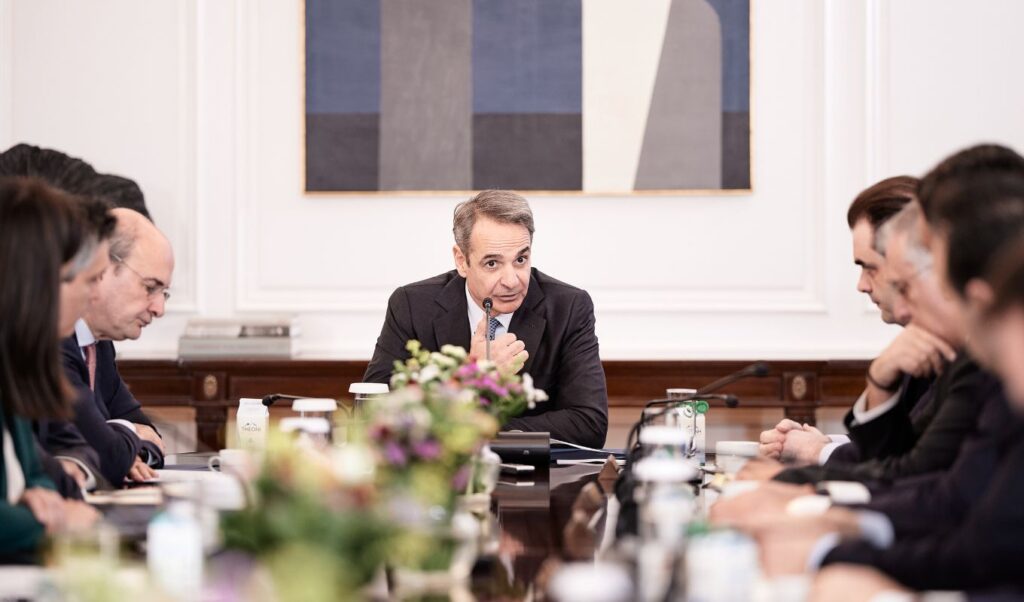
Prime Minister Kyriakos Mitsotakis aims to bring deep cuts to the functioning of the political system through constitutional revision, which is expected to begin during the summer in Parliament – which serves as the proposing body – and be completed after the 2027 elections, with the vote of the Parliament that will emerge from those polls. One of these changes is a unique incompatibility between MP and minister positions, a proposal that essentially adapts to the Greek political system the separation between executive and legislative power that operates in other countries, with the French model being the most characteristic example.
The most careful observers of the political chessboard remember that the incompatibility between MP and minister is a proposal that had been presented in 2017 by Anna Diamantopoulou, Yannis Ragkousis and George Floridis, when they had created the political movement called “Hour of Decisions,” while it is also something that Kyriakos Mitsotakis had supported since he was a simple MP for the then Athens B’ constituency. For now, however, the proposal appears to be meeting reactions and encountering objections within the New Democracy Parliamentary Group.
“No one – and first myself – can close their eyes to the crisis of confidence, which is directed not only at institutions, but also at the country’s political personnel as a whole. A challenge that concerns all liberal democracies. We, however, have a duty to deal with our own house,” the prime minister said in his television message recently, setting the political and ideological framework for this institutional intervention, while continuing: “We have reached, I think, a turning point. As prime minister, therefore, but also as president of a party that guarantees stability and security, I must evaluate the situation, not only as a lesson from negative experience, but also as a new starting point for battle with the ‘deep state.’ With my own party being the first to become a force for breaking with wrongdoings and confronting, with honesty and courage, its own weaknesses.”
Thus, for these reasons, he announced that he would present “a new package of institutional cuts,” with the first concerning “the incompatibility of minister and MP, with replacement of the minister in Parliament by the first runner-up for as long as they participate in the Cabinet and with simultaneous upgrading of the MP’s role.” Therefore, if this regulation is voted by the required majority in the upcoming constitutional revision (note: 180 votes are required either in this or the next Parliament) and if the four-year electoral cycles continue, then this system will be applied for the first time in the 2031 national elections, the ones after next.
What will change
From then on, ministers, deputy ministers and junior ministers that each prime minister selects for their government from their Parliamentary Group will automatically lose their MP status, with their position in Parliament being taken by the first runner-up in their electoral district. If they are removed in a cabinet reshuffle, they will regain their parliamentary status and correspondingly the one who had replaced them will lose it. Pavlos Marinakis subsequently raised another parameter on this issue. “For this proposal to proceed, perhaps we should also discuss reducing the number of MPs, so that we don’t have in reality, instead of 300, 350 total offices,” said the government spokesman. According to information, the proposal being discussed at the Maximos Mansion is the possible reduction of the number of MPs to 250. After all, the Constitution gives this possibility, since it provides (Article 51) that “the number of MPs is determined by law, but cannot be less than two hundred nor more than three hundred.” A second parameter was raised by Deputy Prime Minister Kostis Hatzidakis, speaking on “PARAPOLITIKA” 90.1, regarding the upgrading of the MP’s role.
“For example, personally I believe we should examine how a parliamentary amendment can be approved when it is not of economic content, because until today it is enough for the minister to simply reject it. The role of the committee dealing with monitoring budget implementation could also be strengthened. We must think outside the box and see how both the office of minister and the office of MP can be upgraded for the benefit of Democracy,” the deputy prime minister said.
To make practically understood how the reform proposed by the prime minister works, if it were in effect today, then in Parliament and in the New Democracy Parliamentary Group would be – based on the 2023 election results and vote preferences – the following:
- George Koumoutsakos (instead of Kostis Hatzidakis)
- Fotini Pipili (instead of Kyriakos Pierrakakis)
- Aria Agatsa (instead of Adonis Georgiadis)
- Anna Rokofyllou (instead of Vassilis Kikilias)
- Vaso Kollia (instead of Sofia Zacharaki)
- Fotis Karydas (instead of Niki Kerameus)
- Evita Varela (instead of Olga Kefalogianni)
- Omiros Tsapalos (instead of Thanos Plevris)
- Tasos Gaitanis (instead of Nikos Dendias)
- Kostas Kollias (instead of Christos Dimas)
- Ioanna Gkelestathi (instead of Takis Theodorikakos)
- Marianna Toumazatou (instead of Michalis Chrysochoidis)
- Nikos Manolakos (instead of Domna Michailidou)
- Dora Palli-Petralia (instead of Konstantinos Kyranakis)
- Margarita Varsou (instead of Nikos Papathanasis)
- Anthi Chalkia (instead of Yannis Vroutsis)
- Maria Polyzou (instead of Eirini Agapidaki)
The above is an indicative reference, as it includes only the cases of ministers and deputy ministers who are currently members of Parliament and not junior ministers, who would also have ceased being MPs and whose positions would have been taken by the runners-up in their electoral districts.