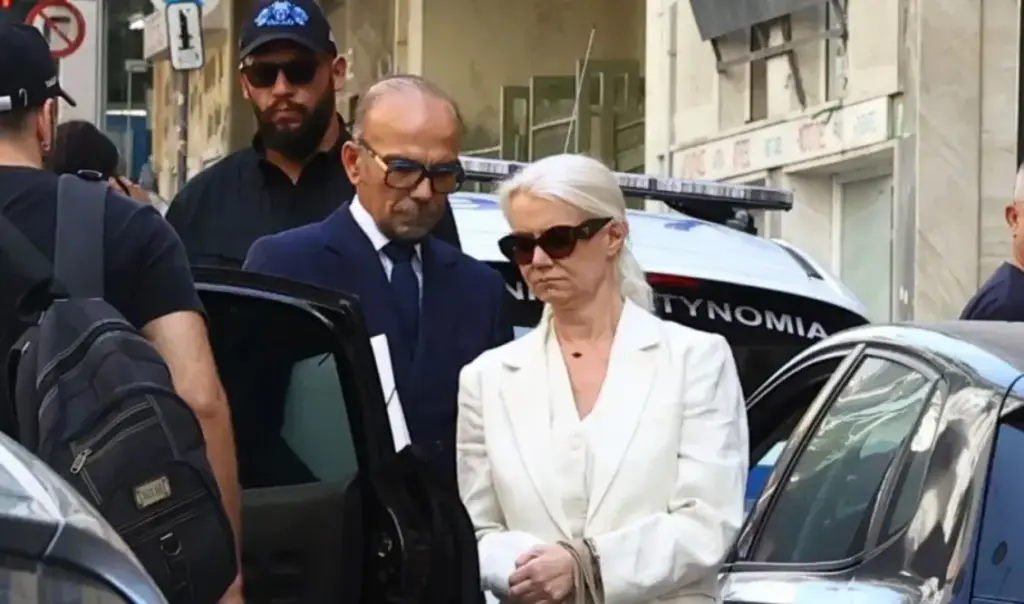
New evidence is coming to light about the critical hours that followed the deterioration of Giorgos Mazonakis, with the investigation focusing on what took place at the medical clinic on Karneadou Street in Kolonaki. Of particular significance is the testimony of a nurse, who describes incidents that, as she stated, had raised serious concerns among the clinic’s staff regarding the medical procedures being carried out there.
Read also: Death of Giorgos Mazonakis: “We are all jointly responsible,” said the doctor from Korydallos — the role of his daughter in the case
Giorgos Mazonakis: the nurse’s testimony about previous incidents
According to the testimony, as reported by Mega, the clinic’s staff had already been alarmed by earlier incidents. The nurse describes cases of patients who, following their treatments, experienced severe drops in blood pressure and momentarily collapsed, only to recover immediately afterwards. She also referred to patients who developed swelling after treatment, and to the instructions that, as she testified, the doctor would give them.
“We were all in shock” — the account of the critical moments
In another testimony that has now been made public, a nurse describes the situation inside the clinic following Giorgos Mazonakis’s collapse. As she recounts: Giorgos Mazonakis was unconscious. A defibrillator was out of order. Two doctors were in a panic. And an unanswered question hung in the air — whether anaesthesia had been administered.
“When I returned to the clinic on Karneadou Street, Mazonakis was already there, and the other girls told me he had already been connected to the plasmapheresis machine. I went to the room with the other plasmapheresis machine, where a session was underway with another patient. At around 4 in the afternoon, I heard the doctor calling for her husband.”
Giorgos Mazonakis was found unconscious in the chair connected to the machine. It was at that moment that the doctor realised the situation was spiralling out of control — she called for help and, in a panic, began searching for the antidote to a substance that induces anaesthesia. “When they called her husband, he shouted ‘oxygen’. Then the doctor came into the room where I was and told me to call the anaesthesiologist and ask whether there was an antidote for propofol. I had never heard the word propofol before that day. I called her and she told me there was no antidote, and I immediately relayed that to the doctors.”
As Mega’s report describes, behind the closed doors of the clinic, panic had taken hold. Emergency services had still not been called, even though Giorgos Mazonakis was unconscious, and the doctors — according to the nurse’s testimony — were attempting to revive him on their own. “Afterwards, the doctor came back into the room where I was to get the defibrillator and returned to Mazonakis’s room. Almost immediately she came back again and told me to call the owner of the company that maintains the defibrillator, because it wasn’t working. I called him and told him the defibrillator wasn’t functioning, then I went into Mazonakis’s room and put the phone on loudspeaker so the owner could speak with the doctors.”
Emergency services had still not been called, and the doctors were seeking instructions over the phone on how to revive him. It was at this point that the 56-year-old nurse saw Giorgos Mazonakis unconscious for the first time. “When I walked in, they had raised Giorgos Mazonakis’s legs and he was very pale. I saw the doctor performing CPR on him. I left the phone with the doctor. I was frightened and left the room. Two other colleagues were also in the room. The doctors asked for adrenaline. We were all in shock. I was trying to calm down the other patient who was in the adjacent room. We all wondered why they weren’t calling an ambulance.”
“We were all in shock. A minute later, the doctor asked us to call an ambulance. I don’t know whether it was the receptionist or the doctor’s daughter who made the call — she was also at the clinic that day with a friend. Within the next 10 minutes, the ambulance arrived. In the meantime, the doctor was trying to perform CPR. We were all terrified. I think that from the moment they called the doctor to when the ambulance arrived, around 10 to 15 minutes had passed. When the ambulance arrived, I had stayed in the other room. I did, however, notice the commotion, and at some point I saw Giorgos Mazonakis in the corridor, seated in a chair, with a piece of the paramedics’ equipment over his mouth. I don’t remember whether his eyes were open or closed. When the paramedics left, I don’t know whether the doctor went down with them. What I do know is that she later came into the treatment room of the other patient, having changed her clothes.”
The dialogue about Giorgos Mazonakis’s condition
Meanwhile, newly surfaced messages reported by Mega capture the exchange between the hypnotherapist and the accused doctor, at a point when Giorgos Mazonakis had already deteriorated significantly.
The hypnotherapist initially refers to the diuretics that, as he had been informed, the singer was taking, while the doctor notes that these can cause a drop in blood pressure.
– Hypnotherapist: The day before yesterday he told me he was taking diuretics because he had fluid retention. Could that be the cause?
– Doctor: Those can lower blood pressure too, but I don’t know what else he may have taken. I couldn’t understand what he was saying.
– Hypnotherapist: That’s why I mentioned it. What a mess we’ve ended up in… Who’s with him?
– Doctor: The ambulance took him. I’ll head over with H… shortly.
– Hypnotherapist: Don’t delay. One of the two of you needs to go right away.
“He squeezed my hand and said: help me, please, help me”
Speaking on the programme “Developments Now,” hypnotherapist Nasos Komnianοs broke his silence on the controversial message he allegedly sent to the 56-year-old doctor — who is currently remanded in custody — in which he wrote “leave it, I’ll pressure him,” referring to the €6,000 fee that had been requested from Giorgos Mazonakis, who had expressed his displeasure.
“They gave me €200, and I asked where I should issue an invoice — send me the details so I can send it through. I assumed — and I’m speculating here — that a media group is probably covering all these costs, and perhaps the group had objections to the six thousand.”
The hypnotherapist went on to describe his working relationship with the Karneadou Street clinic, pointing the finger at the 58-year-old doctor as the person ultimately responsible. “They’re trying to call me a collaborator — I have the contract; legally and financially responsible is the 58-year-old.”
Speaking to the authorities, Nasos Komnianοs stated that he had also spoken with the Karneadou Street doctor on the Monday following his meeting with the singer, in order to discuss the protocol they would follow. “I raised my concerns about his mental state and she told me we would address it and figure out what to do. We agreed that he needed help and that we would do everything we could to support him.”
The singer’s need for help was clear to everyone around him. Yet some failed to treat it with the seriousness it deserved. “When Giorgos left the place, he squeezed my hand and said: help me, please, help me — he looked me straight in the eyes, and his eyes were truly clear and bright, beautiful clear eyes.”
“The doctor has one kind of clientele and the other doctor has another — and they have fans all over Greece. Of course, now I’m hearing various things, that there are also many very unhappy people. I would have bet anything that the doctor was a gynaecologist-obstetrician — I considered it a given; I think even her business card said so.”