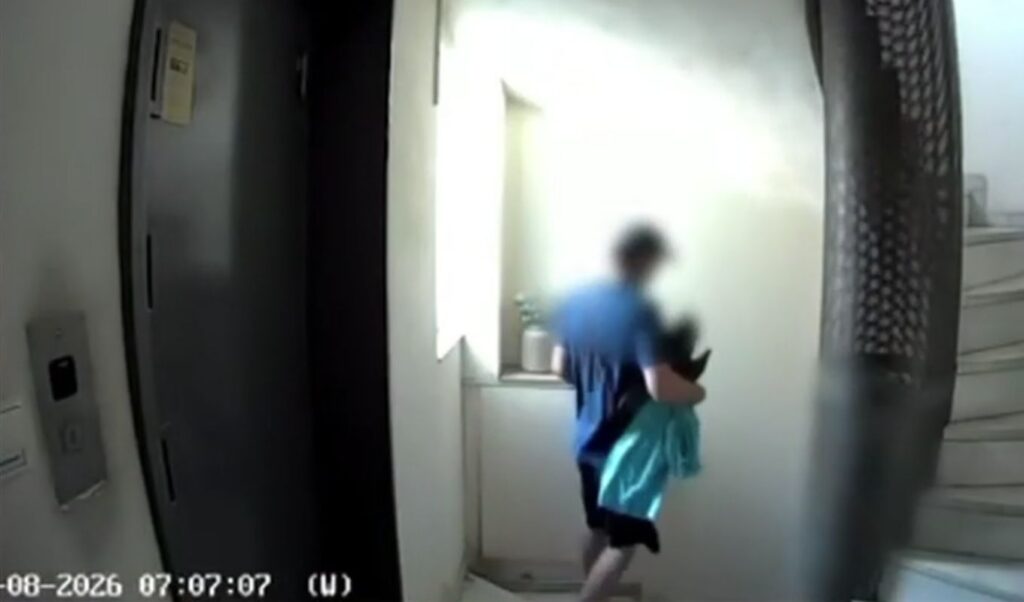
A criminal burglary ring that targeted homes across the Attica region has been dismantled following the arrest of three foreign nationals. The gang of burglars carried out raids in Athens, Kallithea, Neo Faliro, and Spata. Five additional members have been identified — two of whom are already serving prison sentences, while three remain abroad. A video has now surfaced that sheds light on the criminal organization’s modus operandi, showing how the thieves moved through a residential apartment building.
How the criminal organization operated
Targeted surveillance, “marked” doors, operational burner phones, lookouts posted outside apartment buildings, and an organized intelligence network tracking when residents were away from home. According to the Organized Crime Division, this was the methodology employed by the criminal organization believed to be responsible for a series of burglaries across multiple areas of Attica, with the total illegal financial gain estimated to exceed €179,000.
The months-long investigation by the Organized Crime Division led to the dismantling of the organization, which is believed to have been active since at least July 2025. So far, 23 cases of burglaries, thefts, and attempted thefts have been solved. Of particular note is the role of a 48-year-old housekeeper who allegedly acted as an informant, providing details about specific homes and the periods when their residents were away.
During the police operation, three foreign nationals were arrested, while five additional members of the organization were identified. Of those, two are already incarcerated and three are abroad. Criminal charges have been filed against them on a case-by-case basis, including participation in a criminal organization carrying out aggravated thefts — committed jointly and repeatedly — with a total gain exceeding €120,000, as well as violations of drug legislation and money laundering.
According to the police investigation, this was an operationally structured organization with a clear division of roles and responsibilities, an organized infrastructure, and continuous activity. Members are also alleged to have maintained contacts abroad, with a portion of the proceeds being transferred out of Greece.
The organization’s modus operandi
In terms of their operational methodology (modus operandi), members of the criminal organization:
- Initially conducted nighttime surveillance of apartment buildings across various areas of Attica, using vehicles registered in third parties’ names or rented vehicles. They used the home of the organization’s leader as their base of operations, from which they launched their activities — typically splitting into two subgroups in order to carry out more than one burglary per night.
- After identifying apartment buildings and homes that met their selection criteria, they would carry out checks to determine whether residents were absent. In some cases, they used a door-marking technique to verify whether homes remained unoccupied.
- They would then proceed — primarily during nighttime hours — to break into selected apartments, either using keys or by forcing the lock mechanism. In other cases, they gained access through light wells or balcony doors, and frequently stationed a lookout outside the building.
- They intensified their activity during public holidays and vacation periods, exploiting the increased likelihood that residents would be away from home.
- Once inside, they searched all rooms and removed cash, jewelry, and other valuables.
- They maintained an organized intelligence network to identify suitable target properties; in some cases, a member of the organization worked as a housekeeper specifically to gather the necessary information.
- For internal communications, they used not only their personal phone lines, but also “operational” burner phones, SIM cards, and phone lines registered under third parties’ names.
- They possessed specialized knowledge of key and lock types, which allowed them in many cases to enter apartments without leaving visible signs of forced entry.
- Finally, they divided the proceeds from the thefts equally among themselves. A portion was set aside to cover legal costs in the event of a member’s arrest, as well as for day-to-day living expenses, while another portion was transferred abroad.
The roles of the organization’s members
The police investigation revealed that members of the criminal organization held distinct and complementary roles and responsibilities during both the planning and execution of the thefts.
- The 37-year-old foreign national, acting as the organization’s leader and coordinator, allegedly determined target areas and objectives on a case-by-case basis, coordinated the activities of the other members, and kept himself informed of their progress. He also maintained contacts with individuals operating abroad.
- The 43-year-old foreign national, serving as a coordinating and operational member, played a particularly active role in the organization’s activities. He participated in the surveillance of potential targets and in carrying out burglaries, and assumed coordination of the other members in the leader’s absence. Vehicles in his possession were also used for the organization’s movements.
- The 22-year-old foreign national participated in the organization’s operational activities and, as the situation required, took on the role of lookout outside apartment buildings, alerting other members to the approach of residents or other individuals.
- The remaining operational members, aged 36, 40, and 31, along with another 31-year-old, functioned as lower-level executors. They participated in area and property surveillance, the identification of suitable targets, burglary preparation, and — as circumstances required — the actual execution of thefts or acting as lookouts. New individuals were also recruited into the organization and used as peripheral members during burglaries and thefts.
- The 48-year-old foreign national woman, in the role of informant, allegedly provided other members with information about specific homes and the periods when their residents were away. In particular, her work as a housekeeper gave her access to relevant information, which she is alleged to have passed on to the organization’s members, facilitating target selection.
The €76,000 transferred abroad
The financial investigation revealed that the suspects had no steady professional activity or stable source of income, relying on the proceeds of their criminal activities to cover their living expenses.
Additionally, through money transfer companies, they had sent a total of approximately €76,000 to accounts in a foreign country.
The investigation has so far solved a total of 23 cases of burglaries, thefts, and attempted thefts in Agia Paraskevi, Palaio Faliro, Chalandri, Nea Ionia, Galatsi, Athens, Kallithea, Zografou, Petralona, and Pangrati.
What was found during the searches
Searches conducted at residences and on the persons of those arrested resulted in the seizure of, among other items:
- a large quantity of jewelry, gold items, and valuables,
- a large quantity of watches from various brands,
- a large quantity of designer handbags and sunglasses,
- a large quantity of mobile phones and SIM cards,
- a large quantity of costume jewelry,
- a large quantity of perfumes,
- cameras, camcorders, and lenses,
- laptops, tablets, and other electronic devices,
- sets of silver-plated and silver cutlery,
- six silver and gold-toned religious icons,
- two gaming consoles and 14 video games,
- a case containing 40 writing pens,
- €1,300 taken from a piggy bank,
- a large quantity of burglary tools and various types of keys,
- cards and documents related to money transfer services,
- lottery tickets and other items whose origin is under investigation.
A vehicle used to facilitate criminal activity was also seized.
The total illegal financial gain estimated to have been made by the organization’s members exceeds €179,000.
The arrested individuals, who according to police have prior records for similar offenses, have been brought before the competent public prosecutor’s office. The investigation is ongoing to determine the full extent of the organization’s activities and any possible involvement of its members in other criminal acts.