A zoology doctoral researcher at the Aristotle University of Thessaloniki (AUTH) has published a lengthy post explaining why researchers did not attempt to remove and rescue the white puppy that had integrated into a wolf pack in Central Macedonia. Theodoros Kominos, administrator of the page “Golden Jackal Canis aureus and Wolf Canis lupus – in Greece,” shared the post in response to the wave of criticism that followed the animal’s death.
“We were monitoring an entire wolf family with newborns”
The researcher made clear that the purpose of his post was not to apologize, but to explain the real conditions under which wildlife fieldwork is conducted.
“From the very beginning, we weren’t simply monitoring a puppy. We were monitoring an entire wolf family with newborns,” he stressed, emphasizing that the researchers’ responsibility was to the pack as a whole — not exclusively to the dog that had joined it.
As he described, this particular wolf family does not live in an isolated forest or within a controlled protected area, but in a human-shaped agricultural landscape. The wolves move through cornfields, grain crops, sunflower and cotton fields, between livestock farms and dozens of privately owned properties where people work every day. “This is not a place where anyone can simply walk in and organize an animal capture operation,” he noted.
Such an operation would have required a coordinated effort involving a significant number of people, vehicles, a veterinarian, specialized equipment, and hours of searching through farmland. As he argued, such a mobilization would simultaneously have exposed the presence of a wolf family with newborns — one that had until then managed to survive in the area almost entirely undetected.
Why the wolves abandoned the area due to the fire
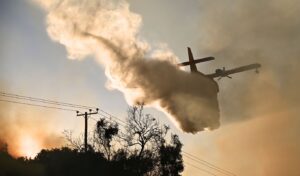
“A few days before the puppy’s death, a large agricultural fire broke out near the den,” he explained, adding that the continuous presence of fire trucks, aircraft, helicopters, and dozens of personnel caused the wolves to abandon their den site and move deeper into the crops, according to Theodoros Kominos.
The dense vegetation of corn, sunflowers, and cotton dramatically reduced visibility, making any potential search-and-capture operation dangerous not only for the animals but for the people involved as well. At that time, he noted, the family consisted of approximately nine wolves of different ages and six newborns.
“No responsible researcher creates conditions where humans and a stressed wolf family with newborns suddenly come face to face in dense vegetation,” he wrote.
“The footage was not filmed because we knew the puppy would die”
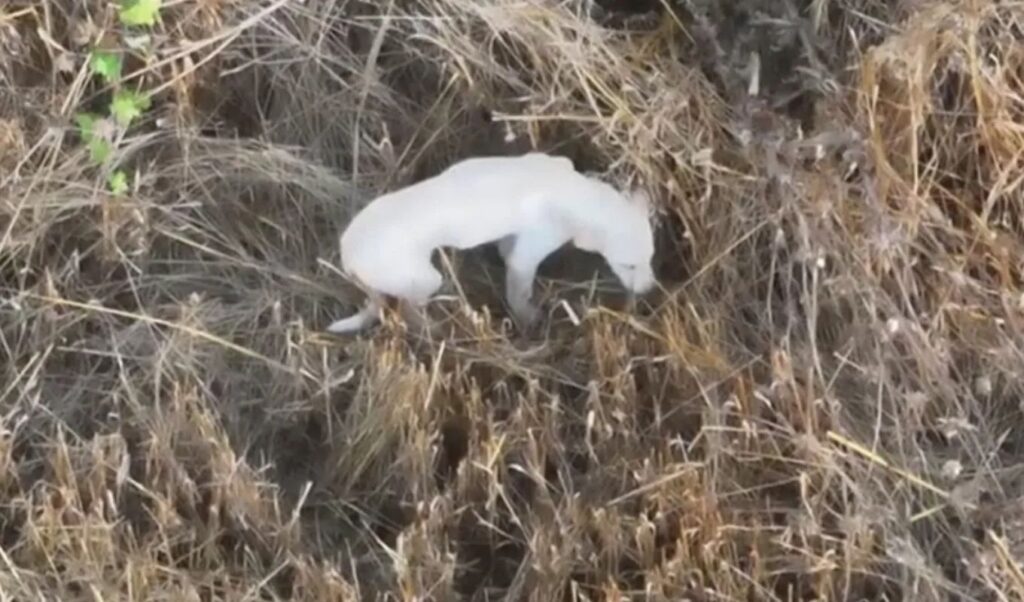
Theodoros Kominos also addressed the footage of the puppy filmed shortly before its death, in which the animal appeared visibly distressed. He clarified that the material was recorded as part of the team’s routine scientific monitoring of the wolf family — not because the researchers knew the animal was in critical condition.
The puppy was observed on that particular day for approximately ten minutes, while the focus of the recording was the behavior of the entire pack. Although it appeared lethargic, similar behavior had been observed in the wolf cubs during the same period — they were sleeping for extended periods, which the researchers had attributed to the exceptionally high temperatures at the time.
Regarding the marks visible on the rear of the puppy’s body, Theodoros Kominos noted that they were initially thought most likely to be residue from cattle manure. As he explained, local farmers frequently dispose of manure in the area, and throughout the course of the research, the team had repeatedly recorded both the wolves and the puppy playing in, rolling around in, or resting on it.
The following day, when the researchers reviewed the footage more carefully and grew concerned about the animal’s condition, they consulted a veterinarian. According to the post, the vet pointed out that the marks could be consistent with diarrhea.
Up until that point, however, the team maintains that they did not have sufficient evidence to reach that conclusion with any certainty. Recordings were taken between 4 and 7 in the morning — the time when the wolves returned from their overnight foraging and retreated to rest.
Based on the information available at the time, Theodoros Kominos states that the team did not assess there to be grounds for such a serious intervention.
The research team returned to the area three days later, with no way of knowing in the interim what had happened to the animal. “Today, everyone watches the footage knowing how the story ends. But when we were filming it, we had no idea what would happen three days later,” he wrote.
The puppy’s contact with other dogs
In the weeks leading up to its death, the puppy had begun making contact with stray or semi-owned dogs in the area, which fed at the same spots where dead livestock were found. This development had given the researchers hope that the puppy might gradually separate from the wolf pack on its own and reintegrate into the local dog population.
“Our answer was no”
At the close of his post, Theodoros Kominos also addressed the practical scale of what a rescue operation would have entailed. As he noted, it would potentially have required the mobilization of public agencies, the Forestry Service, veterinary authorities, the Greek Natural Environment and Climate Change Agency (NECCA/OFYPEKA), and additional personnel — all to organize an operation on private farmland with the sole aim of capturing a sick domestic puppy.
The real dilemma, he argued, was therefore not simply whether to attempt to save the puppy. It was whether the effort to rescue one dog justified the risk of disturbing and exposing an entire wild wolf family with newborns, revealing their presence, mobilizing a large number of people and agencies, and creating additional dangers for both the animals and those involved.
“Our answer was ‘no,'” he concluded. As he noted, it was not an easy decision — but in the research team’s assessment, it was “the only responsible one.”
The full post
“Why didn’t we intervene? Over the past few hours, we have received a considerable number of messages from Greece and abroad, and read numerous comments regarding the death of the white puppy that had integrated into a wolf family.
Most were messages of interest and support. But there were also a number of criticisms — and even personal attacks and insults — all sharing a common question: “Why didn’t you save it?” I will try to explain why we did not intervene.
Not because we feel the need to justify ourselves, but because I believe many people simply don’t know how wildlife fieldwork actually works. From the very beginning, we weren’t simply monitoring a puppy. We were monitoring an entire wolf family with newborns. That was our responsibility. Not just the dog. The entire family — in fact, long before the puppy ever entered their lives.
The reality was very different from what many people imagine. This family does not live in an isolated forest or within a protected public area. It lives in an agricultural landscape. In cornfields, grain crops, sunflower and cotton fields. Among livestock farms. On dozens of privately owned properties where people work every single day.
This is not a place where anyone can simply walk in and organize an animal capture operation. Locating the puppy would have required a coordinated effort involving multiple people, vehicles, a veterinarian, specialized equipment, and many hours of searching across private farmland. Such an operation would have been immediately noticed — but more importantly, it would have served no real purpose.
And the most critical point? It would have revealed the presence of a wolf family with newborns in an area where they have, until now, managed to survive almost entirely unnoticed. And as if that weren’t enough, there was also a fire in the area.
A few days before the puppy’s death, a large agricultural fire broke out near the den. The continuous presence of fire trucks, aircraft, helicopters, and dozens of personnel forced the wolves to abandon the den area and move deep into the crops. From that point on, the situation became even more difficult.
The wolves were moving through dense corn, sunflower, and cotton fields, where visibility is minimal. A capture operation would not only have endangered the wolf family — it would have endangered the people involved as well. At that time, the family consisted of approximately nine wolves of varying ages and six newborns. Let that number sink in.
No responsible researcher creates conditions where humans and a stressed wolf family with newborns suddenly come face to face in dense vegetation.
“If you could see it was sick, why didn’t you do something?” There is a significant misunderstanding here. The footage the public saw was not filmed because we knew the puppy was going to die. It was filmed because that is our research methodology. Scientific fieldwork is based on observing and recording the natural behavior of animals. That is what we do every day. On that particular day, we observed the puppy for just around ten minutes while recording the family’s behavior. Our focus was on the wolves. Yes, the puppy appeared lethargic. But during that same period, we had also recorded wolf cubs appearing particularly sluggish and sleeping almost continuously — something we had attributed to the extreme temperatures of those days.
As for the marks visible on the rear of the puppy’s body, we did not initially assess them as a clear indication of diarrhea. Our first evaluation was that they were residue from cattle manure that the animal had sat or rolled in. In the area, farmers frequently dispose of manure, and throughout our research we had repeatedly recorded the wolves — and the puppy along with them — playing in, rolling around in, lying down on, or resting in it. We even have several video recordings of this.
The following day, when we reviewed the footage again more carefully and became concerned about the puppy’s condition, we consulted a veterinarian. It was he who noted that those particular marks might be consistent with diarrhea rather than manure residue. Up until that point, based on what we were observing in the field and what we had recorded over weeks, there was no reason to reach that conclusion with any certainty.
Our recordings were made between 4 and 7 in the morning — the time when all the animals returned from their overnight foraging and withdrew to rest. Based on the data we had at that moment, we did not assess there to be an immediate reason for such a serious intervention. We returned to the area three days later. During that time, there was absolutely no way for us to know what had happened.
Today, everyone watches the footage knowing how the story ends. But when we were filming it, we had no idea what would happen three days later. There was also one more important factor. In the weeks leading up to its death, we had observed the puppy beginning to make contact with other stray or semi-owned dogs that were feeding at the same spots where dead livestock were found. In fact, we had begun to hope that it would gradually distance itself from the wolves and reintegrate into the local dog population.
And finally…
It should be understood that this entire operation would not have been organized to protect a wolf population or to address a wildlife incident. It would have required the mobilization of public agencies, the Forestry Service, veterinary services, NECCA, and potentially many more people — all to organize an operation across private farmland with the sole purpose of capturing one sick domestic puppy. In reality, we were not asked to decide whether to save a puppy.
We were asked to decide whether the effort to rescue one dog justified putting an entire wild wolf family at risk, mobilizing a whole apparatus of agencies, disturbing an active den, and exposing both people and animals to additional dangers.
Our answer was ‘no.’ It was not an easy decision. But it was, in our view, the only responsible one.”