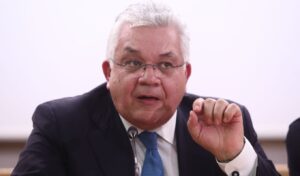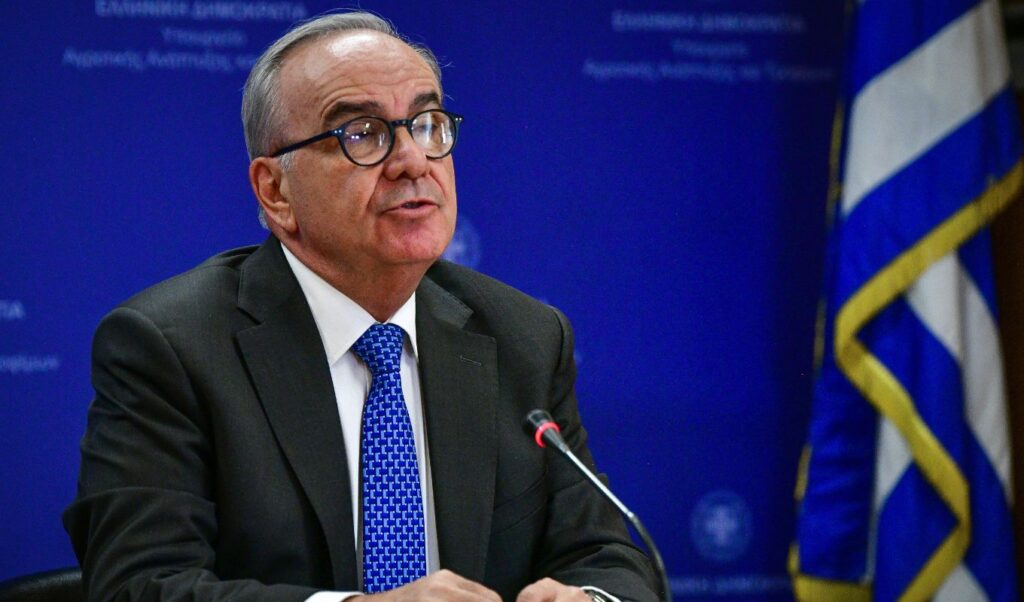
“More than €1 billion” — that’s the size of the economic package set to be unveiled at the Thessaloniki International Fair (TIF), according to Deputy Minister of National Economy and Finance Nikos Papathanasis, speaking on the ERTnews programme Connections. The minister stressed that final decisions rest with the Prime Minister, and previewed that the measures will focus on the middle class, pensioners, families, small and medium-sized enterprises (SMEs), and young people.
Papathanasis also dismissed scenarios of a recession following the completion of the Recovery Fund, arguing that the Greek economy will continue to grow at a rate above the European average. He cited forecasts of 2% growth for Greece, compared to just 0.9% for Europe as a whole.
The discussion came against the backdrop of the Recovery Fund’s conclusion. According to the Deputy Minister, the loan component has now been fully drawn down — reaching 100% — while the grants component must be completed by 31 August, with all required projects delivered by that deadline.
Papathanasis emphasised that the end of the Recovery Fund does not mean a halt to development funding, as the government has already mapped out the path ahead through the National Development Programme and other European financing instruments.
€23 billion for the road ahead
At the heart of the government’s strategy is the National Development Programme 2026–2030, which mobilises a total of €23 billion in national resources — more than double the €10 billion allocated under the previous programme.
The Deputy Minister presented the new programme as the primary financing vehicle for the economy after the Recovery Fund, arguing that resources will be directed towards projects and interventions that have a direct impact on people’s daily lives.
He also referenced the Social Climate Fund, which is designed to support vulnerable households and small businesses, as well as financing tools aimed at energy resilience and economic modernisation. The Social Climate Fund is set to include interventions covering housing, transport, and tackling energy poverty.
“If policy doesn’t translate into an improvement in people’s everyday lives, then it has no value,” Papathanasis said pointedly, linking development policy to boosting entrepreneurship and employment.
Papathanasis: “There will be no recession”
Responding to assessments that the conclusion of the Recovery Fund could lead to a slowdown or even a recession, the Deputy Minister was unequivocal: “There will be no recession.”
He said Greece continues to grow at rates higher than the rest of Europe, and argued that the investment gap has been significantly narrowed. He also highlighted the reduction in unemployment, which he placed at 8% — down from around 18% in the past — and the creation of more than 600,000 new jobs.
In his view, the rise in disposable income stems not only from benefit-related measures, but also from job creation, wage increases, and reductions in the tax burden.
Papathanasis: TIF package to exceed €1 billion
Papathanasis’s remarks on the TIF package drew particular interest. The total value of the interventions will surpass €1 billion, he said, while clarifying that final decisions will be taken by the Prime Minister.
He linked the government’s fiscal capacity to the country’s budgetary trajectory and the so-called escape clause. He explained that Greece has submitted a request to activate it, in order to unlock additional fiscal space for energy resilience projects.
According to his statements, this mechanism could generate extra fiscal room in the years ahead, though he was careful to note that the full amount would not necessarily be channelled immediately into measures for 2027. For 2027, the Prime Minister will select from the available fiscal headroom the specific interventions to be announced at the Thessaloniki Fair.
Papathanasis also recalled that last year’s tax reform included, among other measures, zero income tax for young people up to the age of 25 and a 9% tax rate for those aged between 25 and 30, arguing that this policy has boosted disposable income.
The housing crisis also in focus
Papathanasis noted that more than 8,000 student dormitory places are being built across the country, describing the initiative as the largest student housing construction programme ever undertaken in Greece.
He also referred to an increase in the student housing allowance, noting that in cases of shared accommodation the amount can reach €2,500 per student.
Regarding the My Home 2 programme, Papathanasis said that approximately 14,000 homes have already benefited, and estimated that this figure will rise further before the programme concludes. The final disbursement deadline has been extended to 31 August 2026.
On the programme for renovating vacant properties, he noted that around 9,000 applications have been submitted by owners wishing to bring closed properties back into use. He also estimated that the total number of homes covered by the relevant schemes will increase.
He stressed that the goal is not to solve the housing problem through a single programme, but to gradually expand the supply of available homes and create more options for those seeking accommodation.
Responding to criticism of the Recovery Fund
Papathanasis rejected opposition criticism that Recovery Fund resources were directed primarily towards large businesses rather than SMEs.
He argued that small and medium-sized enterprises have received approximately 60% of the total number of loans from the loan component, and noted that new financing tools are planned for the period ahead through the Hellenic Development Bank, with the aim of giving small and micro businesses access to loans at particularly low borrowing costs.
He also defended the Recovery Fund’s overall impact on everyday life, pointing to preventive screening programmes, the renovation of hospitals and health centres, transport infrastructure projects such as the E65 motorway and the VOAK northern Crete road, schools, and the rollout of interactive whiteboards.
He said that more than 2 million citizens have undergone preventive health screenings, and noted that more than 30,000 women were identified at a pre-cancerous stage through the relevant programmes.
Civil protection and post-Recovery Fund projects
Responding to criticism over the resources allocated to civil protection, the Deputy Minister argued that the country is currently implementing the largest civil protection programme in its history, funded not only through the Recovery Fund but also through ESPA (the EU structural funds programme) and the national funding component.
He explained that projects launched with Recovery Fund resources can continue to be financed through other available instruments. He cited water supply projects, aerial and ground assets, and environmental protection actions as examples.
The Deputy Minister of National Economy and Finance stressed that the completion of the Recovery Fund does not mark the end of public investment, but rather a transition to a different mix of financing tools, with the National Development Programme set to play a central role.
Papathanasis concluded by arguing that the government’s economic policy will continue to be anchored in entrepreneurship and investment, with the stated goal of ensuring that economic growth translates into higher disposable incomes and an improved quality of life for all citizens.