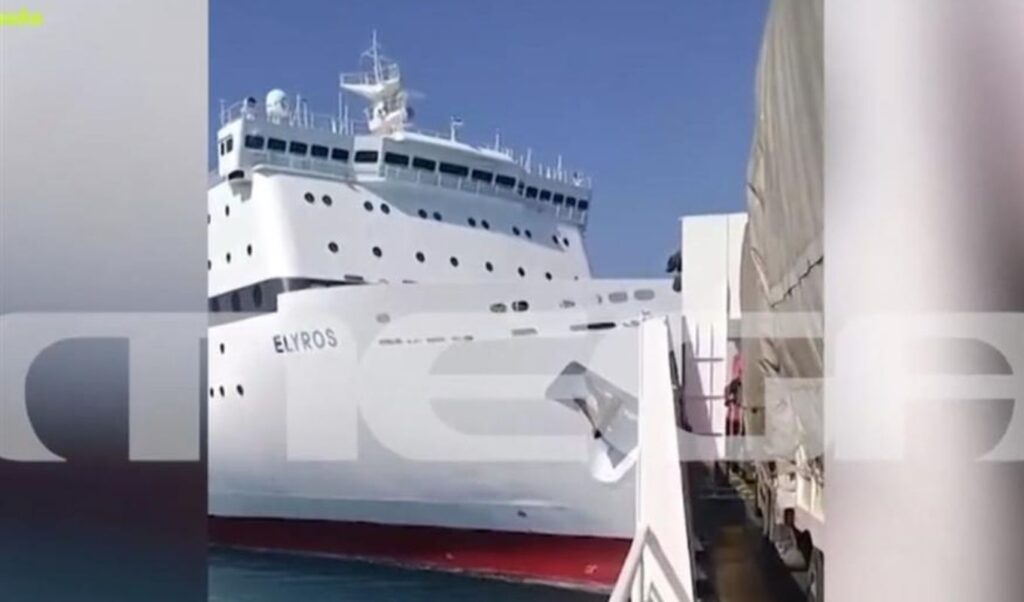
Moments of intense anxiety unfolded on the morning of Tuesday, July 21, at the port of Souda in Chania, when the passenger ferry “Elyros” collided with the cargo vessel “Iosif K.” — an incident that could have easily turned into a major tragedy. Port authorities are investigating the exact circumstances of the maritime accident, with findings confirming that water ballast tanks were punctured during the collision. Fortunately, the tanks containing liquefied petroleum gas, fuel, and oxygen remained intact. The “ELYROS”, which was carrying 100 passengers, 118 crew members, 32 private vehicles, 74 trucks, and 7 coaches, underwent the required damage certification and inspection procedure by the vessel’s classification society. Having received confirmation that it retains its class and is cleared to continue operations, the ferry subsequently departed for the port of Piraeus.
Read also: Chania: Criminal case filed and Coast Guard deputy chief dispatched to Crete following ship collision
Chania: New video document of the two-ship collision at Souda port — eyewitness accounts are shocking
The right side of the passenger ferry’s bow strikes the left side of the cargo vessel’s bow, which is nearly destroyed on impact. The crew of the “Iosif K.” are in a state of panic, as the vessel is carrying 89 vehicles along with 14 fuel tanker trucks — all captured in new documentary footage aired by MEGA.
Crew members describe the terror that broke out on board: “Here, right here — tankers, gas canisters, LPG… The bastard. Something’s happening here. He was moored and suddenly came straight at us, full speed.” At another point, a crew member anxiously asks: “Is that water or petrol?“, receiving the reply: “No, that’s not petrol. It’s water.” Another crew member voices his fear about what could have been a far greater disaster: “That’s an LPG tanker truck. What could have happened? An LPG tank right at the exact point where the other vessel struck.“
Possible causes of the Souda port ship collision in Chania and the right-of-way scenarios
The likely causes that led to the collision between the two vessels at Souda port were analyzed by Giorgos Vallis, president of the Panhellenic Union of Private and Professional Yacht Crews. It is worth recalling that the vessels involved were the passenger/car ferry ELYROS, operating on the Souda–Piraeus route, and the Ro-Ro cargo ship Iosif K. Speaking on MEGA on the afternoon of Tuesday, July 21, Vallis explained what maneuvers could have been handled differently to prevent the accident, emphasizing the critical importance of proper coordination when vessels enter and exit the port.
“For a vessel to be able to leave a port, or for another to enter, there is a port authority official on the quay who manages traffic flow — meaning he decides who gets the order to come in, who gets the order to go out, who moors, who lowers the ramp, who casts off, who ties up. In this particular case, I cannot conceive that this person simultaneously gave one ship the order to depart and the other the order to enter. We shouldn’t immediately jump to saying ‘it’s the ships’ fault, it’s the captains’ fault.’ The management of the port is handled via radio by the officer in charge. From the moment you realize that a vessel is moving astern — in reverse — it takes a few seconds, especially with large ships like these. In the footage, we can see they are extremely close together, so neither one had time to react. But let’s look at where it all began: for the passenger ferry to cast off and depart — to lower the ramp, to untie the lines — it must have received departure clearance from the officer on site. Equally, for the Ro-Ro to enter the port, it also received approval from someone,” he explained.
“Given that one is a passenger ferry and the other is a Ro-Ro, the Ro-Ro should have waited for the passenger ferry to clear the entrance before proceeding in. But here we can see multiple errors. Typically, two or three people share responsibility and oversight, but there is one person in charge — the safety officer, who holds the highest rank and gives the orders and regulates traffic flow. There is one person who decides who enters and who exits.” Finally, when asked whether the captains could have done anything to avoid the collision, Vallis noted: “They could only have acted at the very last moment, and only if they had noticed what we can see in the video. However, what we observe is both the Ro-Ro and the passenger ferry approaching at speed, with neither reducing speed — they were confident nothing was wrong, that they had received their instructions, so everything was fine.“