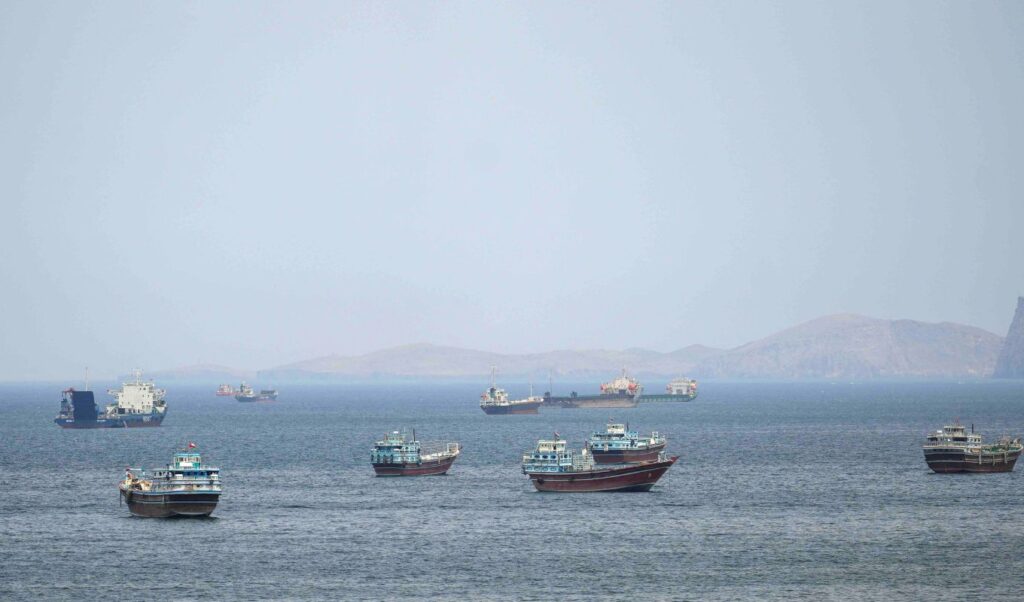
Iran is facing critical dilemmas that will determine both the outcome of the conflict and what comes next for the regime. Despite the resilience it has shown throughout the war and its resistance to American demands, after ten days of mutual strikes centered on control of the Strait of Hormuz, Tehran has three options before it — and none of them offers a clear path to victory, according to a BBC analysis.
Iran’s three difficult choices
As the BBC highlights in its analysis, the first option is to accept American demands: to guarantee free and safe navigation through the Strait of Hormuz by ending attacks on commercial vessels, to abandon or significantly limit its highly enriched uranium stockpiles, and to agree to intensive inspections by the International Atomic Energy Agency (IAEA).
In return, Tehran could seek an end to the American naval blockade of Iranian ports, the lifting of sanctions, and guarantees against further strikes.
In practice, this is the least painful option in military and economic terms — but the most politically difficult.
Reopening the Strait of Hormuz without securing a recognized role for Iran in managing it would amount to surrendering a new deterrent tool — one that has proven more effective than ballistic missiles, regional proxy networks, or even the country’s nuclear program.
For the first time, the Islamic Republic has demonstrated that it can impose direct costs on the global economy in response to attacks it sustains.
At the same time, the nuclear program has been presented for years by Iranian leadership as an inalienable national right — one that cannot be relinquished under pressure.
Furthermore, if Tehran yields to US demands for curbing its nuclear program, it will face fierce criticism from hardliners. This could also open the door to new American demands regarding Iran’s ballistic missile program and its relationships with Hezbollah in Lebanon, Shia armed factions in Iraq, and the Houthis in Yemen.
Escalation as the second option
The second option is escalation. Iran could intensify its strikes on American bases in the region, on shipping, and on critical infrastructure in the Arab Gulf states, hoping that higher energy prices and broader disruption would force Washington and its allies to seek a compromise.
However, an attack causing mass casualties or severe damage to Gulf state infrastructure risks widening the war, as neighboring states could become more directly involved in the conflict and simultaneously rally into a broader coalition against Tehran.
The third option is to maintain the current state of instability: to continue exerting enough pressure on shipping and energy markets to retain negotiating leverage, but not so much as to trigger the resumption of full-scale war with the United States.
This appears to align with the Islamic Republic’s longstanding logic. Iran does not need to defeat a stronger enemy — it only needs to outlast the enemy’s willingness to fight. Survival itself can be presented as victory. Nevertheless, sanctions, war damage, and inflation are steadily increasing domestic pressure.
As time passes, a paradox may emerge: the more Iran uses the Strait of Hormuz as a weapon, the less powerful that weapon may become, as countries find new ways to export energy and other goods while bypassing the region entirely.
Iranian Parliament Speaker Mohammad Baqer Qalibaf has acknowledged this contradiction, arguing that the value of the Strait of Hormuz lies in increasing — not reducing — the volume of shipping that passes through it. A permanently unsafe maritime route pushes the international community to seek alternative passages, ultimately bypassing Iran altogether.
Who makes the decisions in Iran
The situation is further complicated by the uncertainty surrounding Iran’s decision-making process.
Under the leadership of Ayatollah Ali Khamenei — who was killed in an airstrike in the early stages of the American-Israeli war against Iran in February — disagreements between elected politicians, religious institutions, and the Islamic Revolutionary Guard Corps (IRGC) were ultimately resolved by the Supreme Leader. After months of war and under the new leadership of Khamenei’s son, Mojtaba, this balance of power is far less clear.
Iranian President Masoud Pezeshkian and his diplomats may favor reaching a deal to ease economic pressure and restore stability. By contrast, hardliners in parliament, powerful unelected institutions, and conservative media may fear that significant concessions would undermine the ideological foundations of the Islamic Republic and alienate its core base of support.
The biggest question concerns the armed forces — and the IRGC in particular. Iran’s missile program, its regional alliances, and its Strait of Hormuz strategy are all central to the IRGC’s influence, yet it remains unclear how much weight its commanders carry in decisions regarding escalation and negotiations.
The three options before Tehran do not carry the same costs for all parts of the system. Pragmatists may prefer a deal, hardliners may favor continued confrontation, and some military commanders may view escalation as strengthening Iran’s negotiating position.
The question, therefore, is not only which path Iran will choose — but who actually holds the power to make that choice.
What Iranians are saying
The leadership’s perception of “endurance” differs greatly from the perspective of those who are actually living through it. Iran and the US signed a Memorandum of Understanding (MoU) in June, aimed at ending military operations, reopening the Strait of Hormuz, and reaching a war-ending agreement within 60 days. However, three weeks after signing, President Donald Trump declared the ceasefire over, following Iranian attacks on vessels in the Strait and subsequent US retaliation.
One woman from Iran told BBC Persian that she felt “very, very sad” when hostilities resumed. She had hoped the MoU would give both sides time to resolve their differences and restore stability. Instead, she fears infrastructure destruction and loss of life — both civilian and military.
She criticized hardliners within the Iranian system for imposing catastrophic policies, but also Iranian opposition figures abroad who, in her view, encouraged the war.
Another woman in Tehran said the export company where she worked had shut down, leaving her unemployed for four months — despite holding a doctorate and 17 years of professional experience.
“No one is hiring, because no one knows what’s going to happen,” she said. She described soaring prices, power and water outages, rising theft, and occasional gunfire at night. She now limits her movements within the city.
These accounts do not point to a single political conclusion. External attacks can fuel anger toward the US and Israel, even among those who oppose the Islamic Republic. Yet they also expose the limits of demanding that a society endure endless hardship in the name of resistance.
Trump’s difficult choices
Trump is himself facing difficult choices: escalate the war, maintain military and economic pressure, or accept a compromise that allows Iran to retain a limited civilian nuclear program under stricter international oversight. None of these options offers a clear path to victory.
The standoff could continue for months, cycling through rounds of strikes, mediation efforts, and temporary ceasefires. The critical question is how long Iran’s leaders can use Hormuz as a pressure tool without triggering full-scale war, fresh internal unrest, or the development of alternative routes that would ultimately diminish the Strait’s strategic importance.