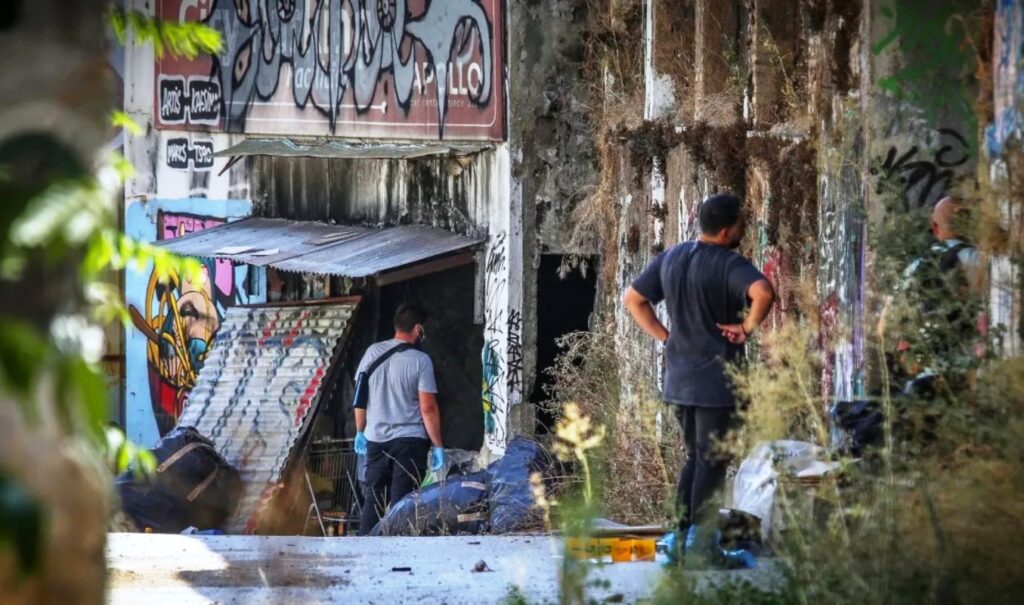
A complex thriller is unfolding in the case of a woman’s body discovered inside a suitcase in Kypseli, Athens, as no missing persons report matching her description has been filed anywhere in Greece. According to the main evening news bulletin on STAR, detectives from the Homicide Division now believe the woman — estimated to be around 30 years old — was most likely not a permanent resident of Greece and may not have had any family or social connections in the country who could have reported her disappearance. The investigation has now expanded internationally through Europol, with particular attention being paid to French missing persons records, following the discovery of a key detail on the victim’s clothing.
Read also: Kypseli: Mystery of the woman found in a suitcase — What the autopsy revealed, victim details, and the Yu Ting scenario
Kypseli: No trace of the woman in missing persons records
According to information reported by STAR’s main evening news bulletin, a thorough search of Hellenic Police records returned no missing persons report matching the woman, who is estimated to have been approximately 30 years old and 1.61 metres tall. This finding reinforces investigators’ belief that the woman was not a permanent resident of Greece, or that she had arrived in the country relatively recently without having established any stable social ties or contacts.
For now, the primary lead being examined by authorities is her clothing. A print on her shorts featured the name of an institution or university written in French — however, that institution has branches in several European countries. This detail does not automatically lead to the conclusion that the woman was French, but it remains one of the very few clues available to investigators as they work to establish her identity.
The three scenarios being investigated by the Homicide Division
Based on the evidence gathered so far, Homicide Division detectives are exploring three main scenarios. The first is that the woman was a French tourist or student who had travelled to Greece without any close ties to the country. The second possibility is that she was an undocumented migrant who had previously passed through France before making her way to Greece. The third scenario under consideration is that she travelled directly from her home country to Greece, where she encountered her killer.
Greek authorities have now activated international police cooperation through Europol, searching for potential matches in missing persons reports filed in other countries. Special focus is being placed on French missing persons records, though investigators have not ruled out expanding the search to other European countries where the institution or university referenced on her clothing also operates.
No signs of sexual assault found
Forensic examination has so far revealed no evidence of rape or any other form of sexual assault. However, the manner in which the perpetrator attempted to conceal the body has been described as particularly macabre and premeditated.
According to findings, the killer placed the woman inside a fabric bag, bound it, and then sealed it with adhesive tape. The bag was then placed inside a dark blue suitcase, which was abandoned in the Kypseli neighbourhood of Athens. Investigators are now working to reconstruct the victim’s final movements and determine when and how she came to be in Greece, hoping that identifying her will ultimately lead them to the perpetrator.