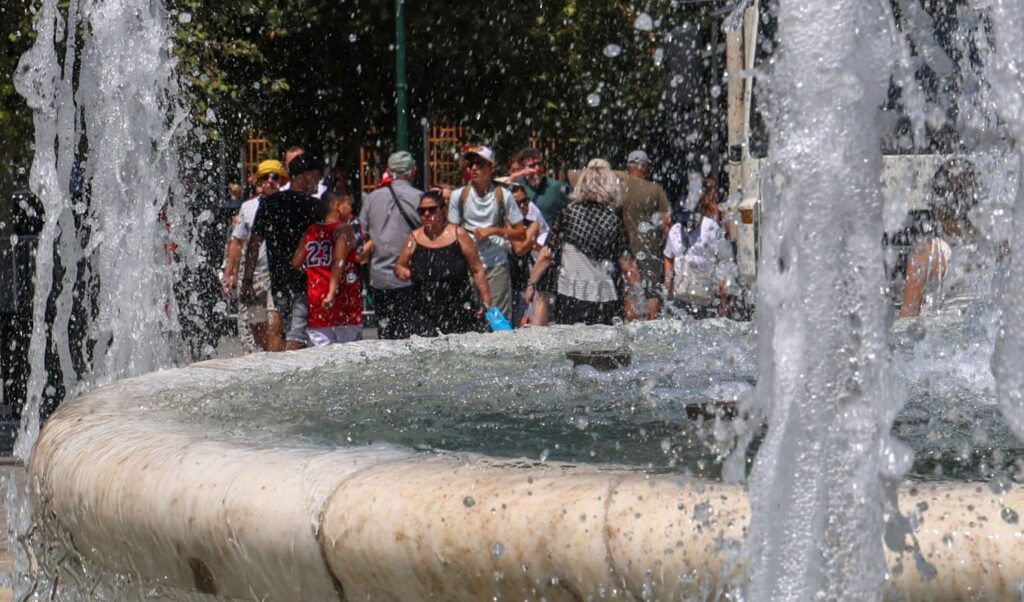
Greece will remain in heatwave conditions through Wednesday (July 22), according to forecasts from the National Observatory of Athens / meteo.gr. Tuesday (July 21) and Wednesday (July 22) call for heightened caution, as the heat stress index is expected to reach the yellow category in several regions, according to meteorologist Thodoris Kolydas. The sustained heatwave conditions have prompted the Ministry of Health to issue an emergency circular, while Greece’s General Confederation of Labour (GSEE) has also published protective guidelines for workers.
Read also: Heatwave week begins: Where temperatures will reach 41°C and when conditions will ease (Video)
Heatwave forecast through Wednesday
According to forecasts from the National Observatory of Athens / meteo.gr, heatwave conditions will persist through Wednesday, July 22.
Indicative maximum temperatures:
- Monday, July 20: locally reaching 40–41°C.
- Tuesday, July 21: locally reaching 41–42°C, with isolated areas potentially hitting 43°C.
- Wednesday, July 22: temperatures will drop in central and northern Greece, but the heatwave will persist in the southern part of the country.
Available data suggests that from Thursday, July 23, a significant temperature drop is expected, accompanied by locally heavy rainfall and thunderstorms.
Meteorologist Thodoris Kolydas’s assessment
According to forecasts shared by meteorologist Thodoris Kolydas, extreme heat stress is not expected to be widespread across large geographic areas. However, Tuesday and Wednesday require increased vigilance, as the heat stress index is locally crossing into the yellow category in several regions.
On Tuesday, the highest heat burden will be felt in Attica and parts of mainland Greece, while on Wednesday, the highest readings are expected mainly in eastern Central Greece, the southern Peloponnese, and locally in Crete. By Thursday, a noticeable easing is forecast across most of the country, with relatively elevated values persisting only in certain southern and southeastern areas.
O ΔΕΙΚΤΗΣ ΘΕΡΜΙΚΗΣ ΚΑΤΑΠΟΝΗΣΗΣ ΓΙΑ ΤΟ ΕΠΟΜΕΝΟ ΤΡΙΗΜΕΡΟ -ΑΝΑΝΕΩΣΗ ΔΕΔΟΜΕΝΩΝ
✅Το επόμενο τριήμερο δεν αναμένονται γενικευμένες πορτοκαλί, κόκκινες ή μαύρες συνθήκες στο δείκτη θερμικής καταπόνησης στη χώρα. Με βάση τη συγκεκριμένη αριθμητική πρόγνωση, δεν διαφαίνεται ακραία… pic.twitter.com/kFCgeQsunP— Theodoros Kolydas (@KolydasT) July 20, 2026
Health Ministry protective measures against the heatwave
High-risk groups
The Ministry of Health identifies the following as vulnerable groups: the elderly, infants and young children, pregnant and breastfeeding women, overweight and obese individuals, those working or exercising intensely in hot environments, as well as people with chronic conditions (cardiovascular disease, hypertension, diabetes, pulmonary disease, kidney disease, mental illness) and individuals taking diuretics, psychotropic medications, or insulin.
Protection guidelines
- Stay in air-conditioned spaces
- Wear light, light-colored clothing made from breathable fabrics
- Avoid sun exposure and strenuous physical activity
- Avoid long trips without air conditioning
- Drink plenty of fluids, avoid alcohol, and eat light meals rich in fruits and vegetables
- Take frequent lukewarm showers and apply cool compresses to the head and neck
- Check in daily on elderly people who live alone
The role of municipalities and employers
The emergency circular calls on municipalities to organize cool, air-conditioned public spaces — with a focus on vulnerable groups — and to consider emergency schedule adjustments to reduce movement during peak heat hours. Special attention is requested for workers engaged in heavy physical labor and outdoor work.
Symptoms to watch for
Early warning signs include headache, weakness, dizziness, low blood pressure, nausea, and rapid heartbeat. Heatstroke manifests as a sudden rise in body temperature above 40.5°C, dry and flushed skin, confusion, and in severe cases, loss of consciousness.
GSEE: Worker protection measures during the heatwave
Greece’s General Confederation of Labour (GSEE) and its Health and Safety Secretariat have released guidelines aimed at preventing heat-related health impacts and workplace accidents, while also ensuring timely referrals to the relevant authorities for required workplace inspections.
As stated in GSEE’s announcement: “Heat stress poses a risk to workers in both indoor and outdoor environments across all sectors. Its severity depends on the workplace environment as well as individual factors such as age, health status, socioeconomic conditions, and even gender. It should be noted that in Greece, the summer months are also characterized by strong winds, which create a complex environmental burden and increase the risk of workplace accidents. All of these factors must be assessed in a timely manner so that appropriate preventive and protective measures can be taken to safeguard the health and safety of workers.”
GSEE once again calls on the Ministry of Labour and Social Insurance to utilize the existing worker-employer agreement framework and the findings of the dedicated working group (2018) on preventing heat stress among workers during summer, with the aim of advancing the adoption of explicit, binding legislative provisions. The operational planning of the Labour Inspectorate, along with corresponding commitments from other coordinating authorities such as the Ministry of Development, must be grounded in a clear framework of legislative rules and ministerial decisions — not merely circulars and announcements.
In light of forecasts for exceptionally high temperatures, and pending official announcements from the General Secretariat for Civil Protection, the National Meteorological Service, and the Ministry of Labour and Social Insurance, GSEE reminds all parties of the following essential measures:
1. Organizational and technical measures in the workplace
- Drinking water: Workers must be provided with ample cool drinking water at a temperature of 10–15°C.
- Facility improvements: Technical protective measures are required, including interventions in building structures, adjustments to production processes, and adaptation of workplace microclimates.
- Working hours and breaks: Work schedules must be organized with planned breaks, and physically demanding tasks should be carried out outside peak heat hours. Work in thermally burdened environments must be reduced or halted between 12:00 and 17:00.
- Rest areas: Appropriate shaded or air-conditioned rest areas must be provided for workers during breaks.
- Air conditioning hygiene: Where air conditioning is used, strict public health safeguards must be observed (to prevent viral or other infections), along with proper unit maintenance to prevent the development of contamination sources.
- Risk factor assessment: Individual and environmental factors must be taken into account, such as lack of acclimatization, dehydration, intense physical labor, and heavy or non-breathable clothing.
2. Outdoor work and personal protective equipment (PPE)
For outdoor work, in addition to the above measures, the following provisions apply:
- Shaded areas must be identified or created, and appropriate shelters must be constructed for carrying out work and for rest breaks.
- Suitable head coverings must be provided and used (where helmets are not required).
- Skin protection (sunscreen) and neck coverings must be provided, following advice from the Occupational Physician and Safety Technician.
3. Mandatory work stoppage (12:00–17:00) and special categories
A mandatory work stoppage between 12:00 and 17:00 is required for manual outdoor labor when any of the following conditions apply:
- Temperature exceeds 40°C with simultaneous humidity of at least 20%.
- Temperature exceeds 42°C with simultaneous humidity of at least 14%.
- The bioclimatic index (WBGT) value exceeds 32.2.
Sector-specific provisions:
- Construction sites and technical projects: Work must be mandatorily halted between 12:00 and 17:00 at outdoor construction sites, as heat stress is significantly intensified by the absence of natural shade, heavy physical exertion, and heat accumulation from building materials (e.g., concrete, asphalt, metal structures).
- Delivery workers and platforms: The mandatory work stoppage applies to all workers delivering products and items by two-wheeled vehicle, including those working through digital platforms, regardless of the type of employment contract.
- Shipbuilding and repair yards: Under special collective agreement provisions, working hours are set at 07:00–13:00 (with a stoppage until 19:00 without pay deduction) when temperatures reach 38°C. At 36°C and 37°C, work is halted from 14:00 to 18:00.
- Mining and quarrying: Suspension of outdoor operations is required to avoid exposure to solar radiation when temperature thresholds are exceeded.
4. Protection of vulnerable groups (high-risk groups)
- Remote work (teleworking) must be made available to employees belonging to high-risk groups, where the nature of the work permits.
- Vulnerable groups include individuals at elevated health risk from high temperatures, such as those with heart disease, pulmonary conditions, chronic illnesses (e.g., diabetes, chronic kidney failure, blood pressure disorders), those taking specific medications (e.g., insulin, antidiabetics, diuretics, anticholinergics), pregnant women, workers over 60 years of age, and those working in hot environments.
- Inclusion in these groups must be certified by a medical certificate or by the company’s Occupational Physician.
5. Inspections and penalties
- The Labour Inspectorate is responsible for intensified preventive inspections, with priority given to high-burden environments such as outdoor workplaces and those involving outdoor work (e.g., construction sites, road or other technical projects, two-wheeled delivery services, outdoor service provision, agricultural work, etc.), as well as covered facilities with specialized production activities (e.g., foundries, steel mills, glassworks, metallurgy plants, plastics industries, ceramic factories, cotton gins, shipbuilding operations, laundries, dry cleaners, ironing facilities, grill restaurants, catering kitchens, etc.), and manual labor operations (e.g., manual handling of heavy loads in transport, construction, etc.).
- In the event of a violation of the mandatory work stoppage or non-compliance with heatwave measures, a fine of €2,000 per worker will be imposed on the business. Beyond financial penalties, Labour Inspectorate officers have both the authority and the obligation to order the temporary suspension of the production process or the specific work activity if they determine that workers’ lives or health are at immediate risk, with the possibility of further measures if the business continues to systematically violate legal provisions after temporary suspension or the imposition of administrative penalties.
6. Current information and practical resources on heat stress
The European Agency for Safety and Health at Work (EU-OSHA) has published the guide Heat at work – Guidance for workplaces, which provides practical advice on managing the risks associated with working in hot conditions. The guide is also available in Greek.
Important information is also available on the website of the Hellenic Institute for Occupational Health and Safety (ELINYAE), which hosts a recently published and extensively updated edition on heat stress at work, alongside practical resources for protecting workers during heatwaves.
On the website of the National Meteorological Service, in addition to weather forecasts for the whole country and individual regions and cities, forecast maps are published showing the range of WBGT (Wet Bulb Globe Temperature) bioclimatic heat stress index values for outdoor environments nationwide. Collective labor agreements can be found on the websites of the Mediation and Arbitration Organization and the Ministry of Labour and Social Insurance.
7. Union action and complaints
The identification of measures and the assessment of occupational risk must be carried out with the active participation of the Safety Technician and Occupational Physician, in cooperation with workers’ representatives. Trade unions and health and safety committees have the right to consultation and to sign collective arrangements.
In any case, it remains a standing demand from GSEE to the Ministry of Labour that explicit provisions be incorporated into existing occupational health and safety legislation — covering employer obligations and, crucially, prohibitions aimed at preventing worker heat stress and regulating working conditions during extreme weather events (heatwaves, extreme cold, etc.) — accompanied by strict penalties and intensified timely inspections by the Labour Inspectorate.
Furthermore, GSEE and the Union of Consumer Workers of Greece (EEKE) urge all consumers to avoid placing delivery orders — particularly those requiring two-wheeled vehicle transport — during the coming days and for as long as exceptionally high temperatures persist, in order to prevent the risk of serious workplace accidents.
Delivery work carried out outdoors on two-wheeled vehicles is extremely hazardous to workers’ health and must be suspended — without any loss of pay. As consumers, we are also workers, and it is therefore our responsibility to protect the health and safety of our colleagues through our own behavior, by making use of alternative collection methods such as picking up orders directly from stores or collection points (take away), or via other air-conditioned vehicles rather than motorcycles and mopeds.