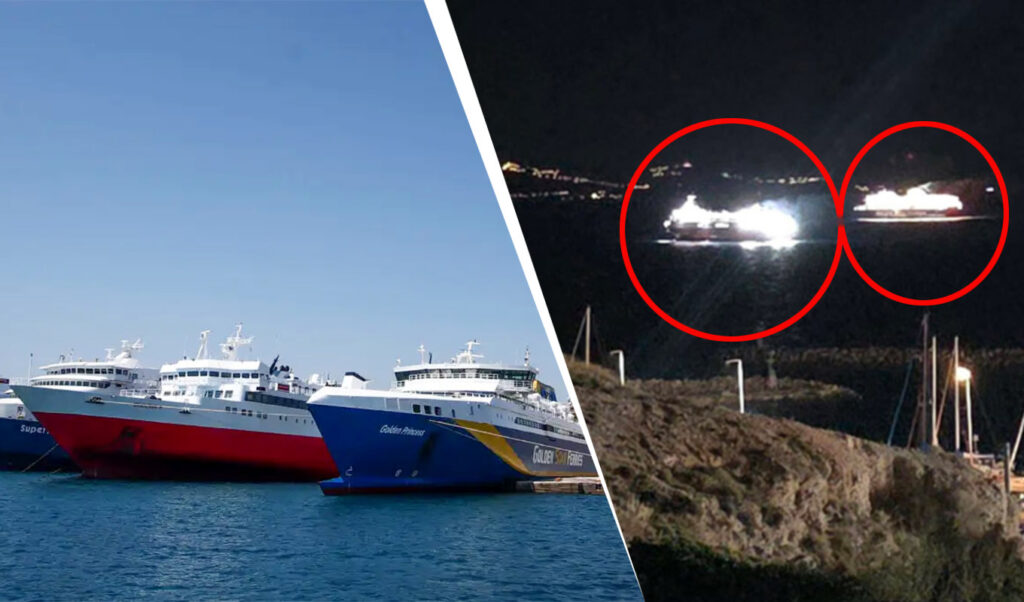
An unprecedented situation is unfolding this summer at Rafina port, where surging ferry traffic has created a problem of an intensity never seen before. Every night, passenger ferries are forced to anchor offshore, as the available berths are simply insufficient to accommodate the number of scheduled vessels. The sight of ships anchored off the coasts of Rafina, Mati, Nea Makri, and Marathon — as well as other areas of the southern Euboean Gulf — has sparked fierce reactions from both permanent residents and local authorities, who argue that the port is now operating well beyond its actual capacity.
The issue, moreover, extends well beyond schedule management. The situation has reignited debate over the port’s planned Master Plan, with the municipal authority arguing that what is happening today proves that any further expansion of port activities cannot proceed without substantial infrastructure investment and without taking into account the city’s real capacity to absorb growth.
Mayor of Rafina: The problem is mismanagement, not the ships themselves
Speaking to parapolitika.gr, the Mayor of Rafina-Pikermi, Dimitra Tseva, says that the problem that has emerged is the result of flawed planning that is placing an enormous burden on the entire city. “I don’t want to comment on how the Ministry of Shipping manages the ferry schedules, because that is not our responsibility. The problem that has been created by ships remaining at anchor, however, is the result of mismanagement of Rafina port,” she stresses.
According to the mayor, the port has specific operational limits that simply cannot be exceeded without serious consequences. “Rafina port is small. It cannot accommodate that many ships. Despite this, this year eleven vessels were approved to operate routes. When you know that the port cannot handle them, it is only to be expected that problems will arise,” she notes.
Three ships anchored offshore every night
According to Mayor Tseva, the direct result of this situation is that every single night, three passenger ferries are unable to remain inside the port. Some make their way to Lavrio — when a berth is available — while others drop anchor off Nea Makri, Marathon, or other safe locations, depending on weather conditions and the judgment of each captain. These scenes have already caused considerable alarm among residents of the wider area, who are witnessing for the first time such large vessels anchored daily along their coastline.
“The city cannot take any more”
For the municipal authority, the biggest problem is not the sight of ships sitting in the Euboean Gulf — it is the mounting pressure being placed on the city itself. The mayor argues that the increase in ferry routes has led to an explosive rise in traffic, air pollution, and noise. “There is a world of difference between serving five ships and eleven. More ships mean more passengers, more cars, more buses, more exhaust fumes, and a greater burden on residents.”
As she points out, Rafina simply does not have the infrastructure needed to absorb this level of traffic, while the city’s roads and parking areas have already been pushed to their absolute limits. “When thousands of passengers return from the islands, everyone has to make their way toward the Athens basin. The area’s infrastructure cannot cope with such a volume of traffic.”
“It feels like a trial run before the Master Plan”
Mayor Tseva draws a direct connection between the current situation and the port’s development plan. In her view, the surge in ferry activity creates the strong impression that an informal “stress test” of the area’s limits is being carried out, even before the implementation of the Master Plan has begun. “This whole issue was reignited through the Master Plan. It feels like a test to see what will happen if traffic at the port increases — but without the necessary infrastructure works having been completed first,” the mayor says pointedly.
She also expresses serious concern over the interventions planned for Rafina’s coastal zone. “That is precisely where we are drawing the line. You cannot plan interventions of this scale without having thoroughly assessed all the environmental consequences and the impact on residents’ daily lives.”
The municipal authority’s response has moved well beyond public statements. The Municipality of Rafina-Pikermi has already launched a petition against the Master Plan, calling on citizens to support a resolution formally expressing opposition to the port expansion plans and demanding meaningful participation by the local community in all decisions affecting the city’s future.
The Rafina Port Authority responds: We manage the infrastructure we have
For its part, the Rafina Port Authority (OLR) states that it bears no responsibility whatsoever for the number of vessels operating at the port this year, maintaining that its sole mandate is to manage the port’s infrastructure and ensure safe operations. Speaking to parapolitika.gr, OLR President Theofanis Matsopoulos makes clear that the organization has no say in either how many ships are scheduled or what their timetables look like. “Ferry routes are approved exclusively by the Coastal Shipping Council (SAS), which falls under the Ministry of Shipping. Port authorities have neither an advisory nor a recommendatory role in this process. We manage the infrastructure that is at our disposal.”
As he explains, each year the ferry companies submit their route requests and it is the SAS that decides which ones are approved. The OLR is informed of those decisions but has no power to intervene.
What has changed this year
According to Mr. Matsopoulos, this year is markedly different from previous ones. He explains that while more routes than the port could comfortably handle were approved in prior years as well, a number of companies ultimately chose not to activate them, withdrawing vessels shortly before the tourist season began. “Up until last year, there were requests for more ships, but in practice several companies never actually deployed them. So we would end up with five ships berthing overnight in Rafina and there was no problem.” This year, however, the picture changed dramatically. “Seven ships have been approved to stay overnight in Rafina, while during the day routes can reach as many as eleven. This is the first time something like this has happened,” he underlines.
“The port has specific limits”
“The port can safely accommodate five ships. It cannot accommodate six, seven, or eight. That is the reality,” states the OLR president plainly. As he explains, in practice only four berths are used, since one is always kept free for safety reasons. “We always keep one berth available so that if any emergency arises, a ship can dock immediately. It is a decision made purely on safety grounds.” As a result, of the seven ships that need to stay overnight, four remain inside the port and three are forced to anchor outside.
Where the ships anchor — “There is no designated anchorage area”
Mr. Matsopoulos also clarifies that there is no officially designated anchorage area off Rafina. This means that neither the Port Authority nor the Port Authority Coastguard directs ships to where they should remain overnight. “The choice is made exclusively by the captain and the company. A ship may go to Lavrio — if a berth is available — or anchor off Nea Makri, Marathon, or wherever the captain judges to be safe, while naturally observing all regulations and avoiding protected areas,” Mr. Matsopoulos notes.
He describes the situation as unprecedented for Rafina, while pointing out that similar practices are applied at other major ports when berths are not available.
“Safety is the top priority”
Despite the backlash, the OLR president insists that both the organization and the Rafina Central Port Authority are working extremely hard every day to ensure the port operates without incident. “We work in complete coordination with the Port Authority Coastguard. Our absolute priority is the safety of passengers, crews, and vessels. That is the fundamental principle behind every decision we make,” he concludes.
The ministry’s response in parliament
The dispute has also spilled over into parliament, following a parliamentary question submitted by Giorgos Vlachos, MP for Eastern Attica representing New Democracy, directed at the Ministry of Shipping and addressing the Master Plan and its implications for port operations. In response, Deputy Minister of Shipping and Island Policy Stefanos Gikas argued that the port’s Master Plan has not yet been approved, as it is currently at the stage of environmental assessment.
He stated that the public consultation process has been completed and that the procedure is currently under review by the Environmental Licensing Directorate of the Ministry of Environment. It will subsequently be followed by an environmental recommendation, the drafting of a Presidential Decree, a new opinion from the Port Planning and Development Committee (ESAL), and finally a review by the Council of State.
The deputy minister acknowledged that both the Municipality of Rafina-Pikermi and the Region of Attica have issued negative opinions on the plan, while maintaining that these views have been incorporated into the process and will be taken fully into account before any final decision is reached.
PENEN: Seafarers, passengers, and residents are the ones paying the price
An additional perspective on the issue comes from the Panhellenic Union of Merchant Marine Seafarers (PENEN), which is raising serious concerns not only about the port’s operations but also about the working conditions of maritime workers and passenger safety. PENEN President Apostolos Kypreos, speaking to parapolitika.gr, attributes the situation to decisions made by the Ministry of Shipping and the manner in which this year’s routes were approved.
“The situation that has developed in Rafina is the result of both competition between ferry companies and Ministry of Shipping decisions on route allocations. Despite it being well known that there are only five overnight berths available, eleven ships were approved to operate. It is only natural that there would not be enough space for all of them inside the port,” he argues. According to him, the problem goes far beyond the image of ships anchored offshore — it affects the entire functioning of the port.
The risks highlighted by maritime workers
The PENEN president explains that ships remaining outside the port are in a constant state of operational readiness, as they must be prepared to depart at any moment in the event of changing weather conditions or an emergency. At the same time, as he notes, ships berthed inside the port are required to carry out constant repositioning maneuvers in order to facilitate the arrivals and departures of other vessels.
“Crews are working continuously, with very long shifts and heightened stress levels. When a seafarer does not get the rest they need, the likelihood of human error increases significantly. And that is, above all, a matter of passenger safety,” he points out.
He also recalls that a number of incidents have occurred at the port in recent times, emphasizing that the mounting pressure on crews simply cannot be ignored.
He too highlights the fact that there is no officially designated anchorage area for passenger ferries in the wider sea area off Rafina — meaning that every captain must choose their anchoring position based solely on weather conditions and the safety of the vessel.
Mr. Kypreos further notes that in the event of a serious medical emergency involving a crew member or any other critical incident, access to shore is not immediate — the ship must first weigh anchor, approach the port, and berth. He also points out that there is no permanently available tugboat in the area, which in his assessment makes it significantly harder to respond effectively to emergency situations.
The municipality escalates its response
Against this backdrop, the Municipality of Rafina-Pikermi has decided to go a step further, launching a petition against the Master Plan and calling on citizens to participate in the relevant resolution.
In the text, the municipal authority formally expresses its opposition to the expansion of port facilities, arguing that the plan fails to account for the real capacity of the city and the areas affected by port operations.
It specifically calls for:
– the alignment of port operations with the city’s actual capacity,
– the participation of the municipality and local community at every stage of the planning process,
– the development of a comprehensive plan to address the traffic, environmental, and urban planning impacts,
– as well as the establishment of compensatory measures in favor of the local community.
“The city has limits. Citizens have rights. The environment has a breaking point. Safety cannot be compromised,” the resolution states emphatically.
A port at the center of a wider conflict
The Rafina port issue has evolved into a complex and multi-layered dispute, with fundamentally different visions for the future of Attica’s second-largest passenger port now in direct collision.
On one side, the Ministry of Shipping maintains that the Master Plan process is still ongoing and that no final decision has been made. The Rafina Port Authority insists that it does not set the routes, but simply implements the decisions of the Coastal Shipping Council, with safe port operations as its sole guiding principle.
On the other, the municipal authority, local residents, and maritime workers argue that this summer’s situation is conclusive proof that both the port and the city are already operating at the very edge of their limits. The surge in ferry routes, ships anchoring offshore every night, mounting road congestion, environmental pressures, and serious safety concerns collectively paint a picture that, as they stress, cannot be ignored in any planning for the road ahead.
With the Master Plan still under environmental review and the local community steadily escalating its mobilization, all signs point to the debate over Rafina port’s future remaining firmly in the spotlight in the months to come — as all parties involved are called upon to strike a delicate balance between the needs of ferry transport, maritime safety, and the quality of life of those who call this city home.