Constantine the Great is considered one of the most important figures in the history of Christianity and the Roman Empire, as his name became associated with pivotal decisions that changed not only the development of the Christian faith but also the political course of the world.
Born during a turbulent era marked by wars, political conflicts, and persecutions, Constantine grew up under the strong influence of his mother, Helen. The deep faith and values she passed on to him played a significant role in shaping both his character and his future path. From her, he learned that true strength is found not in weapons, but in God.
He was raised within the Roman military system, became a general, and soon emerged as one of the most powerful figures of the Roman Empire, eventually ascending to the imperial throne. However, one of the most defining moments of his life occurred shortly before a major military confrontation, when he reportedly saw a bright sign in the sky in the form of a Cross, accompanied by the words: “In This Sign, Conquer” (In hoc signo vinces).
This event is considered a decisive moment in his spiritual transformation. Constantine came to believe that true victory does not come through violence, but through Christ. He ordered the symbol of the Cross to be placed on his army’s banners and, following his victory, implemented historic changes that profoundly influenced the world of his time.
Perhaps the most significant development was the end of the persecution of Christians and the establishment of religious freedom. For the first time, Christians were able to worship freely, pray openly, and build churches without fear of persecution.
At the same time, Constantine the Great played a decisive role in shaping Church history by convening the First Ecumenical Council of Nicaea, one of the most important moments in establishing the doctrines of the Christian faith.
During the same period, his mother, Saint Helen, traveled on a pilgrimage to Jerusalem, where, according to Christian tradition, she discovered the True Cross, the Cross upon which Jesus Christ was crucified.
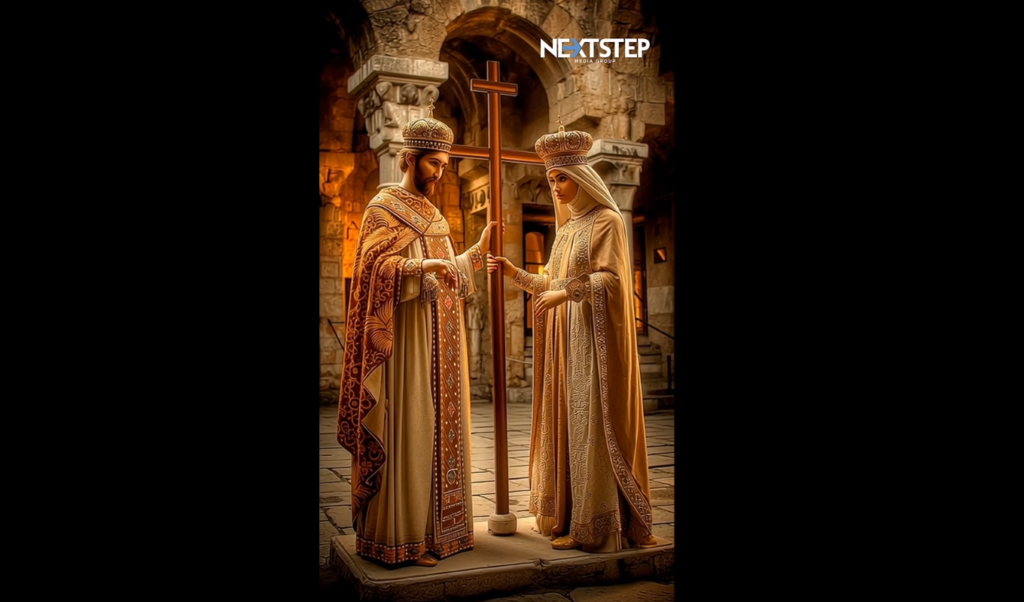
For this reason, the Orthodox Church often depicts Constantine the Great and Saint Helen together, holding the Holy Cross between them as a symbol of faith, sacrifice, and hope.
The legacy of Constantine the Great did not endure solely because of his political or military decisions, but also because it became connected with a profound transformation that influenced the history of humanity and the place of Christianity in the world.