Greece’s emergence as a key gateway for American natural gas into the European market is far more than just another energy project — it represents a strategic choice with sweeping geopolitical implications. The Vertical Corridor is reshaping the balance of power in Southeastern Europe, strengthening efforts to reduce energy dependence on Russia while simultaneously curbing Turkey’s regional influence. Behind the agreements already signed under the banner of Atlantic SEE LNG Trade lies a chain of political decisions, diplomatic contacts, and business moves that have positioned Greece as a privileged partner of the United States.
Read also: Ignatiou: Rubio clarifies US stance on Vertical Corridor and Crete-Cyprus interconnection (Video)
The key message about the Vertical Corridor
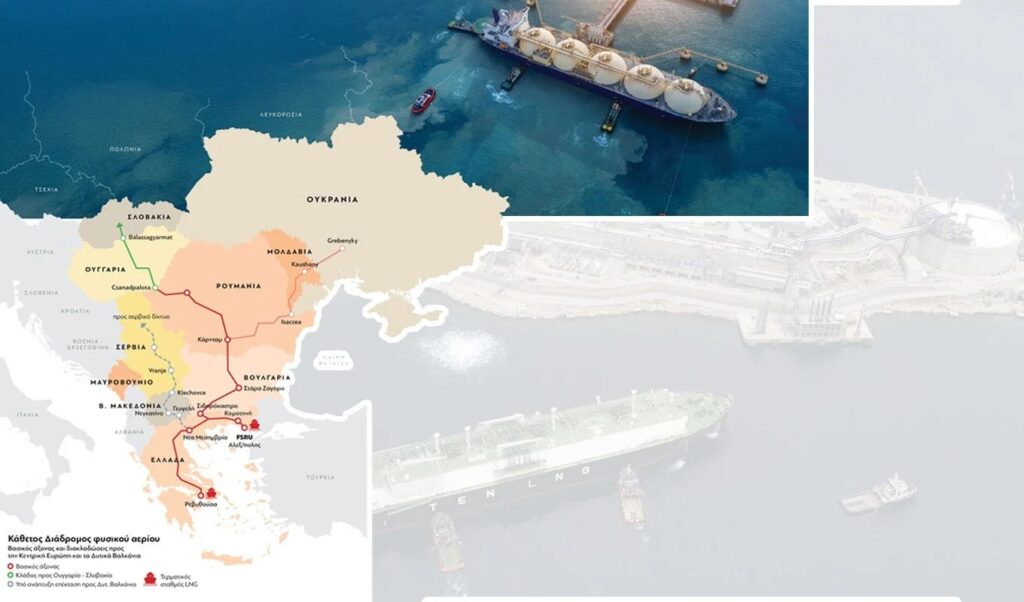
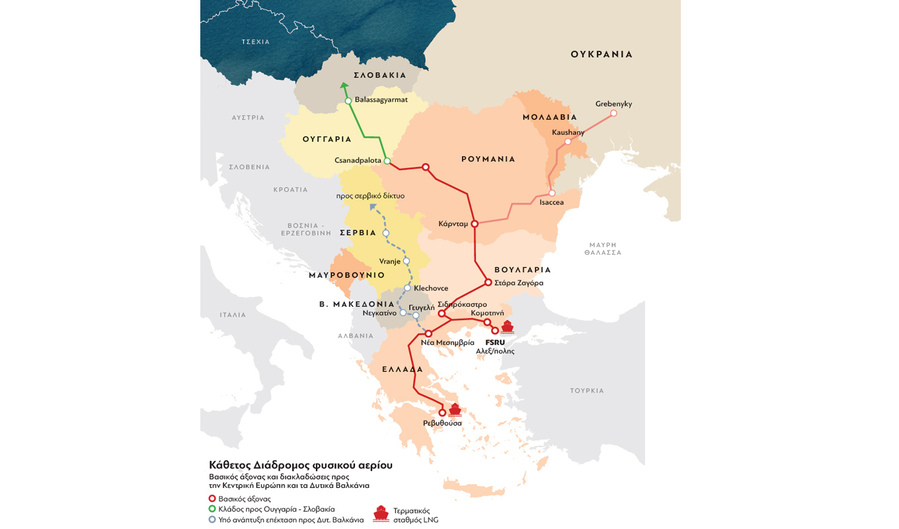
The stakes, however, go far beyond the success of specific deals or the role of individual players: what is at issue is Greece’s ability to secure a new, stronger position on Europe’s energy map. The core message is clear — the Vertical Corridor is a matter of national interest that transcends personalities and business agendas. It represents a deliberate government strategy to leverage Greece’s existing infrastructure (pipelines and LNG terminals) as the starting point of a route capable of supplying American LNG to a market of at least 100 million people across Central and Southeastern Europe and the Balkans. In doing so, it offers a credible alternative to Russian gas, reinforces the energy security of the region, and elevates Greece’s geopolitical standing.
Greece is currently choosing to utilize its infrastructure for the transportation of American LNG on the basis of commercial agreements, with the American side requiring the signing of long-term supply contracts as a prerequisite — seeking to firmly establish its position in the broader region over the long term. This is driven by the understood reality that Russian gas will eventually return to the market at some point, even if that moment is not on the immediate horizon.
A major business opportunity
Within this framework, Atlantic SEE LNG — the joint venture between AKTOR and the state-owned DEPA Commercial — took on a central role in the commercial development of the project, bridging private initiative with public sector participation. Recognizing both a significant business opportunity in the twilight of Russian gas dominance and a national opportunity for Greece to rise up the ranks on Europe’s energy map, Atlantic SEE LNG decided to bring the Vertical Corridor to life by signing a long-term LNG supply agreement with American producer Venture Global. The company took on the weight of an initial 20-year contract providing for the supply of 1 million tonnes of LNG annually — and has already secured the sale of these volumes through binding agreements signed with Bosnia and Albania.
What is, however, worth noting is the striking absence of support from EU member states for concluding additional long-term agreements for American LNG — particularly given that such deals serve as a critical safety valve against the energy supply risks currently facing Europe. The “double front” of the Russia-Ukraine conflict and the Middle East crisis has not only sent natural gas prices soaring but has raised the very real risk of shortages this winter, which is shaping up to be exceptionally harsh from an energy perspective — as European Commission President Ursula von der Leyen herself recently acknowledged.
Just how far ahead Atlantic SEE LNG was looking when it signed its agreement with Venture Global is further demonstrated by the fact that China Gas, QatarEnergy, and ConocoPhillips have all recently inked their own long-term contracts with the same company. Three industry giants from China, Qatar, and the United States — the last of which is, remarkably, a direct competitor of Venture Global — clearly recognized early on how difficult it would be to secure volumes of American LNG for the international market over the long term. European players have been slower to grasp this reality.
In any case, what must be clearly understood is that the “heart” of the Vertical Corridor lies not so much in the physical infrastructure — which already exists, is not owned by any of the companies trading the gas, and is freely accessible to any interested party — but primarily in the commercial agreements that secure its use. And it is of critical importance that the United States chose Greece as the entry gateway for American LNG into Central and Southeastern Europe, with Atlantic SEE LNG serving as the vehicle created to advance the shared strategic vision of both Washington and Athens.
Turkey’s refusal
Just how significant the US decision to route the Vertical Corridor through Greece truly was is something Prime Minister Kyriakos Mitsotakis himself made clear in recent public statements, noting that “America — both the government and the companies — chose to do this through Greece. They could have done it through another country,” leaving little doubt that the project could equally have been routed through Turkey.
Indeed, as well-informed sources point out, it is no coincidence that momentum behind the Vertical Corridor began to build in September 2025, following a meeting between US President Donald Trump and Turkish President Recep Tayyip Erdoğan — during which Trump asked Erdoğan to commit that Turkey would not transport Russian gas through its infrastructure. Erdoğan refused.
Around that same time, in September 2025, US Interior Secretary Doug Burgum — who also serves as chair of the National Energy Dominance Council, the body that reports directly to Trump and shapes American energy policy both domestically and internationally — visited Greece and toured the Revythoussa LNG terminal. According to the same sources, it was during that visit that the Vertical Corridor was effectively locked in.
Subsequently, Greece’s Minister of Environment and Energy, Stavros Papastaurou — who had long maintained open lines of communication with both Burgum and US Energy Secretary Chris Wright — agreed with the American side to place the Vertical Corridor at the heart of the Partnership for Transatlantic Energy Cooperation (P-TEC) conference in Athens, held on November 7, 2025, at the Zappeion.
It was there that — among other agreements — the landmark 20-year deal between Atlantic SEE LNG Trade and Venture Global was signed. This sequence of events also sheds light on the true architects of the Vertical Corridor on the American side: none other than Burgum and Wright. As for former US Ambassador Kimberly Guilfoyle, she arrived in Greece on November 1, 2025 — by which point the groundwork had already been firmly laid. From that point forward, she served consistently in support of the US government’s overarching strategic plan throughout her tenure.
The geopolitical footprint
All of this considered, Greece’s selection as the entry point for American LNG into Europe is a matter of national importance and represents a major boost to the country’s geopolitical footprint — a view shared by virtually all parliamentary parties. Particularly noteworthy in this context is the recent assessment by PASOK MEP and former Energy Minister Yannis Maniatis, who stated that the Vertical Corridor has overturned Turkey’s regional energy ambitions.
The same argument can certainly be made with regard to Russia, which stands to be another major loser from the project’s success. Moscow would not only lose sales of at least 20 billion cubic metres of gas per year, but also a powerful tool of political influence over countries that, to this day, remain dependent on the Kremlin and Gazprom for their energy supplies. Strong backing for the Vertical Corridor was also expressed by US Secretary of State and National Security Advisor Marco Rubio during his recent visit to Greece.
This development likely damages the interests of other states that may have preferred to play the role of the Vertical Corridor’s hub themselves — and who are now searching for ways to undermine the agreements or derail the project altogether. Such an outcome would be an exceptionally damaging blow to Greece’s national interests, and it is clear that it must be prevented at all costs.
Published in Parapolitika