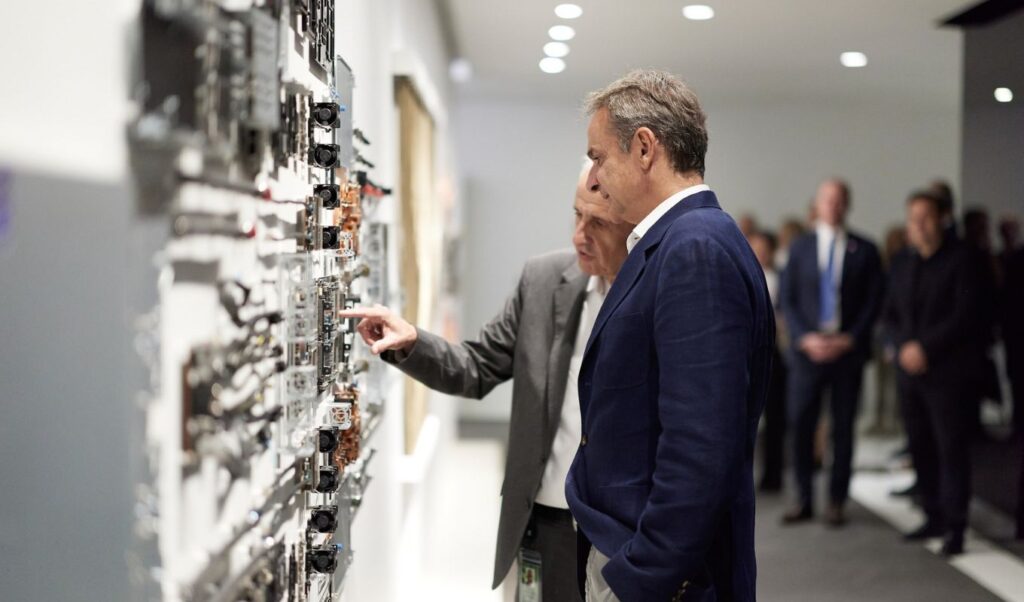
Greece’s data center market is emerging as a prime investment opportunity, with the four largest American banks — J.P. Morgan Chase, Bank of America, Citigroup, and Wells Fargo — eyeing significant opportunities in the country. During meetings held on American soil with Prime Minister Kyriakos Mitsotakis and his team, senior executives from these banks expressed their belief that Greece could double or even triple its current data center capacity within the coming years. Furthermore, as they emphasized to the Greek delegation, they are prepared to participate in investment initiatives either through loan financing or direct capital support.
Mitsotakis lands data center deals
During the US meetings, special reference was made to the recent agreement between PPC (Greece’s Public Power Corporation) and AWS for a data center in Western Macedonia. The American bankers were already familiar with PPC’s moves — as sources indicate that prior discussions had taken place with the company — as well as with the specialized workforce available in Western Macedonia, which represents a significant competitive advantage for the region.
Their interest, according to the same sources, is not limited to Western Macedonia but extends across the whole of Greece. In the coming period, further consultations are expected to take place in order to transform these statements of intent into concrete investment action.
The PPC – Amazon project
It should be noted that in recent years Greece has successfully attracted billions of euros in investments directed toward infrastructure that forms the backbone of cloud computing, artificial intelligence, and digital services.
A recent landmark example is the deal between PPC and Amazon Web Services (AWS) for the development of a large-scale data center in Western Macedonia. The project, located in Agios Dimitrios, Kozani, with an initial power capacity of 300 MW and the potential to scale up to 1 GW, is shifting the market focus from traditional data centers to hyperscale facilities capable of supporting the ever-growing demands of cloud computing and artificial intelligence.
Under the agreement, PPC will provide the land, buildings, and energy infrastructure, while AWS will install and operate the IT equipment. The lease is expected to run for 15 years. Energy supply will be provided through long-term power purchase agreements sourced from renewable energy.
The economic footprint of this project is substantial. The first phase of the plan has already been linked to multi-billion-euro investments, while market reports suggest the total potential value could reach significantly higher levels if the expansion proceeds. In any case, the true significance of the deal extends beyond the investment figure itself. The installation in Western Macedonia marks the first time at such a scale that energy infrastructure has been directly linked to the needs of the global digital economy.
The choice of location is no coincidence. The former Agios Dimitrios power plant and the surrounding area offer extensive land and energy infrastructure that can be repurposed in the post-lignite era. The data center thus represents an entirely new kind of activity for the region — one centered not on lignite-based electricity generation, but on the consumption and utilization of large volumes of electricity for digital services.
Infrastructure is the critical factor
The critical issue is energy. Data centers operate continuously and require stable power supply, while AI-linked infrastructure is significantly increasing power density demands.
For this reason, the availability of grid capacity, network connections, substations, transmission lines, and access to competitively priced and preferably green electricity are becoming key factors in attracting new investments.
In any case, investment activity in the Greek market began several years ago and has been primarily centered on the Attica region.
Microsoft is advancing its own investment plan for the development of data centers in Spata and Koropi. The project includes three facilities with a total planned capacity of approximately 38.4 MW and a budget of close to €1 billion. The investment creates infrastructure for cloud services including Azure, Microsoft 365, and Dynamics 365, while construction work on the Spata data center has already entered the building phase.
In Paiania, Data4 is simultaneously developing its campus. The French company initially announced an investment of over €300 million for its entry into the Greek market, and the scope of the project has since expanded. The campus is intended to host infrastructure for cloud computing, data storage, artificial intelligence, and telecommunications services.
Digital Realty also holds a strong presence in the market through Lamda Hellix. The company has developed the Athens Data Center Campus, with its ATH3 and ATH4 facilities further boosting available capacity. ATH3 was designed with a capacity of up to 6.8 MW, and ATH4 adds equivalent additional capacity, reinforcing Athens’ role as a connectivity and interconnection hub.
The cumulative effect of these investments is gradually transforming the profile of the Greek market. Data centers are no longer simply technical facilities housing servers — they have become critical infrastructure for the cloud economy, artificial intelligence, digital services, and businesses that depend on immediate access to data.
Greece’s geographic position, the development of its telecommunications networks and submarine cable systems, and the growing potential of its renewable energy output are all creating the conditions for further sector growth.
Originally published in Kyriakátiki Apogeumatini