Motor Oil and HELLENiQ ENERGY are emerging as key suppliers to the European fuels market — particularly diesel and aviation fuel — at a time when the prolonged Middle East crisis and repeated strikes on Russian energy infrastructure have left the market severely short of refined products. In this high-pressure environment, the two major refineries — controlled by the Vardinogiannis Group (Motor Oil) and the Latsis family (HELLENiQ ENERGY) — are capitalizing on their high refining capacity, which they have carefully maintained and expanded while the rest of Europe moved in the opposite direction. Backed by strong export capabilities and the ability to source crude from multiple origins, both groups are seamlessly meeting domestic demand while channeling a significant share of their output to international markets at improved margins.
Read also: “Stories of Hope” by Motor Oil: First cycle completed — second cycle coming soon with four new additions
Motor Oil & HELLENiQ ENERGY exports
HELLENiQ ENERGY operates the Aspropyrgos, Elefsina, and Thessaloniki refineries as a unified system, with a combined capacity of 344,000 barrels per day. The three facilities have a combined storage capacity of 6.9 million cubic meters. The group is active in eight countries in total and operates more than 1,900 fuel stations across Greece and abroad.
Motor Oil’s core asset is the Agioi Theodoroi refinery, with a capacity exceeding 200,000 barrels per day. It is one of the most complex refining units in Europe, with a storage capacity of 2.9 million cubic meters. The group exports to more than 70 countries, has over 100 subsidiaries, and operates a network of more than 1,500 fuel stations with a broad geographic footprint.
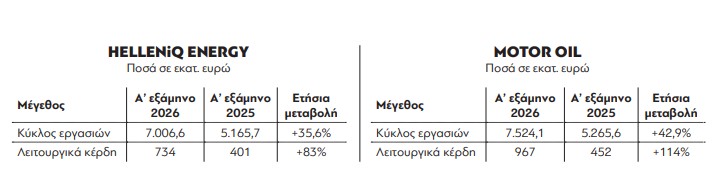
In the first half of 2026, Motor Oil’s direct fuel segment exports reached 4.79 million tonnes, up from 3.65 million tonnes a year earlier — a year-on-year increase of approximately 31%. These exports accounted for 67.5% of the group’s total fuel sales, which stood at 7.1 million tonnes. An additional 704,000 tonnes were channeled to the shipping and aviation sectors. Key European markets for the group include Gibraltar, Italy, Slovenia, and Spain.
The picture at HELLENiQ ENERGY is equally impressive. The group’s export revenues in the first half reached €1.97 billion, up from €1.67 billion in the same period of 2025, with approximately €1.84 billion derived from refining operations alone. In the second quarter alone, exports of refined products reached 1.73 million tonnes, accounting for 48% of total refinery sales. Diesel and aviation fuel exports surged by 35%, directed primarily to European markets experiencing supply shortfalls.
Investments
HELLENiQ ENERGY recorded a record €407 million in investments during the first half, with maintenance and upgrade works at the Aspropyrgos refinery alone exceeding €200 million. But the bigger bet lies ahead: as the group’s CEO Mr. Siamisis revealed at the Thessaloniki International Fair, HELLENiQ ENERGY is evaluating a €3–5 billion investment programme spanning five to ten years across Aspropyrgos, Elefsina, and Thessaloniki, targeting a 10%–15% capacity increase — primarily in diesel and gasoline — with an eye firmly set on export markets.
Motor Oil made investments totaling €191.3 million in the first half of the year, with group management projecting that the full-year figure will reach €420 million. At the parent company level, investments amounted to €79.3 million, with €76.9 million directed to the refinery. The second half of the year includes scheduled maintenance works on the Hydrocracker and FCC units.
In conclusion, the two Greek groups are doing far more than simply ramping up exports. They are investing strategically to ensure their facilities remain available, flexible, and capable of producing greater volumes of high-value products — reinforcing Greece’s role as a reliable regional energy supply hub. In a Europe that has lost a significant portion of its refining base, HELLENiQ ENERGY and Motor Oil are making a decisive contribution: ensuring that Greece is not merely self-sufficient in fuels, but a critical link in the energy security chain of the entire continent.