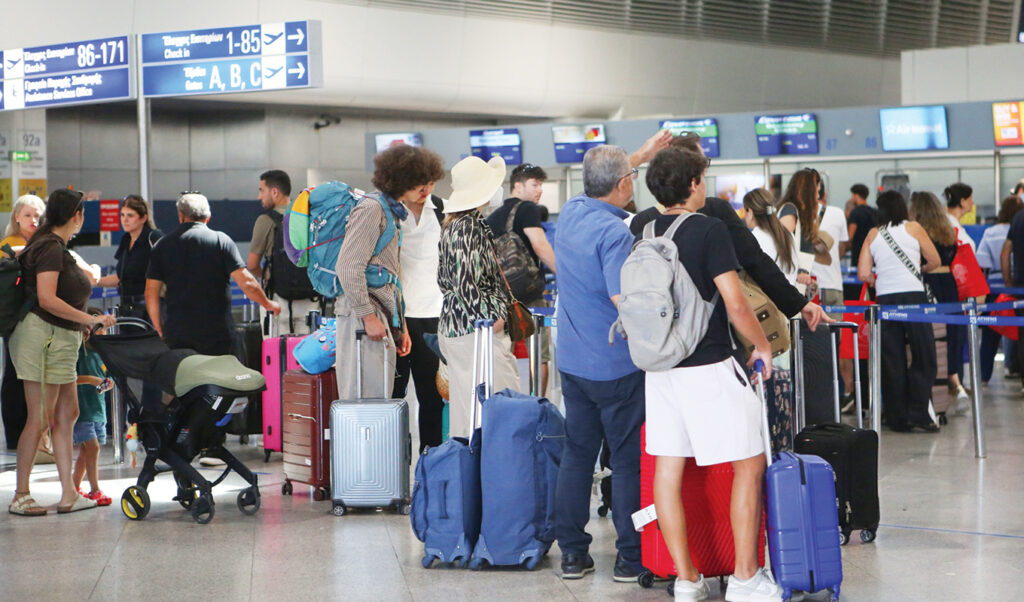
The plane is on the runway, passengers have boarded, but departure keeps getting pushed back. The explanation may lie neither with the airport nor with the airline. A storm over Europe, limited flight handling capacity in a particular airspace, or the late arrival of the same aircraft are all it takes to throw an entire day’s schedule into disarray.
Airports: what’s really behind major delays
Greece finds itself at one of the pressure points where this strain becomes visible. According to Eurocontrol, during the week of September 7–13, the Macedonia and Athens control centres ranked among the five European centres contributing most to en-route delays, measured in delay minutes per flight. Barcelona, Marseille, and Belgrade were also in that top five. This is not a ranking of airports with the most delayed departures — it concerns air traffic management across the airspace.
Each section of airspace can safely handle a specific number of flights. When demand exceeds available capacity, European coordination assigns later take-off slots to certain aircraft. As a result, the wait often happens on the ground, even when the sky above the airport is completely clear.
For the week of September 7–13, Eurocontrol attributes 60% of European en-route delays linked to traffic management restrictions to capacity shortfalls and staffing at control services. Weather accounted for 33%. These figures apply specifically to this category of delays and do not cover every possible reason a flight might arrive late at its destination.
Industry insiders with detailed knowledge of how Greece’s Civil Aviation Authority (CAA) operates note that from August 1 to September 23, flights handled by the Athens and Macedonia control centres increased by 6.2% compared to the same period last year. The pressure is concentrated during peak hours, while the number of available controllers has remained essentially the same as last year, as newly recruited staff are still in training. Additional traffic is routing through Greek airspace due to developments in the Middle East. As they explain, when the system approaches its capacity limits, even a modest increase in flights can trigger a disproportionate rise in delays, with the problem compounding throughout the day. Ground handling times, available parking stands, and restrictions that the next flight may encounter all add further links to the chain. For the passenger, all these different causes appear as a single word on the departures board: “delayed.”
There is, however, a contradiction that should not be overlooked. During the summer of 2026, the European network handled an average of 35,959 flights per day — up 2.4% on the previous year. Despite the higher traffic volumes, delays linked to traffic management restrictions fell overall by 17%, and arrival punctuality improved slightly. Nevertheless, approximately 681,000 flights — 21% of the total — were affected by such restrictions during the June–August quarter.
What Greece needs is not simply to hold on through the peak days. It needs sufficient capacity and staffing when tourist traffic remains high, so that a problem somewhere else in Europe does not translate into lost hours for thousands of passengers here.
Published in MoneyPro by Parapolitika