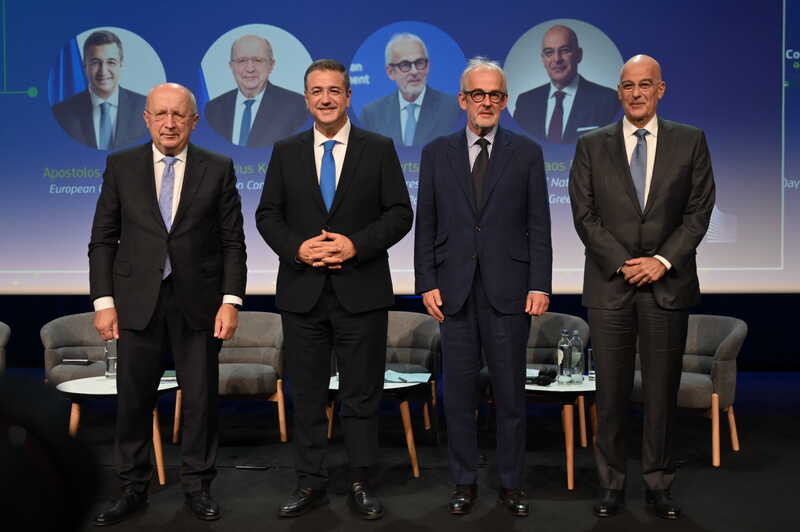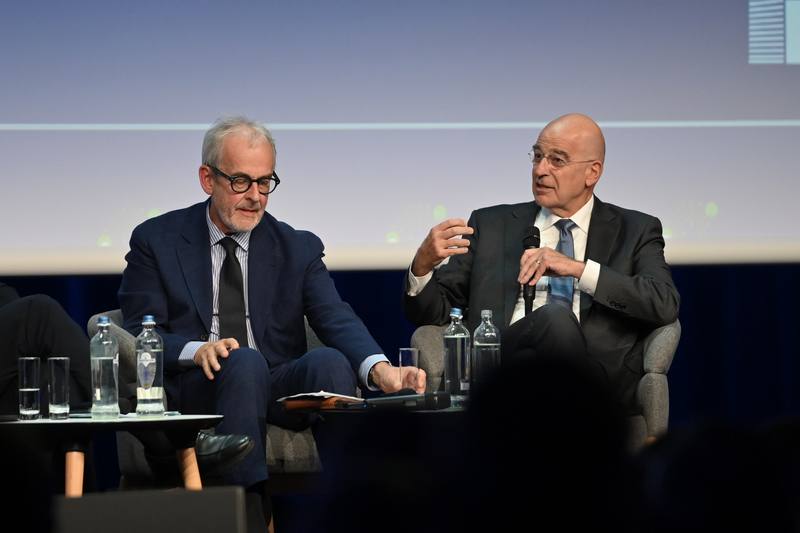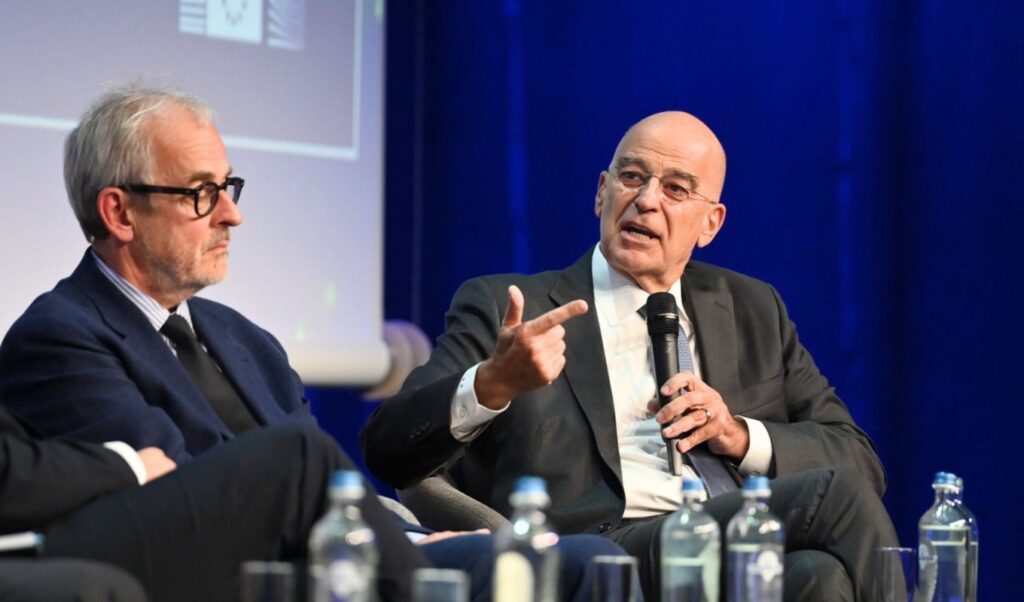
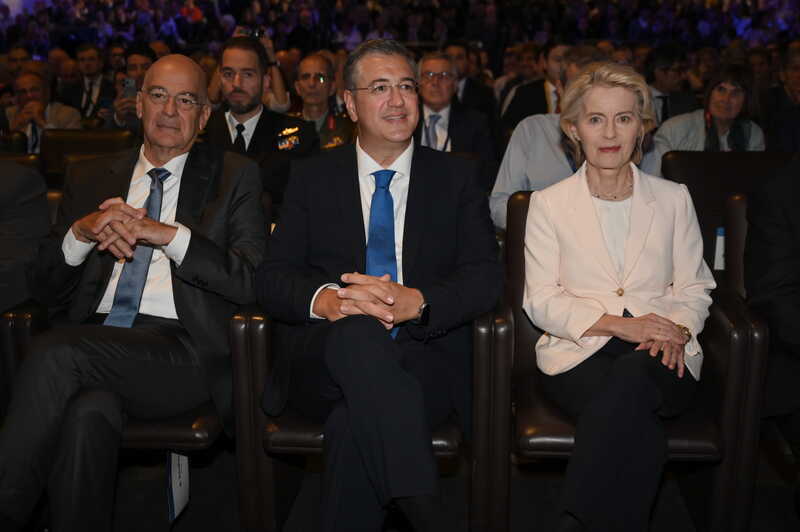
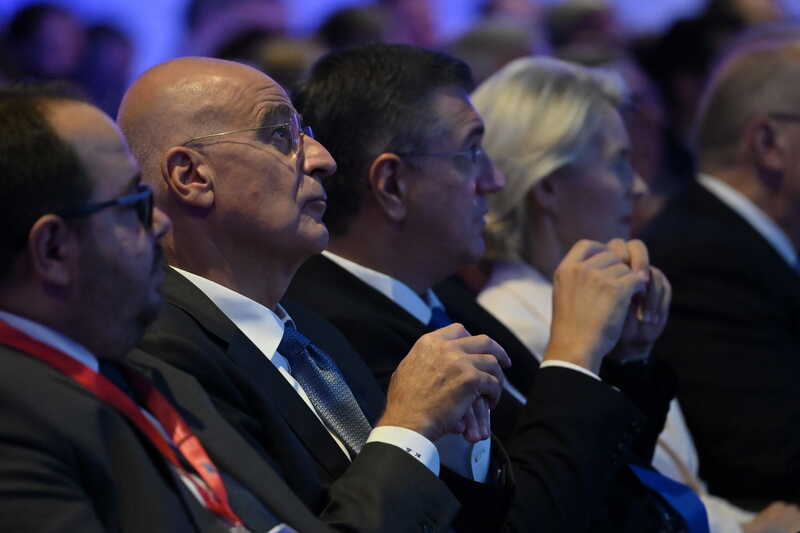
Greek Defense Minister Nikos Dendias highlighted the Turkish threat facing Greece and the urgent need for the European Union to accelerate the strengthening of its defense capabilities — and to build pan-European infrastructure that can be protected in times of crisis. Speaking on the sidelines of a discussion on Military Mobility at the “Connecting Europe Days – Europe’s Mobility and Transport Flagship Event” in Brussels on Tuesday (29/09), Dendias stressed that Europe has fallen behind. “We need to move very, very fast,” he said emphatically, calling for the creation of a “pan-European defense.”
Read also: Dendias: “Greece can serve as a pan-European model for dual-use infrastructure” (Video)
Dendias from Brussels: Turkey is a threat to Greece
The Defense Minister opened by stating: “Greece has our neighboring Turkey, which constitutes a threat to us” — a neighbor with whom coexistence is extremely difficult. He went on to add: “Iran is much closer to us. The Sahel, which today serves as a haven for terrorists, is much closer to us. Libya, a failed state, is much closer to us. Syria was, until very recently, a failed state, and we do not know what course it will take. Lebanon is also very close.”
The Greek “Achilles’ Shield” plan
Against this backdrop, Nikos Dendias described the region as “an exceptionally difficult neighborhood” and presented the Greek “Achilles’ Shield” plan — a comprehensive defense system covering, as he explained, five distinct layers: land, sea, air, cyberspace, and outer space.
Dendias argued that this logic must acquire a pan-European dimension. He raised the question of who would be able to counter a ballistic threat against a small European country — such as Cyprus — if that country does not independently possess the necessary anti-ballistic capabilities. “We need to do this at a pan-European level. That is the only way,” he stressed.
He also warned that tomorrow’s challenges could be even more complex, as capabilities currently held only by major military powers may, through artificial intelligence, fall into the hands of terrorist organizations and non-state actors.
For this reason, he argued that protecting the European project requires “a holistic approach” and cannot be addressed by each country individually. His overall proposal, he noted, goes beyond strengthening the EU Military Committee — extending all the way to the creation of a “pan-European defense.”
“This is how I envision the Europe of the future,” he said, while acknowledging that such a development cannot happen overnight and will come at a significant cost. He nevertheless maintained that it is a coherent idea that could be taken up by Europe’s younger generations.
The strategic importance of Alexandroupolis
Speaking in his capacity as Greece’s Defense Minister, Dendias clarified that he cannot speak on behalf of a European institution. He did, however, propose that Greece be used as a model for the development of European military mobility and resilience.
As he explained, Greece can serve as a prime example, given its proximity to Europe’s main current defense challenge — the Russian invasion of Ukraine. In this context, he underscored the strategic importance of Alexandroupolis, which he described as “the closest port to the Ukrainian front.”
Strengthening resilience and relevant capabilities in Greece — as well as along the corridor connecting the country to the north via Bulgaria, Romania, and Moldova — could, according to the minister, serve as a model for how Europe can simultaneously develop interconnections and corridors while ensuring their protection.
What he said about military mobility and defense
When asked whether Europe is where it needs to be on military mobility and defense, Nikos Dendias began by thanking Greek Commissioner for Sustainable Transport and Tourism Apostolos Tzitzikostas and Commissioner for Defense and Space Andrius Kubilius for the initiative, before offering a brief historical retrospective. He noted that during the 1980s, Europe assumed that NATO — and in practice, the United States — would handle its defense.
After the fall of the Berlin Wall, he added, the notion of the “end of history” took hold, along with the belief that Europe no longer needed to defend itself.
In his view, Russia’s invasion of Ukraine served as a “wake-up call,” bringing Europe back to reality. The new situation, he said, demands the defense of European territory — something that cannot be achieved without the ability to rapidly move forces and equipment.
Dendias: We have fallen behind, so we need to move very, very fast
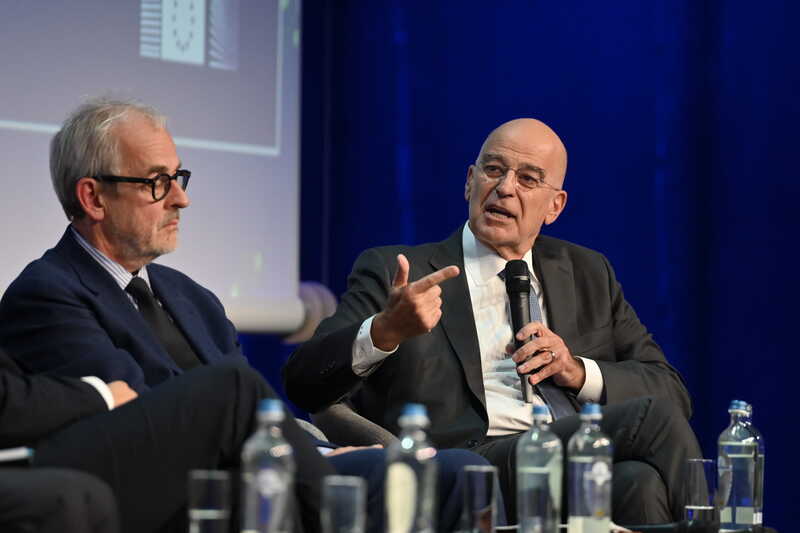
Dendias drew a parallel between military mobility and the historical experience of the Roman Empire, noting that the legions’ ability to move quickly relied on its extensive road network. Today, he pointed out, the European Union — with a population many times larger and an economy of nearly €20 trillion — has fewer kilometers of railway lines than the Romans had roads. Europe, according to Dendias, is now working to close that gap, with an approach that must cover “the full spectrum of threats, across 360 degrees.”
Military mobility, he noted, is not only about the current threat from Russia but also about the challenges of the future. He warned that strengthening European defense will come at a cost — one he described as necessary. “We are doing the right thing. We have fallen behind, so we need to move very, very fast,” was his conclusion.
Asked whether there is sufficient European coordination to make up for lost ground in military mobility infrastructure, Dendias replied that significant work is being done, but not without conditions. He acknowledged the efforts of both Commissioners and placed particular emphasis on the need to factor in the defense of the infrastructure being built. The critical question, according to the minister, is who will be responsible for defending pan-European infrastructure — estimating that “cooperation is already significant, but it must go further, with structures that respond to today’s needs.”


He also dismissed the notion that a stronger European defense structure would compete with NATO. On the contrary, he argued it should function “complementarily to NATO,” which, he said, must remain in Europe and participate in collective defense. In this context, he expressed support for strengthening the EU Military Committee and its work, as well as further empowering the initiatives of the two Commissioners.
When pressed on whether he supports the creation of new European structures, the minister made clear that he is not advocating for new structures, but rather for strengthening existing ones. Specifically, he spoke of transforming the EU Military Committee into an institution with “greater capabilities and more forces.”
When asked whether Europe is at the desired level when it comes to defending its infrastructure, Dendias was unequivocal: “No, we are not where we should be. On the contrary, we are far from it.”
In this context, he proposed that Greece be used as a model for developing European defense capabilities, emphasizing that the country faces a particularly challenging security environment. As he noted, the threat is not limited to Russia and the war in Ukraine — it concerns Europe’s neighborhood as a whole.
Η Ελλάδα βρίσκεται αντιμέτωπη με ένα εξαιρετικά δύσκολο περιβάλλον ασφαλείας. Δεν πρόκειται μόνο για την απειλή που αποτελεί η Ρωσία για το ΝΑΤΟ και την Ευρώπη. Επιπλέον, έχουμε τη γειτονική μας Τουρκία, η οποία αποτελεί απειλή για εμάς. Όλοι έχουμε έναν γείτονα με τον οποίο… pic.twitter.com/NclXjUBtAk
— Nikos Dendias (@NikosDendias) September 29, 2026
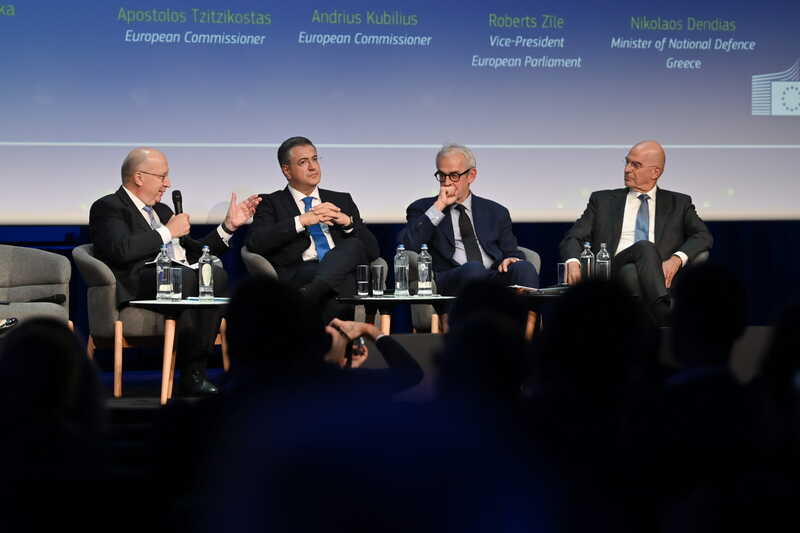
Who participated in the discussion
The event was opened with addresses by European Commission President Ursula von der Leyen and European Commissioner for Sustainable Transport and Tourism Apostolos Tzitzikostas.
Also taking part in the discussion were European Commissioner for Defense and Space Andrius Kubilius, Romania’s Deputy Prime Minister and Minister of Defense and acting Minister of Transport and Infrastructure Radu-Dinel Miruta, and European Parliament Vice-President responsible for Military Mobility Roberts Zile.