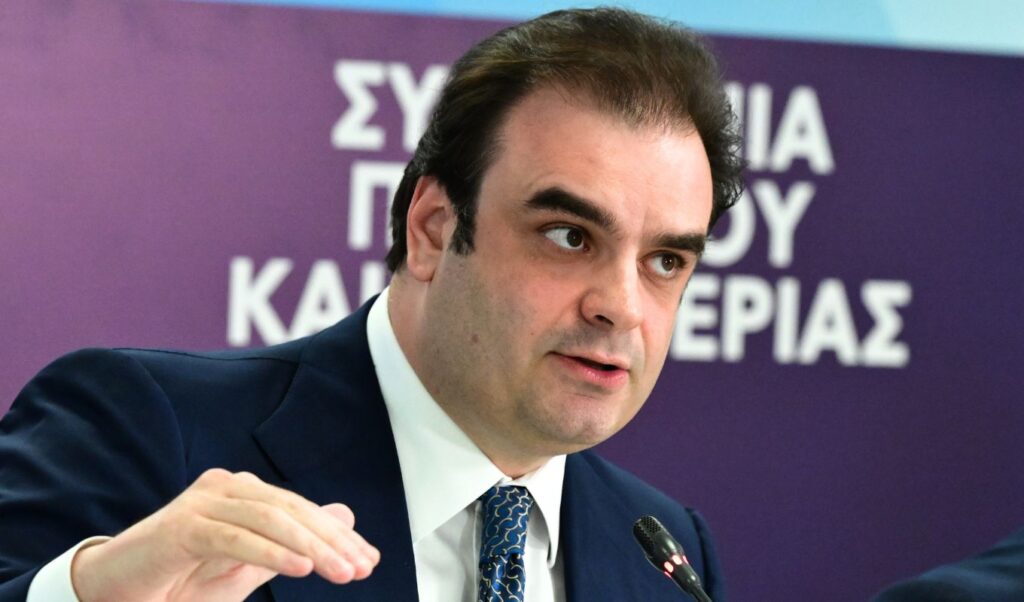
In a social media post, Greece’s Minister of National Economy and Finance, Kyriakos Pierrakakis, offers a detailed breakdown of the «Piggy Bank for the Next Generation» initiative. Through a series of questions and answers, he clarifies how the program actually works — cutting through the misconceptions and myths that have surrounded it since its launch.
Pierrakakis: A guide to the “Piggy Bank for the next generation” — everything you need to know
In the informational video he published, Minister Pierrakakis takes a direct, no-nonsense approach to explaining the state contribution mechanism. He also breaks down the graduated increase in payments and the expected investment returns that will accumulate in this dedicated account until the child reaches adulthood.
The first issue addressed in the presentation concerns the legal and financial nature of the instrument itself. When confronted with the assumption that the Piggy Bank is “simply a savings account,” Pierrakakis answers plainly: “No.” As he explains, “it is a special investment account that parents can open within the first 2 years of their child’s birth, with the goal of gradually building up capital until the child turns 18.” With this clarification, he makes it clear that this is not a static bank deposit, but rather an investment structure with a defined time horizon and age-based eligibility criteria.
How deposits get doubled
The presentation then turns to the state matching mechanism — specifically, the principle that “for every €1 contributed by a parent, the state adds another €1.”
Pierrakakis fully confirms this, stating: “Exactly — €1 from the parent, grandparent, or godparent, and €1 from the state.”
Another key point clarified concerns the annual ceiling on state contributions. When presented with the assumption that “the state contributes up to €1,200 per year and that figure doesn’t change,” Pierrakakis corrects the record: “On the contrary — it does change.” He explains that the initial €1,200 is not fixed over time, but is instead adjusted upward, as “the €1,200 increases by 10% every 5 years.” This periodic increase ensures that the state’s contribution grows dynamically throughout the full 18-year period.
The presentation then examines the total amounts that can be accumulated by the time the child reaches adulthood.
Pierrakakis lays out the precise figures. According to the data he presents, if the maximum contributions are made throughout the full 18 years, the total state contribution amounts to exactly €24,652. He adds that when the corresponding family contributions are included, the combined total of all deposits reaches €49,304.
Pierrakakis dismisses the notion that the benefit is limited solely to the sum of contributions made, answering simply: “No.” As he clarifies, because this is an investment product, “with enhanced returns, the amount could reach €60,000 or even more.” It is this investment upside that allows the final available capital to significantly exceed the nominal value of the deposits made.
Wrapping up his presentation, Pierrakakis articulates the fundamental goal of the “Piggy Bank for the Next Generation” — to provide “a strong financial head start for every child.” Summing up the philosophy behind the measure, he concludes with a memorable line: “We are not borrowing from our children’s future — we are investing in it.”