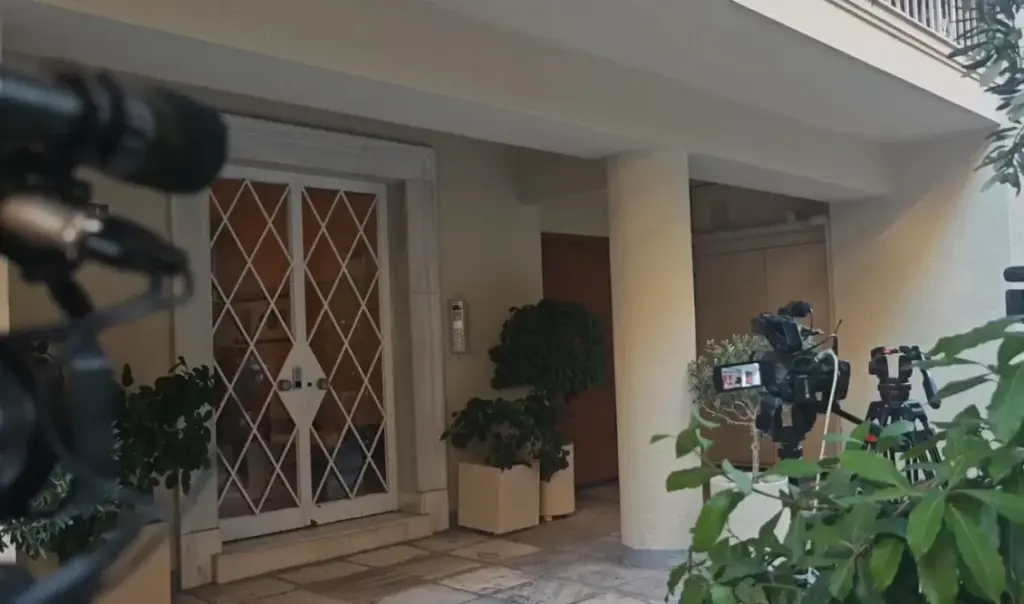
New details have emerged about the inspections carried out at the private clinic where Giorgos Mazonakis lost his life, along with a series of issues now coming to light in the wake of the tragedy. Polytimi Leonardou — a member of the Board of Directors and chair of the Audit Committee of the Athens Medical Association (ISA), as well as former Deputy Regional Governor of Attica for Social Policy and Cultural Development — spoke exclusively to parapolitika.gr to reveal what inspectors found both before and after the singer’s death.
Read also: Georgiadis on the Kolonaki clinic: “It had been operating for 15 years — I will ban all these misleading online advertisements”
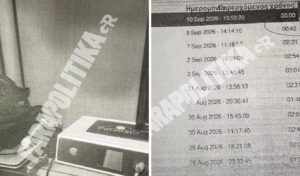
Ms. Leonardou, who personally took part in inspections at the clinic on Karneadou Street, walks through the full timeline of site visits conducted before the popular artist’s death — and describes what inspectors found when the team returned to the premises after the tragedy. She speaks of irregularities identified as far back as July 2025, a centrifuge machine that had been ordered removed yet was discovered hidden in a wardrobe during the post-death inspection, and a second, brand-new centrifuge machine that was also found on site.
At the same time, the chair of the ISA Audit Committee is unequivocal: plasmapheresis was not legally permitted to be performed at this clinic. She also raises another critical concern — according to findings from the inspections, patients undergoing the procedure had not been given a prior cardiological assessment.
Beyond the specific findings at this clinic, Ms. Leonardou uses this interview with parapolitika.gr to open a broader conversation about gaps in the inspection framework, so-called holistic and alternative therapies, the promotion of medical procedures through social media, and the urgent need for coordination among all competent regulatory bodies.
Giorgos Mazonakis’ death: the irregularities identified as early as July 2025
Inspections at the clinic had begun long before Giorgos Mazonakis’ death. As Ms. Leonardou reveals to parapolitika.gr, an inspection carried out in July 2025 uncovered irregularities relating to the declared use of the premises, and a centrifuge machine was found on site — one that inspectors ordered to be removed.
“In 2025, an inspection had taken place in July. Some irregularities were found regarding the declaration of the premises and regarding the centrifuge machine. We asked for all of this to be corrected,” she states.
The inspection team attempted a follow-up visit in September, but the clinic was closed and no one was found on the premises. Another inspection followed in November. “In November we found Mr. Theodoropoulos and everything seemed to be in order,” she notes. According to her, the centrifuge machine that had been flagged in July and ordered removed was not present during that follow-up visit.
After the death, the machine ordered removed was found again
Following Giorgos Mazonakis’ death, a new inspection of the clinic was conducted — and it produced a particularly significant finding. The centrifuge machine that had been ordered removed since July 2025 was discovered on the premises once again.
“In a previous inspection, no plasmapheresis machine had been found. The centrifuge machine had been found, which we had asked to be removed, and in the end we found it hidden in the wardrobe during the new inspection carried out after Giorgos Mazonakis’ death,” the chair of the Audit Committee states.
She also clarifies that no plasmapheresis machine had been identified during any of the earlier inspections.
A second, brand-new centrifuge machine
The post-tragedy site inspection also produced another finding. As Ms. Leonardou reveals to parapolitika.gr, a second, brand-new centrifuge machine was discovered on the premises — covered with styrofoam packaging. These details take on particular significance in the context of the ongoing investigation into exactly what was taking place at the clinic and under what conditions the disputed procedures were being performed.
“Plasmapheresis was not legally permitted at this clinic”
Ms. Leonardou is categorical when asked whether plasmapheresis could legally have been performed at this location. “Plasmapheresis is a procedure that has specific medical indications and is carried out in hospitals, not private clinics,” she stresses. She adds: “Plasmapheresis was not legally permitted at this clinic — just as it is not permitted at any private clinic.”
She emphasises that this is a medical procedure performed for specific conditions, not a wellness practice. “There are conditions for which this method is legally permitted. It is not a wellness or lifestyle method,” she underlines.
“No cardiac screening was being carried out”
Another serious concern raised by the chair of the ISA Audit Committee relates to the absence of cardiological assessment prior to the procedure. According to her, no cardiac examination, electrocardiogram, or thorough cardiological evaluation was being carried out on patients before they underwent the treatment.
“It was not being done, and I asked about it many times, because I consider it unacceptable to subject a patient to an extracorporeal procedure such as plasmapheresis without even having carried out a cardiological assessment,” she states.
Ms. Leonardou explains that precisely because of the potential for serious complications, such a procedure must take place in a hospital setting. “It is a procedure that is performed in hospitals, where there is the capacity for intubation or even an ICU bed, in case something goes wrong,” she points out.
The gaps this case has brought to the surface
For the chair of the ISA Audit Committee, the case no longer concerns only what was happening at this particular clinic. It highlights a far broader issue: how thousands of private clinics are monitored, and how medical procedures advertised online and through social media are regulated. As she explains, the Athens Medical Association is responsible for overseeing approximately 15,000 clinics and 28,000 doctors, while having only eight three-member audit committees at its disposal.
“The Medical Association is doing everything humanly possible, with the staff it has and the audit committees it has,” she clarifies. “It is not possible for us to cover all of these irregularities. We cannot put cameras behind closed doors.”
“There is a massive problem here”
Ms. Leonardou also draws particular attention to the advertising of medical procedures online. “We oversee 28,000 doctors, but also non-doctors who set up companies, carry out medical procedures, and advertise them on the internet. There is a massive problem here, and many bodies are involved,” she notes.
She argues that addressing the problem cannot be the responsibility of the Medical Association alone — it requires collaboration across multiple regulatory bodies. “All of these bodies need to work together in order to fix what is broken. But this is not solely the responsibility of the Medical Association; many bodies are involved,” she continues.
She also reveals that as far back as 2020, the Athens Medical Association had already requested that the Ministry review the regulatory framework concerning medical advertising and social media.
The murky landscape of holistic and alternative therapies
Another dimension Ms. Leonardou highlights concerns so-called holistic and alternative therapies and the framework within which they are provided. Referring to Ms. Gaka, she notes that she “claims to be a holistic doctor,” adding: “There is no institutional framework. In general, there is a big question mark over what this means, who is legally entitled to practise it, and what medical ethics apply. All of this needs to be examined from the ground up.”
According to her, this re-examination must be carried out “collectively.”
“Let this tragedy be the catalyst for bringing order to this disorder”
In light of everything that has come to light, Ms. Leonardou believes the Giorgos Mazonakis case can serve as the catalyst for a broader institutional conversation. “It is an opportunity. Beyond the good this man did — because from what I hear, he quietly did a great deal of good for many people — and the reputation he had, this will also help bring order to this disorder,” she says emphatically.
She explains that the ISA proceeds with formal action when a written and officially logged complaint is submitted, and can also act when information about potential irregularities comes to its attention. In the case of this particular clinic, she maintains, no information or complaint regarding the use of plasmapheresis had previously been brought to the ISA.
The tragedy of Giorgos Mazonakis has therefore not only opened a judicial and forensic investigation into the precise circumstances of his death. It has simultaneously brought to the surface a far larger conversation — about practices marketed as wellness methods, the way in which they are provided and advertised, the limits of regulatory oversight, and the gaps in an institutional framework that is struggling to keep pace with a rapidly changing reality.
And that, perhaps, is the most important issue Ms. Leonardou raises: in the aftermath of this tragedy, the discussion is no longer only about what happened behind the door of one particular clinic — but about what must change so that such practices can be regulated more effectively and with clear, enforceable rules.