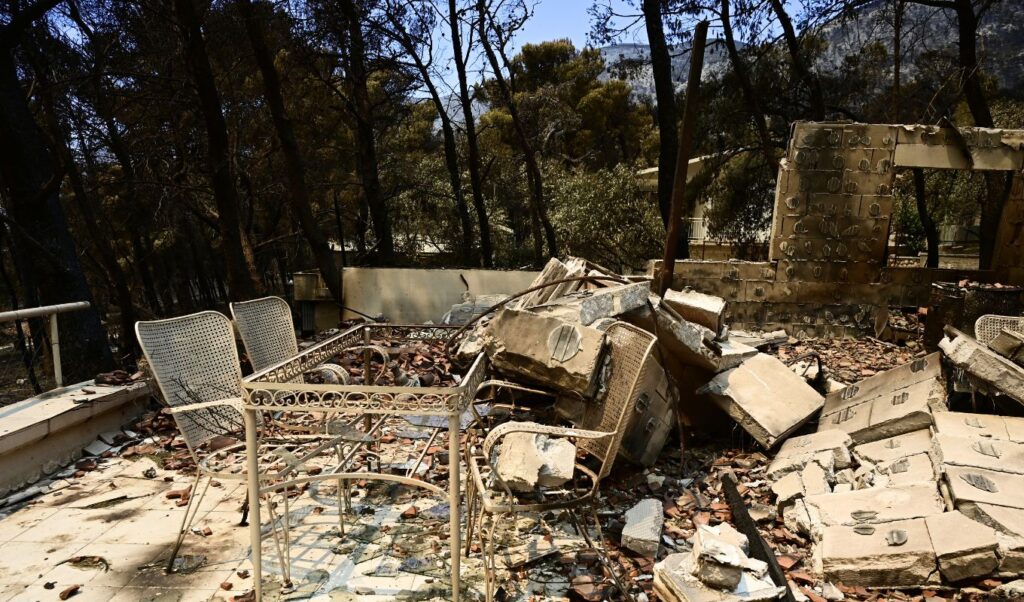
A subsidy of up to €500 per month will be provided to victims of this year’s devastating wildfires, designed to cover their immediate housing needs. This temporary housing subsidy is intended for owners or occupants of properties deemed uninhabitable or dangerous as a result of natural disasters.
Wildfires: Who qualifies for the housing subsidy
Specifically, regarding temporary housing assistance for natural disaster victims:
– A temporary housing subsidy is granted to occupants of primary residences that have sustained damage from the natural disaster, in order to cover their temporary housing needs. The terms, conditions, required documentation, and application procedure are defined in Joint Ministerial Decision No. 67959/ΓΔΑΕΦΚ-ΚΕ/Α36/30.10.2025 (Government Gazette B’ 5926).
The temporary housing subsidy is provided in the form of a “rental subsidy” — when the affected resident rents another property in the same or an adjacent Regional Unit as the damaged home — or as a “co-habitation subsidy” — when the resident is hosted in the primary residence of another person within the same or an adjacent Regional Unit. The co-habitation subsidy amounts to 50% of the rental subsidy.
– Eligible recipients of the rental or co-habitation subsidy include: Owners or users of rent-free properties used as primary residences, which — due to damage sustained from the natural disaster — have been classified by inspection teams of the General Directorate for Restoring Natural Disaster Consequences (GDAEFK) as temporarily unfit for use (“YELLOW”) or dangerous for use (“RED”), provided they do not own or have access to a vacant or secondary residence within 25 km of the damaged property.
An additional condition is that the damaged residence must be demonstrably occupied prior to the natural disaster and demonstrably uninhabited following it.
Subsidy start date
Citizens whose primary residences are classified as temporarily unfit for use (“YELLOW”) or dangerous for use (“RED”) may rent alternative accommodation or be hosted elsewhere, with the subsidy start date being the date the hosting arrangement or rental agreement begins — which may be as early as the day following the natural disaster.
The amount of the rental subsidy is determined based on the number of people permanently residing in the damaged property. It is disbursed on a quarterly basis and is set at €300/month for one (1) person, increasing by €50/month for each additional co-resident, up to a maximum of €500/month (the co-habitation subsidy is equivalent to 50% of the rental subsidy amount).
The number of co-residents is increased by one for each occupant of the damaged property who is a person with a disability, with the maximum cap remaining at €500/month.
The subsidy is granted for a maximum period of two years for property owners or users of rent-free residences, and for up to six months for tenants of damaged properties — and only in the form of a co-habitation subsidy.
What eligible recipients need to do
Following the issuance of the relevant Joint Ministerial Decision (JMD), affected citizens are required to submit an application for the temporary housing subsidy to the competent GDAEFK authority within a specific deadline to be defined in that JMD, attaching the following documents:
- A copy of the on-site inspection report issued by the General Directorate for Restoring Natural Disaster Consequences (GDAEFK) for the affected primary residence,
- Tax forms E1, E2, E9 and ENFIA for the most recent tax year, for both the applicants and all co-residents,
- Proof of timely submission of the Rental Property Information Declaration relating to the rented property, submitted after the fire (required in cases of rental subsidy),
- Relevant statutory declarations (forms are attached to Government Gazette 5926/B/5.11.2025),
- In the case of persons with disabilities, a certification from a Disability Certification Centre (KEPA) confirming a disability rating of at least 67%.