“Lower installments, less burden, faster repayment. This is what the new debt settlement arrangement provides for loans under Law 3869/2010,” stated Minister of National Economy and Finance Kyriakos Pierrakakis in a social media post. “Our goal remains to give citizens room to breathe — especially those who need it most,” the minister added.
Read also: Pierrakakis: “The legislative arrangement for Katseli Law loans affects more than 100,000 of our fellow citizens”
Pierrakakis on the Katseli Law: “The court ruling doesn’t compel us to do this — we’re doing it on our own initiative”
In a video accompanying his post, the Minister of National Economy and Finance explains how the new arrangement will work, which he is advancing through an amendment to a wide-ranging omnibus bill on private debt and support measures for citizens and businesses:
“First, we take the Supreme Court ruling and apply it universally. That means it applies to everyone with active debt settlement arrangements. But we’re not stopping there. For those with an active arrangement, we are declaring that payments already made fall under this specific ruling and the amendment we are introducing — and they apply retroactively. This, I should point out, is not something the court ruling requires us to do. We are doing it entirely on our own initiative,” the minister emphasized. He further stressed that “this will apply to everyone with active arrangements. How many people does this affect? More than 100,000 of our fellow citizens. And this is exactly what we had said we were studying and would implement very quickly.”
Using a concrete example, Kyriakos Pierrakakis illustrated what this change means in practice: “Take a borrower — let’s say from January 2024 — who had an outstanding debt of €144,500. Under the previous calculation method, they would have been paying a monthly installment of €731 for 300 months. What changes now? Under the new calculation method, the installment drops to €483 — of which €482 goes toward principal repayment and just €1 toward interest. If that borrower had been paying €731 from January 2024 through to June 2026, they will have overpaid for 30 months by the difference: €731 minus €483, multiplied by 30. That comes to approximately €7,500 — specifically €7,440. As a result, instead of having 270 installments remaining, that overpaid amount is deducted from their future payments. They will ultimately pay 255 installments of €483. In other words, where that borrower was originally facing total interest payments of €74,852, they will now pay just €411 in interest — to give you a sense of the difference.”
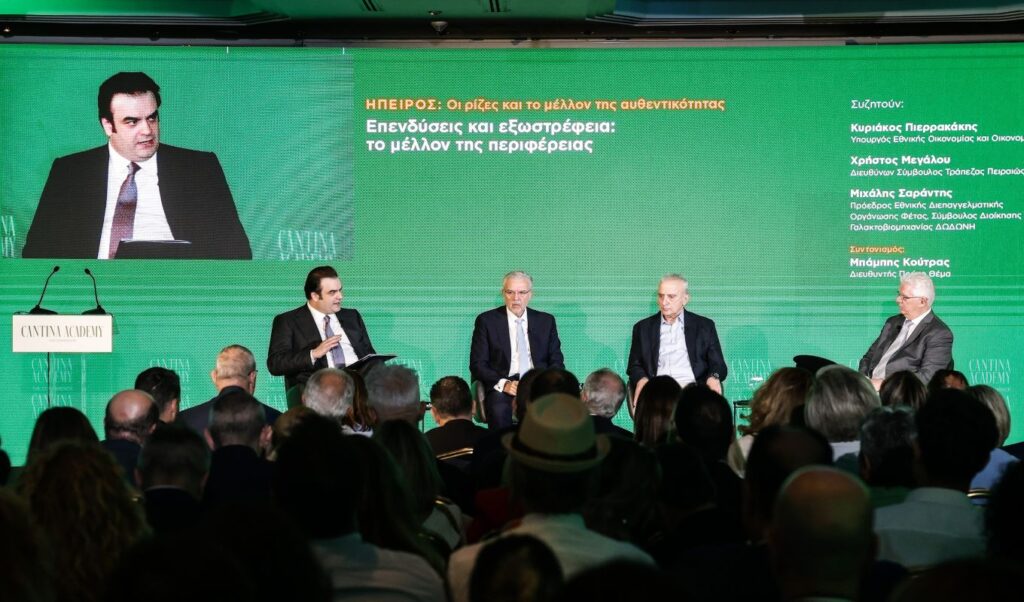
Pierrakakis concluded with a political remark in the same video, delivered during his address at the “Cantina Academy” conference on the theme “Epirus: The Roots and Future of Authenticity,” organized by Proto Thema and Cantina Magazine. As he stated, “While I’ve recently been listening to the opposition’s commentary — with the opposition seizing yet another opportunity for political exploitation — we view this as an obligation of political responsibility, not an opportunity for political gain. And that is precisely what sets us apart, and will continue to set us apart,” said the Minister of National Economy and Finance.
Kyriakos Pierrakakis’ full post: