Strong international interest continues to be one of the key pillars supporting the Greek real estate market, which maintains its upward trajectory — albeit at a more moderate pace compared to previous years. According to data from Spitogatos, Greece continues to attract buyers from abroad, while property prices remain on an upward trend despite a decline in transaction volumes.
Who is buying Greek property and what are they spending?
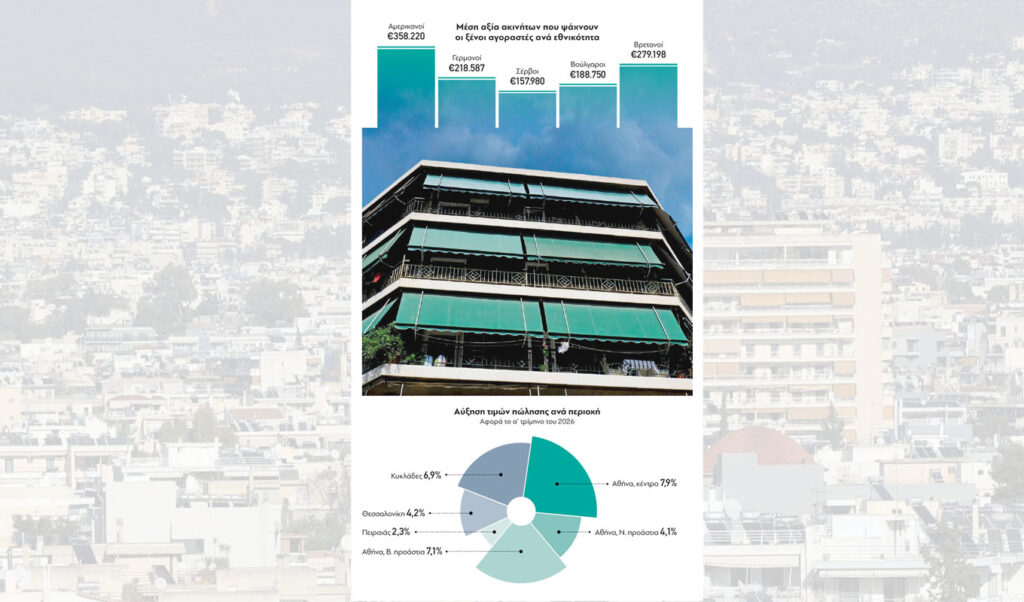
Data for the first quarter of 2026 shows that the five countries with the highest demand for residential property in Greece are the United States, the United Kingdom, Germany, Bulgaria, and Serbia. Americans emerge as the most high-spending buyers, with an average target property value of €358,220. They are followed by British buyers, with an average budget of €279,198, and German buyers at €218,587. Buyers from Bulgaria and Serbia operate at lower price points, seeking properties with average values of €188,750 and €157,980, respectively. This picture reflects Greece’s enduring appeal both as an investment destination and as a second-home market, with Western buyers predominantly targeting higher-value properties. At the same time, the Greek residential market continued to record increases in average asking sale prices. During the first quarter of 2026, prices rose by 7.9% year-on-year, compared to an 8.8% increase recorded during the same period in 2025. This development confirms that the market remains on a growth trajectory, though the rate of price increases is now more restrained than in previous years. A similar picture emerges in the commercial property segment, where average asking sale prices rose by 5.1% — below the 7.8% recorded a year earlier. Land, by contrast, was the only category to move downward, with asking prices falling by 1.7%, compared to a 1.5% increase in 2025.
A regional breakdown
At the regional level, central Athens continued to be among the market’s top performers, with average asking residential sale prices rising by 7.9%. While this falls short of the 11.7% increase recorded a year earlier, it still underscores the area’s enduring appeal. The northern suburbs also remained strong, with prices rising by 7.1% — nearly in line with the previous year.
In the southern suburbs, price growth slowed to 4.1%, pointing to signs of stabilization following a prolonged period of sharp appreciation. Similarly, Piraeus recorded a modest increase of just 2.3%, significantly below the 7.1% logged in 2025, while Thessaloniki continued on an upward path with a 4.2% rise, compared to 12.5% the previous year. The Cyclades, on the other hand, maintained their momentum, with average asking prices rising by 6.9% — keeping them among the strongest performers in the Greek market.
In the residential rental segment, average asking prices also continued to climb, though at a slower pace. Nationally, rents rose by 4.2%, compared to 6.7% during the same period in 2025. Central Athens posted the strongest increase, with rents rising by 6.9%, confirming its position at the heart of demand. In the southern suburbs, rental growth came in at 3.2%, while the northern suburbs remained almost flat at 2.6%.
Piraeus presented a notable shift, with asking rental prices falling by 1.8% — reversing the 5.7% increase seen previously. An even sharper decline was recorded in the Cyclades, where rents dropped by 7% after a 12% rise in the prior period. Thessaloniki, despite a significant slowdown compared to past performance, continued to see rental prices increase by 5.1%.
Despite the continued rise in prices, the data suggests that the market is gradually entering a more mature phase. Residential sales transaction volumes fell by 13.35% year-on-year, while demand — as reflected in searches across Spitogatos platforms — increased by 12%. This divergence highlights that interest in the market remains strong, yet completing transactions is becoming increasingly challenging due to higher prices, limited supply, and financing difficulties. The overall picture for the first quarter of 2026 confirms that the Greek real estate market continues to grow, with international demand remaining robust and prices pressing higher. However, the slowing rate of price increases and the decline in transaction volumes suggest the market is now transitioning into a more balanced and mature phase, following years of intense appreciation.
Published in MoneyPro by Parapolitika