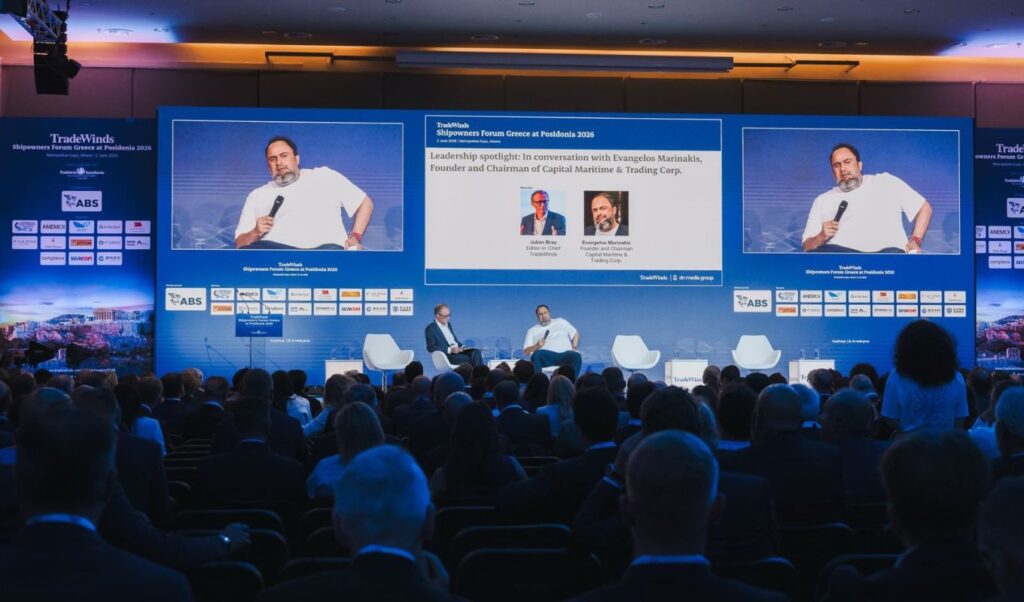
“Better transit fees of $100,000 or $200,000 than closed Strait of Hormuz,” stated Vangelis Marinakis in his discussion with Julian Bray about all the burning issues in shipping, during Posidonia 2026. The Greek shipowner outlined to the Tradewinds Editor-in-Chief the immediate impacts on maritime transport.
Vangelis Marinakis: Crew safety takes center stage
Referring to crisis management in the Middle East, Mr. Marinakis revealed that he immediately decided not to risk any accidents or loss of life, putting safety above the high risk premiums offered for passage through the Strait of Hormuz. “We made the decision not to sail in that specific area. We couldn’t take such a risk and have something happen, especially not have any loss of life,” he stated characteristically.
The day after
Regarding the aftermath following the end of the war and the market’s return to normalcy, Mr. Marinakis appeared extremely cautious, warning the industry to manage its expectations. “Unfortunately, historically in shipping, when we have great expectations we face the greatest crises. Of course, there are expectations. It’s natural, because we have many stocks that are almost depleted and it’s logical to believe that as soon as this treaty is signed, everyone will rush to replenish their stocks… We need to be present in the region, but we may not see the freight rates we have in mind. It’s something that will be built slowly and conservatively,” he responded among other things to the relevant question.
At the same time, he argued that with oil prices at $80-90 per barrel, stock replenishment will be extremely expensive for economies. Mr. Marinakis also emphasized the issue of changing consumer habits and trends, highlighting that the energy crisis forced the world to get used to consuming less energy. This behavioral change, as he said, doesn’t reverse overnight, a fact that will delay the market’s full return to pre-crisis normal levels.
Transit fees preferred
When asked whether the aftermath would bring permanent financial burdens, such as the imposition of transit fees by regional countries, Mr. Marinakis clearly favored such a possibility, provided the area becomes secure.
“Even if we had to pay a fee, it would be much better than having the Straits closed. Also, we must calculate that all these years we’ve been paying additional ‘war risk’ expenses without there being war. So, if you calculate how much money we’ve paid so far, sailing in and out of the Arabian Gulf or even in the Red Sea area without there being actual war, it would be better to pay a fee of $100,000 or $200,000, depending on the cargo size and ship size, and not have all this disruption,” said Mr. Marinakis, emphasizing that such revenues could be directed toward restoring the damage caused by war to basic infrastructure.
The impressive course of Greek shipping
Regarding the impressive course of Greek shipping, Mr. Marinakis stated in his remarks: “Greece is a small country, a poor country, that nevertheless achieves all these miracles in shipping. Why? Because there’s no state intervention. Thus, we compete worldwide with freedom.
And we have achieved what we’re discussing here today. Therefore, where governments stay away, we overperform. We see that where there’s intervention, there’s a big problem.” Concluding, Mr. Marinakis noted that “the role of shipping is more important than ever, and that’s why we must feel much more responsible for what we do and perform as best as we can.”