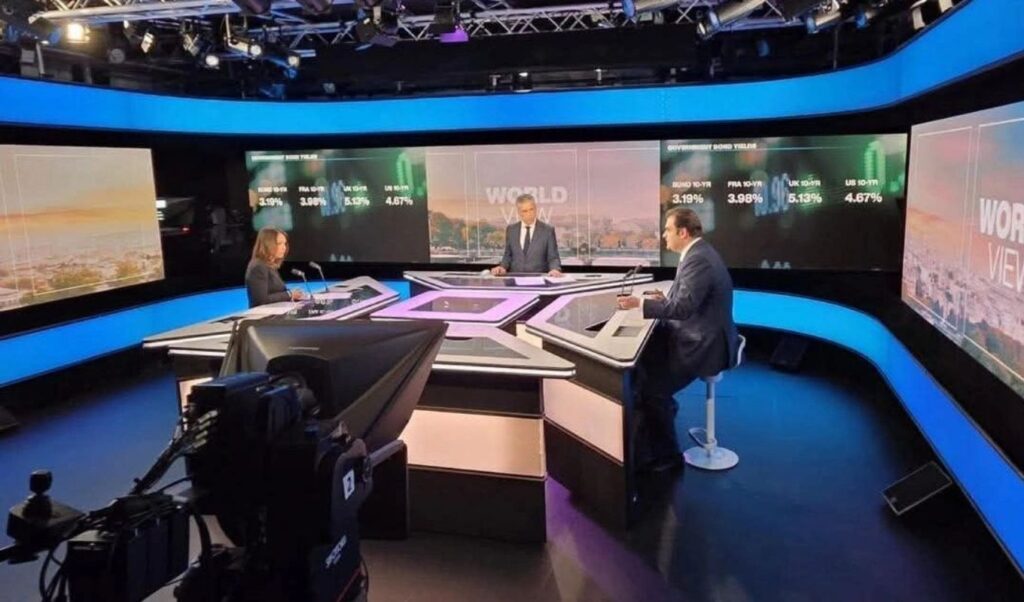
“Without production there is no European power”, stated the Minister of National Economy and Finance and President of the Eurogroup, Kyriakos Pierrakakis, on France 24. Additionally, Kyriakos Pierrakakis emphasized that “we need investments in electrical networks, innovation and a truly unified European energy market”, with the Eurogroup President calling for the creation of Europe’s own Silicon Valley.
Pierrakakis on the Middle East crisis and the Strait of Hormuz
Regarding the Middle East crisis, Mr. Pierrakakis reiterated that the European Commission has established that measures taken by member states must be temporary, targeted and adapted to each situation’s needs. Emphasizing that the Strait of Hormuz must be opened and not transformed into a toll road, he added that “we must act daily, in a coordinated manner, and have a complete picture of developments“. He also outlined three parameters regarding the crisis: “First, as politicians and policymakers, we know we must support businesses and households, because there are people who are deeply affected by this crisis and watch our decisions with anxiety. Second, we must ensure that the energy crisis does not evolve into a fiscal crisis. Third, the decisions we make in the short term deeply affect long-term developments“. Finally, he called for Europe to accelerate its moves, such as in banking union and capital markets integration.
Full interview of the Minister of National Economy and Finance and President of the Eurogroup Kyriakos Pierrakakis on France 24 with journalists Yuka Royer and François Picard
Question: Mr. Pierrakakis, thank you again. You are the president of the Eurogroup, which includes the 21 members of the eurozone, the single currency zone of the euro. The effective closure (of the Strait of Hormuz), as we just heard from the French minister, and the tensions around the Gulf are already causing tremendous impact on the global economy. High energy prices have now pushed general inflation in the eurozone upward in April, mainly due to increased energy costs. What will policymakers put on the agenda next?
Kyriakos Pierrakakis: First, allow me to say that I am very happy to be with you and that we had a very interesting G7 session. The French G7 presidency is doing excellent work. What I would like to say is that there are geopolitical dividing lines that we need to discuss and for which we need to develop a common vocabulary among us.
And, naturally, at the European level we must do exactly what your question implies. We must implement a series of policies that are coordinated, orchestrated and effective. To a very large extent, this is exactly what we were discussing with the International Monetary Fund. We saw what applied in 2022, when Russia invaded Ukraine. Some policies worked, others did not. So now we have a ready toolkit. Have we already activated it? To a very large extent, yes.
The European Commission has established that measures that work must be temporary, targeted and adapted to each situation’s needs. In many eurozone countries we are implementing exactly these measures. Therefore, everything depends on how this crisis will evolve. I agree with my good friend, Roland Lescure. The Straits must be opened. They must not be transformed into a toll road. However, the duration of the crisis, its intensity and the regime of the Strait of Hormuz after the end of the crisis will determine exactly the final outcome. Needless to say, we are closely monitoring the situation, but we know we must act daily in a coordinated manner and have a complete picture of developments.
Question: Now coordinated efforts are required. We agree on that. However, there are disagreements. US Treasury Secretary Scott Bessent called on the European Union to participate in the US effort to dismantle the financial networks supporting the Iranian regime, critically noting that the United States sometimes finds itself alone in this effort. What do you have to say about this?
Kyriakos Pierrakakis: First, we are part of the solution and not part of the problem regarding the Strait of Hormuz. What you just described falls within the framework of a broader initiative taking place here in Paris, at Bercy, which was undertaken by the French G7 presidency: how to stop the financing of terrorism.
All of us, therefore, are part of the solution and we are determined to contribute. However, what we understand, and which we all realize, is that certain issues exceed the capabilities of a single country, even the largest and most powerful country in the world. There are issues that require multilateral cooperation. And I am happy to say that, within the framework of the meeting – I cannot, as you understand, refer explicitly to what was discussed – the spirit of the discussions was constructive and positive.
There is understanding that in most of the issues we are trying to address today, whether it concerns the energy crisis we face and its geopolitical extensions, or artificial intelligence and how we will regulate it, following recent developments around Anthropic’s Mythos, we need a more multilateral cooperation framework. And this is happening at a time when, to be honest, the very concept of multilateral cooperation is being questioned. However, there is common understanding that certain issues make greater and deeper coordination among us necessary.
Question: Multilateral cooperation is a key word, because in 2008, faced with the financial crisis, everyone had to move in the same line. Times are different in 2026. On Friday, Donald Trump is set to personally swear in the new president of the Federal Reserve. Trump has repeatedly criticized high interest rates, while inflation remains. Do you see a divergence forming between European Central Bank policy and that of the Federal Reserve?
Kyriakos Pierrakakis: First, because you asked me about interest rates, for us interest rates and interest rate policy are inextricably linked to the independence of the European Central Bank, which we must safeguard and protect.
Question: And what will happen if the Federal Reserve is no longer independent?
Kyriakos Pierrakakis: The Federal Reserve has institutionally guaranteed independence, as provided by the institutional architecture of the US federal government. However, what I can tell you is what our own policy is.
The transatlantic relationship, which relates to the issue you raised, but also to many other issues – I mentioned artificial intelligence earlier – is, in my opinion, a relationship of existential importance. And it is a relationship that must far exceed the conjuncture, the rhetoric of the moment or the current topic of the day.
Question: What will happen if interest rates rise in Europe and fall in the United States?
Kyriakos Pierrakakis: If, or when something like that happens, further economic discussions will follow. I will not comment on such a possibility in advance. It is something we will evaluate based on actual data.
What I can say overall about our relationship is that, within the G7 framework, we just had meetings with our counterparts from the United States and Japan. We tend to overdramatize the present and underestimate the future, even the near future. There is, however, common understanding that, due to the seriousness of the issues we discuss and for which we seek solutions, we need better coordination among us.
And I believe this need becomes increasingly apparent as the issues we face become more difficult, whether concerning critical raw materials, artificial intelligence, or how to address the crisis in the Strait of Hormuz. We understand that the implications are global and, therefore, the required solution is inherently global.
Question: Could today’s crisis affect the long-term plans of the European Union and the Eurogroup, such as banking union and capital markets integration?
Kyriakos Pierrakakis: Yes, certainly, and indeed it must affect them. Because, if we examine what the International Monetary Fund told us in a recent Eurogroup session, where it presented an assessment of actions Europe undertook from 2022 onwards, the conclusion was that measures adopted from 2022 reduced the impact of today’s crisis by 12% compared to a scenario where no measures had been taken then. That is, diversification from Russian energy sources and investments in energy infrastructure yielded substantial results.
Therefore, we must do even more at the European level. We must produce more. For Europe, a simple axiom applies: without production, there is no power. We must understand that we owe it to ourselves to put our European affairs in order. And this has significant implications for energy policy: more energy storage, more investments in electrical networks, more innovation and a broader, truly unified European energy market.
This constitutes a first package of solutions that we must definitely examine and implement. However, there is also the Savings and Investment Union, which we have been discussing for years. We had approached it in the past through the Capital Markets Union and Banking Union, as you correctly pointed out. If we combine all these elements, what emerges is essentially what Europe needs today.
We continue to operate in a fragmented environment of 27 separate capital markets and we do not fully utilize this dynamic. We do not adequately channel savings toward investments. And this is critical both for economic development and for financing the energy transition.
We know this. European leaders know it. Europe’s finance ministers know it. I can assure you of that. Today, the challenge is implementation. Everything has already been documented in the European Union’s strategy texts, whether it concerns the Draghi report or the Letta report. We know very well what we need to do. Now we are in the implementation phase.
Question: With inflation rising and many households struggling to cope with increased cost of living, it might be difficult to ask citizens to invest more. Is it really the right time to invest instead of keeping money in cash?
Kyriakos Pierrakakis: This is undoubtedly a challenge, because right now we must keep in mind three basic parameters. First, as politicians and policymakers we know we must support businesses and households, because there are people who are deeply affected by this crisis and watch our decisions with anxiety.
Second, we must ensure that the energy crisis does not evolve into a fiscal crisis. You saw today’s developments in bond markets. To a very large extent, these movements reflect the uncertainty caused by developments in the Strait of Hormuz. At the same time, we know well that economic policy must take into account the functioning and messages of the markets.
Third, the decisions we make in the short term deeply affect long-term developments. We need only remember the oil crisis of the 1970s. Many decisions of that period had a permanent imprint: the development of nuclear energy, especially in France, the intensification of oil research in the North Sea and the creation of the International Energy Agency. During the same period, Europe developed a long-term dependence on Soviet, and later Russian, energy sources. Some consequences of that energy crisis were positive, others proved negative.
That is why we must ensure that what we do today to address the current crisis will be compatible with Europe’s long-term ambitions.
The critical question for Europe is whether we can enhance our sovereignty, not necessarily our autonomy, as autonomy does not fully coincide with sovereignty. We must understand how to become more sovereign, whether in technology or overall in our ability to project power. As I said earlier: without production, there is no power. We must strengthen our productive and strategic capabilities and move quickly to implement this strategy.
Question: Returning to artificial intelligence, we saw earlier this year the capabilities – and potential implications – of methods developed by Anthropic, which could cause collapse of global financial markets within seconds. Are banks today safe against artificial intelligence threats?
Kyriakos Pierrakakis: First, this is a discussion with exponential dynamics. Every technological innovation evolves exponentially. Always. The challenge for all of us is that today the speed of this exponential change is no longer measured in years, but in months or even weeks.
Today the focus of discussion is Anthropic’s Mythos large language model. However, in a few months – or even earlier – we might see another company in the United States making a similar technological leap, and then another in China or anywhere else in the world.
We often focus on the tree and miss the forest when we limit our discussion to one specific large language model. The broader question is how we will optimally regulate artificial intelligence. And to achieve this, no country in the world is large enough to act alone. Global, multilateral coordination is required.
We may need to create new institutions to monitor and guide the development of these technologies. Because, indeed, artificial intelligence has enormous positive prospects. It resembles a “race to the moon” in terms of the productivity increase it can offer. At the same time, however, it also has characteristics of a “nuclear arms race,” as it can bring serious negative consequences.
You mentioned the financial system and the risks that arise for its stability, as well as challenges for institutional cybersecurity. Yes, this concern is absolutely real.
At the same time, however, our ability to protect ourselves will increase as we study these technologies more and gain access to them. The critical question is whether we can quickly develop the necessary capabilities and create the appropriate institutional framework to limit risks while simultaneously utilizing the significant productivity benefits that artificial intelligence offers.
Question: You mention regulation and institutional framework, but at the scaling level there is not yet a truly pan-European champion. There is French Mistral in large language models, but not a European champion in the broad sense. Does it concern you that there has not been a truly pan-European effort to develop such companies?
Kyriakos Pierrakakis: If you allow me, as President of the Eurogroup I consider Mistral a European champion and not simply a French champion.
And I believe we must cultivate this mentality throughout Europe – whether in banking, telecommunications or any other sector. We must leave behind the logic of national champions operating in 27 fragmented markets. What Europe needs is European champions, capable of scaling up and competing internationally. This is exactly the great challenge we face today as finance ministers and as European leaders.
If we examine the banking sector, for example, and compare European banks with American or Chinese ones, the question is whether they are making the necessary technological investments to participate effectively in the new global competition. The honest answer is that they are not investing in technology at the scale and speed required. In terms of size, European banks more closely resemble banks in the United Kingdom or Japan.
This issue has already been discussed in the Eurogroup and we plan to continue the discussion in cooperation with the European Commission, because we understand that Europe needs greater banking consolidation – more cross-border mergers and acquisitions in the banking sector.
However, the discussion is not only about artificial intelligence. Artificial intelligence is certainly a critical element and, to a large extent, a strategic infrastructure. Essentially, this is a broader discussion about Europe’s technological sovereignty: what we decide to do, when we do it and how we implement it.
We need to make conscious decisions. There are sectors where Europe already has excellent global champions: ASML in the Netherlands, Mistral in France, but also infrastructure companies like