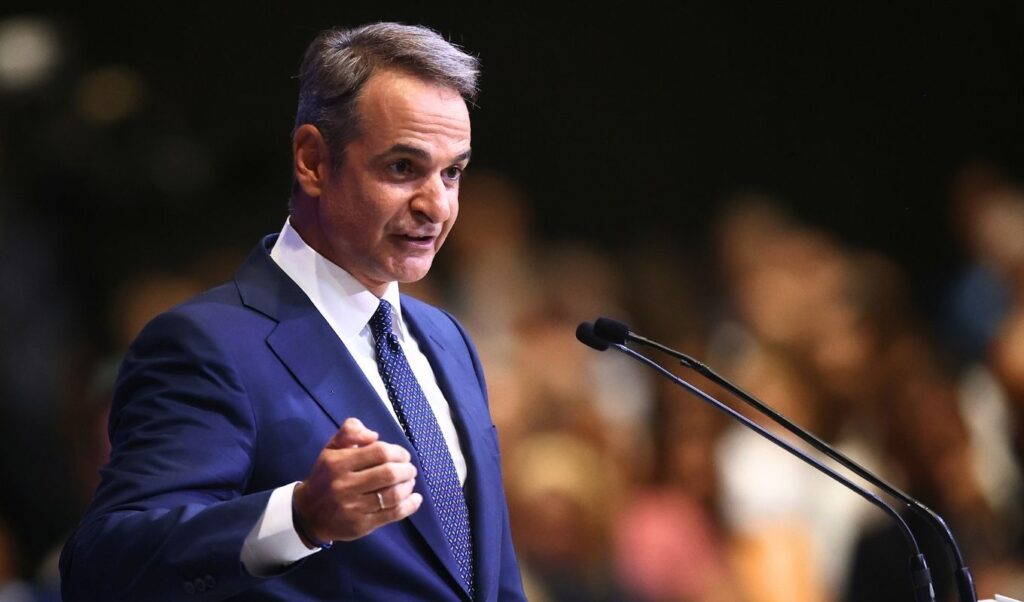
The government’s “Thessaloniki International Fair (TIF) week” kicks off today, building toward the highlight of Prime Minister Kyriakos Mitsotakis‘s address this Saturday afternoon at the Vellidio Convention Centre, followed by a press conference on Sunday midday. The total package of measures could exceed €2 billion, with a primary focus on small and medium-sized enterprises and self-employed professionals — though they won’t be the only beneficiaries. As government spokesman Pavlos Marinakis hinted yesterday on Real radio, responsible borrowers and families with children will also be among those set to benefit from the relief measures and benefits the Prime Minister is expected to announce.
“The truth is that now is the time to pay much greater attention to those who have been paying, complying, and contributing throughout all these years — to Greek society as a whole, but especially to these particular groups of our fellow citizens. And of course, to continue what began last year: significantly strengthening support for families with children,” the government spokesman noted.
TIF: Kyriakos Mitsotakis to deliver his address on September 5
At Maximos Mansion, the government is already playing the economic card heavily, while simultaneously continuing on the purely political front with a two-pronged confrontation against both SYRIZA under Alexis Tsipras and PASOK. The Ministry of Finance responded yesterday with a lengthy statement to PASOK’s attack on the government regarding the ability of borrowers to buy back their loans from banks, stressing that the opposition is “handing out costless promises and sending the bill to those who pay their dues.” The ministry underlined that “the debtor may, within the framework of the restructuring process, propose a lump-sum payment and the write-off of part of the debt,” adding that “the policies adopted by the government since 2019 have delivered very measurable results in the area of private debt.”
What’s being considered on the economic front
On the economic front, and specifically in the effort to combat the cost-of-living crisis, the National Price Reduction Initiative is launching today — covering nearly 1,700 product codes — with reports suggesting the average price reduction will ultimately come in higher than expected, potentially reaching as much as 9%. The initiative covers essential food and daily living items, school supplies, private-label products, and meat, with the product list expected to be further expanded by midday today, when related announcements will be made. “What matters to me is not exactly how many product codes are included. What matters is that they are mass-consumption products that affect the average Greek household, the average Greek family: food, basic living essentials, basic household maintenance items,” Development Minister Takis Theodorikakos stated earlier this week. He clarified that for a product to be included in the initiative, its price reduction must be at least 5%, lasting between two and four months, with some products seeing double-digit reductions proposed. More than 90 supplier companies, 12 supermarket chains, and 3 toy and school supply chains have already joined the initiative, while the process remains open and additional participants are expected to sign on.
The Recovery and Resilience Facility implementation period draws to a close
Today marks the end of the implementation period for the Recovery and Resilience Facility across the entire European Union, with the government planning extensive efforts to showcase the projects completed through this European funding package. “The original plan projected a 7-percentage-point increase in real GDP, 180,000 additional jobs, and a 20% rise in investment. The final results, however, far exceeded those targets: GDP grew by 11 percentage points, new jobs reached 550,000, and investment increased by 60%,” Prime Minister Mitsotakis noted in his regular Sunday Facebook post. As Finance Minister Kostis Hatzidakis wrote in his own post, “Greece had a total of €35.95 billion at its disposal (€18.22 billion in grants and €17.73 billion in loans) and will manage, through final disbursements by year-end, to ensure their full absorption.” The Deputy Prime Minister also took a jab at the opposition, remarking that “the opposition is here to say what it has to say. And reality, of course, is here to prove them wrong.”