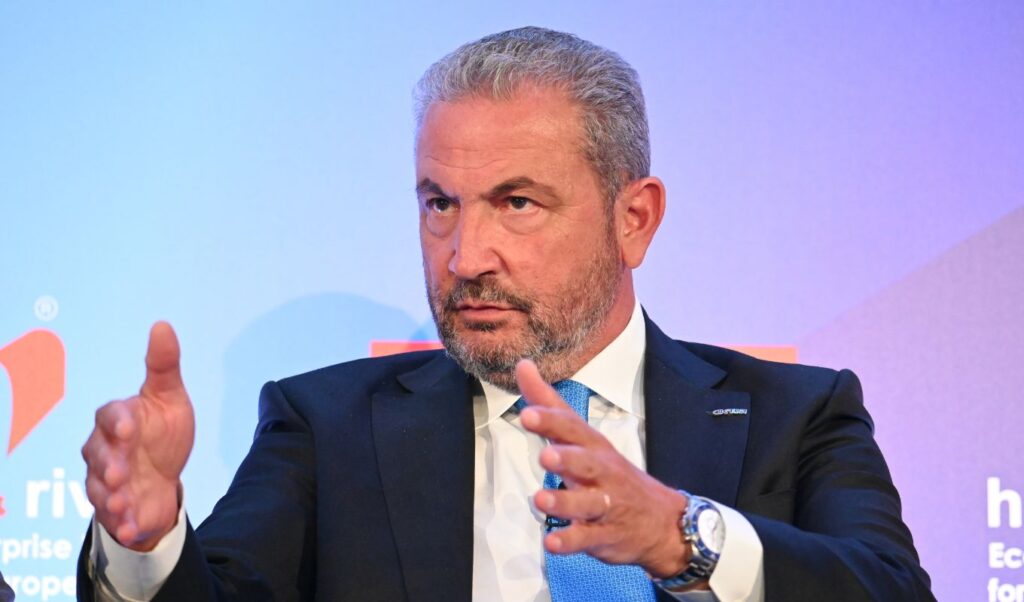
The chairman and CEO of AKTOR, Alexandros Exarchou, painted the picture of a group growing dynamically across all its business segments — both established and new — and armed with low financial leverage and high liquidity, on course to achieve its operating profitability targets: €375–425 million in the medium term and €600 million over the long term. Exarchou made these remarks during a comprehensive press conference held following the publication of the group’s half-year results and an analyst briefing. He addressed rumors of “excessive debt” with hard data, discussed the progress of the group’s major projects, and outlined the next steps in LNG, renewables, energy storage, and the circular economy.
He also did not shy away from pointed interventions on energy policy, analyzing what he called the dangerous delay by Europe in securing long-term commitments for American LNG at a time of fierce competition for available volumes — leaving the continent exposed to a price crisis that has already begun to materialize and could worsen during the winter. He also delivered sharp criticism of the political leadership at the Ministry of Environment and Energy over restrictions on energy storage investments in Greece, arguing that the market must be fully liberalized and interested parties must be free to develop large-scale battery systems — which he described as the “antidote” to renewable energy curtailments. Should curtailments exceed the “red line” of 20%, he warned, an energy problem risks becoming a financial one, as bank loans to renewable energy projects could turn non-performing, with their viability coming into serious question.
AKTOR’s low debt-to-EBITDA ratio and the “malicious” rumors
According to the figures presented by Exarchou, AKTOR’s total net debt stands at €429 million, equivalent to 1.9 times its trailing twelve-month EBITDA — a ratio significantly lower than that of its competitors. “All this talk about an over-leveraged company,” he remarked pointedly, asserting that AKTOR’s financial position is particularly strong in terms of debt leverage. He noted that if the “Moreas” motorway concession is excluded from the calculation, the net debt-to-EBITDA ratio falls below one times, while if only loans attributed to the parent company are considered, a negative net debt position of €412 million emerges. In other words, he said, the group could fully repay that debt and still retain that amount in its treasury.
The AKTOR group chief also dismissed claims that the company has outstanding obligations to subcontractors and suppliers. He stated that prior to the capital raise in July, AKTOR had paid subcontractors approximately €150 million more than it had received for the corresponding projects. “There is not a single unpaid subcontractor at this moment… all of this is deliberately spread misinformation designed to damage AKTOR and the work we are doing,” he said, citing among other evidence the due diligence process that preceded the underwriting of the capital raise and the international bond issuance totaling €1 billion by Goldman Sachs, UBS, and Bank of America. “Let them do it again now. I challenge them. Let them show me which of our competitors can match these numbers,” he added.
Exarchou’s warning on gas prices and the race for American LNG
Alexandros Exarchou once again delivered sharp criticism of how Europe is securing its future natural gas supplies. In his assessment, while the European market is preparing for the halt of Russian gas imports from 2027, it is not moving fast enough to lock in long-term LNG volumes from the United States.
To illustrate the intensifying competition, he pointed to LNG purchases from the US by Qatar and China. “China is buying from the Americans, the Qataris are buying from the Americans — where exactly do Europeans hope to buy from?” he asked. His concern extends beyond current cargo prices. It is about the availability of those volumes going forward, as more buyers have already secured quantities through long-term contracts.
He made a particular reference to China, arguing that it is actively choosing to purchase gas and build up its reserves. With that logic, he said, Europe cannot take for granted that it will be able to cover both a difficult winter’s needs and replenish its storage through short-term spot purchases. “I would like to see someone securing American LNG volumes now, on a long-term basis,” he stressed.
Exarchou did, however, argue that Europe should not simply replace its dependence on Russian gas with exclusive dependence on American LNG. His position is that more than one supply source is needed in order to ensure energy security and greater negotiating leverage. If the ban on Russian gas did not exist, he explained, the European market could have pursued a balance between Russian volumes and American LNG.
For now, the group is planning its moves on the working assumption of a full ban on Russian gas by end-2027, as stipulated by EU regulation. This is why it considers the conclusion of agreements for American LNG to be urgent. A potential future shift in European policy would change the landscape of options, but in his view it does not justify waiting: “Let them decide what they want,” he said of European governments, calling for clear rules so that companies can plan their investments and procurement strategies.
The delay in decision-making takes on greater significance, according to Exarchou, as natural gas prices continue to rise — currently hovering around €75/MWh — with TTF prices potentially exceeding €85. He warned that a cold winter would boost demand and push even greater pressure from gas prices onto electricity bills. “If the winter is cold for Europe, those of us who won’t be cold will still feel the consequences,” he said characteristically.
The projects and agreements activating the Vertical Corridor, and the latest on FSRU Dioryx Gas
When asked about AKTOR’s planning regarding American LNG procurement, Exarchou stated that spot transactions have increased in cooperation with DEPA (through Atlantic SEE LNG) and could generate even higher turnover this year than originally expected. He also reiterated that long-term contracts are being pursued, with Romania representing what he called a pivotal market for the group’s strategy — though one complicated by the country’s ongoing political uncertainty. In the same context, he mentioned early-stage discussions regarding gas-to-power plants in Albania and Bosnia, describing them as possible complementary moves in the commercial development of the Vertical Corridor, while clarifying that these are not yet mature projects. Considerably more advanced is the plan for a second FSRU at Agioi Theodoroi, for which AKTOR is now partnering with Motor Oil following an agreement to acquire 50% of Motor Oil’s subsidiary Dioryx Gas, which is developing the project. Exarchou said the agreement will be finalized in the immediate term, after which the project’s business plan will be developed — paving the way for a Final Investment Decision — with construction completion targeted for around 2030, if everything proceeds according to plan.
Batteries: “What public interest is served by these restrictions?”
Energy storage was the second area of intense criticism, with Exarchou this time directing his remarks squarely at the political leadership of the Ministry of Environment and Energy. The AKTOR chief called for any party with the capital available to be able to develop battery storage systems at whatever scale they deem economically viable — even without subsidies.
“What aspect of the public interest is served by restricting the development of batteries when they are not being subsidized?” he asked. On the 100 MW cap, he argued that it does not necessarily allow for the scale required to make a large storage investment viable. “Large-capacity batteries that can absorb power from multiple solar installations make sense. Explain to me why the state won’t let us do it,” he said.
In his view, restrictions on licensing may end up benefiting actors who secure development rights without the ability to actually finance the projects. “You’ll get the same black market in permits that already exists in solar energy,” he warned, arguing that transfers and negotiations will delay the actual deployment of battery systems.
Commenting on the government’s target of reducing electricity bills by 30% over three years, he said he had expected “a very powerful, large-scale fast-track battery program,” strongly implying that this expectation was not met by the roadmap presented by the Ministry. He was also critical of the government’s presentation of measures to tackle electricity theft — something he described as a self-evident obligation of any government, rather than a meaningful new initiative to reduce costs for law-abiding consumers. “So we’re saying we’ll lower the price of electricity because we’ll catch those who steal it and therefore won’t make everyone else pay for the thief. That’s the first time I’ve ever heard of such a measure,” he remarked.
Renewables priced with a 20% curtailment assumption
In the renewables sector, AKTOR remains open to acquisitions and potentially developing its own projects, but with specific return criteria. Exarchou explained that the group currently values renewable energy projects by factoring in production curtailments of 20%.
He estimates that curtailments could reach this level within the next two to three years if sufficient storage capacity is not deployed. For new investments, he set a minimum return threshold of 13%, without factoring in any additional benefit from battery integration.
His warning on higher curtailments was unambiguous: “If they exceed 20%, the problem that arises won’t concern renewables — it will concern the banks.” In his view, pressure on the revenues of a large number of financed energy parks could transmit risk to the broader financial sector.
A new pillar for water and waste management
A distinct new pillar for water and waste management is being added to the group’s portfolio, with the participation of Motor Oil. Exarchou highlighted the synergies created by combining the capabilities of Helector and Thalis — including their existing project pipelines — with AKTOR’s own expertise, within the framework of a strategic partnership with French global leader Suez. “The Greek pipeline is primarily in waste and water,” he said, estimating that the group is now well-positioned to compete for the major projects coming to market, worth billions of euros. On water specifically, he warned that recent rainfall has not resolved the needs of Athens and other regions. “The next wave of large-budget projects will be about water,” he predicted.