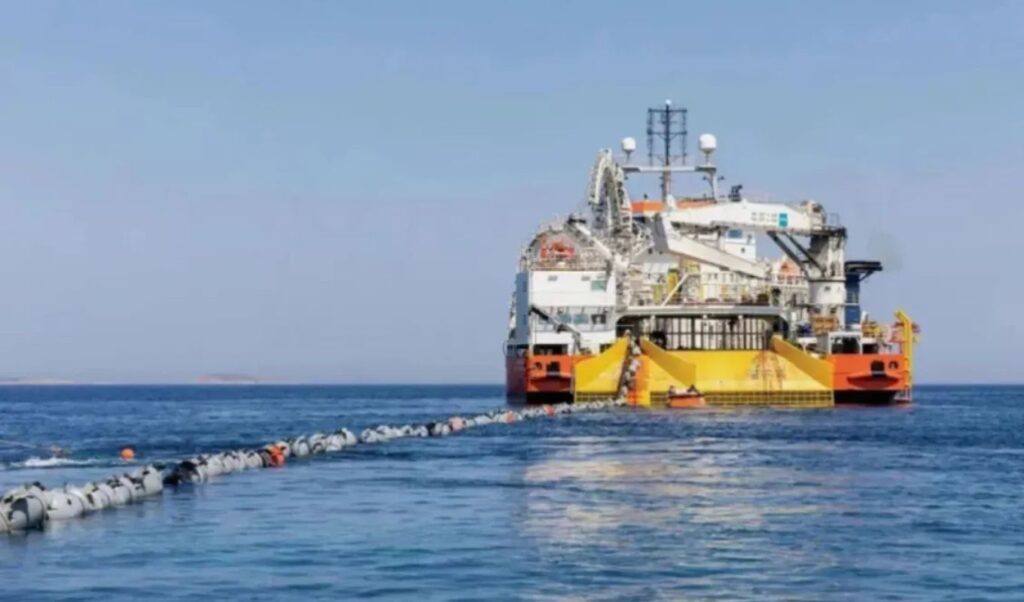
A significant crash test for the Turkey-Libya maritime memorandum is expected to unfold as survey operations begin for the laying of the GSI undersea cable. The French vessel Abeille Marengo, which arrived at the port of Heraklion, Crete yesterday morning, will be conducting these operations. According to the current plan, NAVTEX notices will be issued at the beginning of next week, following the return of Foreign Minister Giorgos Gerapetritis from the UN General Assembly session in New York. The resumption of seabed surveys along the cable’s planned route will begin from the point where operations were halted in 2024. While Turkey — through Foreign Minister Hakan Fidan — is awaiting written notification regarding the vessel’s passage, and Greek diplomacy is being called upon to navigate these obstacles, Turkish opposition leader Özgür Özel sharply criticized his government’s handling of the matter, stating: “We say we are not asking for permission, but notification. Since when does Greece say it is opposed even to notification?”
Eftychidis on the cable: We must avoid the mistake of notifying Turkey — directly or through the French company
As international relations expert Thrasyvoulos Eftychidis told parapolitika.gr, “what we need to be careful about is not taking actions that are not required — specifically, notifying Turkey, whether directly or through the French company. Doing so would essentially mean acknowledging some form of Turkish jurisdiction over the area. This is a mistake that our country would do well to avoid.”
Meanwhile, Athens, in coordination with Cairo, is intensifying diplomatic efforts to block any fait accompli consequences arising from the recent ratification of the Turkey-Libya memorandum.
Foreign Minister Giorgos Gerapetritis, following a joint statement at the UN on behalf of Egypt, Cyprus, Bahrain, the UAE, and the European Union, is expected to once again assert the invalidity of the Turkey-Libya memorandum in his upcoming meeting in New York with UN Secretary-General António Guterres — who, it should be noted, issued a sharp condemnation from Cairo on Monday, calling out countries that violate international law and the Law of the Sea.
In parallel, Prime Minister Kyriakos Mitsotakis, who is expected to address the UN Security Council tomorrow on the topic of “Maritime Security,” will deliver a statement condemning the Turkey-Libya memorandum.
Özel fires back over the Turkey-Libya memorandum: “Our agreement with Libya is condemned, while Greece’s deal with Egypt is accepted by everyone”
International backlash over the ratification of the Turkey-Libya maritime pact appears to be putting pressure on Ankara. Turkish opposition leader Özgür Özel fiercely criticized his country’s foreign policy yesterday, pointing out that “the agreement signed between Egypt and Greece is accepted by everyone, while our agreement with Libya — signed between two sovereign states — is being criticized, condemned, and rejected by arrogant Europeans.”
On the Egyptian side, Cairo is escalating its international response and is expected to submit a formal memorandum to the United Nations, making clear that it will not accept any fait accompli. This position was conveyed directly by Egyptian Foreign Minister Badr Abdelatty to his Turkish counterpart Hakan Fidan during their meeting in Istanbul.
At the same time, Athens and Cairo are coordinating efforts toward negotiations aimed at extending the 2020 Greek-Egyptian Exclusive Economic Zone (EEZ) delimitation eastward beyond the 28th meridian. This prospect has alarmed Libya, with Libyan Prime Minister Abdul Hamid Dbeibah reassuring the head of Egypt’s intelligence service that his government would not act against Cairo’s interests. Turkey’s Defense Minister Yaşar Güler also entered the conversation, announcing that Ankara is prepared to sign a maritime delimitation agreement with Egypt — one that would grant Egypt 15,000 square kilometers more maritime jurisdiction than a comparable deal with Greece would offer. In line with this approach, the commander of Turkey’s ground forces, Metin Tökel, visited Cairo yesterday.
As Eftychidis argues, “the Ankara-Cairo talks are something we need to watch carefully, because we are once again making the mistake of taking certain allies for granted — when in fact we are seeing not just a rapprochement, but even military cooperation between Ankara and Egypt, which we have not given sufficient attention to. We therefore need to look at certain issues as they truly are and pay closer attention, so that we are not caught off guard further down the line.”
Meanwhile, Turkish Defense Minister Yaşar Güler made further provocative statements yesterday, once again adding fuel to the fire. Addressing Athens, he stressed that while there is a willingness to resolve disputes peacefully, “it is not possible for us to accept approaches that work against the rights and interests of our country and our nation, increase tensions, or complicate the resolution of problems.”
Following the same strategy, Ankara is responding to international and European condemnation of its actions through legislative initiatives and diplomatic maneuvering. According to reports in pro-government Turkish media, Turkey is expected to submit the “Blue Homeland” bill to the Grand National Assembly before the end of the year. As reported in the Turkish press, the ruling AKP party is in the final stages of preparing legislation that would define maritime jurisdiction zones in the Aegean and Eastern Mediterranean. Under the proposed law, Ankara’s explicit authorization would be required for any economic, scientific, or environmental activity within its claimed EEZ. The bill also includes provisions for the legal definition of islets and rocks, addressing what Turkey refers to as “gray zones.”
According to Eftychidis, the “Blue Homeland” bill pertains to Turkey’s domestic law. As he explains, “it is of course illegal under the Law of the Sea, but there is nothing Greece can do. This is internal Turkish legislation — it does not concern Greece directly, and we cannot intervene to prevent it.”