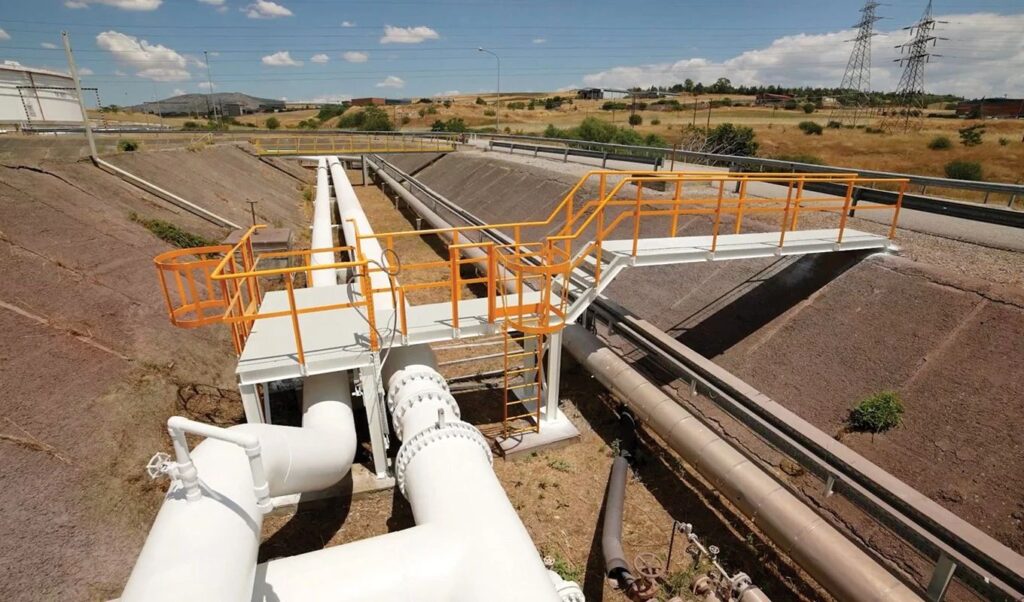
Greek investment activity in North Macedonia has experienced a significant revival over the past year, with a particular focus on energy corridors. Greek business groups already maintain a strong and highly visible presence in the neighboring country across key sectors such as banking, industry, and retail trade. In the energy sector, a critical development is the ongoing completion of the Vertical Natural Gas Transmission Corridor. A memorandum of understanding signed on September 4, 2026, in Thessaloniki by the natural gas transmission network operators of three countries — if fully implemented — will interconnect the networks of Greece’s DESFA, North Macedonia’s Nomagas, and Serbia’s Transportgas Srbija.
Investment surge in North Macedonia
This corridor will run parallel to the Ukraine–Moldova route and will channel natural gas toward the Western Balkans. To make this a reality, however, two major new infrastructure projects must be completed. The first is a natural gas interconnector between Greece and North Macedonia with an annual capacity of 1 billion cubic meters (bcm), and the second is a corresponding interconnector between North Macedonia and Serbia, with a capacity of 1.5 bcm. The announced plan envisions the full interconnection of the three networks by 2028.
Fifth largest trading partner
The warming of trade relations between Greece and North Macedonia is also evident from the reactivation of Vardax, the oil pipeline running from Thessaloniki to Skopje. The pipeline was brought back online earlier this year by OKTA (HELLENiQ ENERGY), following the resolution of a long-standing dispute between the company and the North Macedonian government. Undoubtedly, these two energy axes not only make a significant contribution to strengthening energy supply security for North Macedonia, but will also substantially boost bilateral trade between the two countries.
Today, Greece is North Macedonia’s fifth-largest trading partner, behind Germany, the United Kingdom, China, and Serbia. Last year, the total volume of trade (imports and exports) between the two countries reached €1.2 billion, representing 6.1% of North Macedonia’s total trade volume. Greece’s main exports to North Macedonia consisted of energy commodities (fuels, lignite, and electricity) as well as iron and steel products, while imports from North Macedonia were primarily agricultural products (tobacco), iron products, and various plastic goods.
The trade balance is, unsurprisingly, firmly in Greece’s favor, with Greek exports running at more than triple the value of imports. Specifically, according to the Office of Economic and Commercial Affairs of the Greek Ministry of Foreign Affairs in Skopje, Greek exports to North Macedonia in 2025 amounted to €937 million (a decrease of 5.2% compared to 2024), while imports stood at €261 million (down 0.3%). The decline in Greek exports was attributed primarily to falling energy commodity prices — a trend that is expected to reverse this year. It is worth noting that 2 out of every 3 euros’ worth of Greek exports to North Macedonia consist of energy goods. Of the €937 million in total exports, €675 million were energy commodities broadly, while €542 million were specifically fuels (diesel, petrol, etc.).
In this context, Greece’s export profile to its neighbor reveals a significant degree of concentration. The development of both the Vardax pipeline and the Vertical Corridor is expected to further deepen North Macedonia’s energy dependence on Greece.
Expansion through 20 business groups
That said, it is not only energy companies that are doing business in North Macedonia. The country’s second-largest bank is Stopanska Banka, which has been under the control of the National Bank of Greece since 1994. It holds 16.8% of the country’s total banking assets and is the largest bank in North Macedonia controlled by foreign investors. The National Bank of Greece is widely regarded as one of the largest foreign investors in the country. In total, 20 major Greek business groups have invested in North Macedonia. In addition to HELLENiQ ENERGY and the National Bank of Greece, these include:
- PPC (DEI), which controls Energy Delivery Solutions (EDS) AD
- Titan, which controls Cementarnica Usje AD, and Viohalco, which controls Dojran Steel AD
- Pavlidis Marmara, which controls Mermeren Kombinat AD
- Olympos (dairy group), which controls the identically named Olympos Foods LTD
- Metlen, which controls Protergia Energy DOOEL, and Veropoulos, which controls Vero DOOEL
- Alumil, which controls the identically named Alumil Ltd
- Coca-Cola HBC and Heineken (Netherlands), which jointly control Pivara Skopje AD
- SEKE (Cooperative Union of Tobacco Growers of Greece), which controls SEKE DOOEL
These represent very substantial investments by any measure relative to the scale of North Macedonia’s economy. Over the years, major Greek construction firms have also secured contracts for large-scale infrastructure projects through international tenders — most notably AKTOR and GEK TERNA.
It is worth highlighting that the total stock of Greek investment in North Macedonia at the end of 2024 stood at €869 million, placing Greece among the top foreign investors in the country. Austria led the rankings with €1.37 billion, followed closely by Turkey (€875 million) and Germany (€874 million) — both just slightly ahead of Greece. The gap separating the three is narrow and could easily be closed in the coming years, particularly if the Vertical Energy Corridor is completed as planned by 2028.
Originally published in Money Pro by Parapolitika