
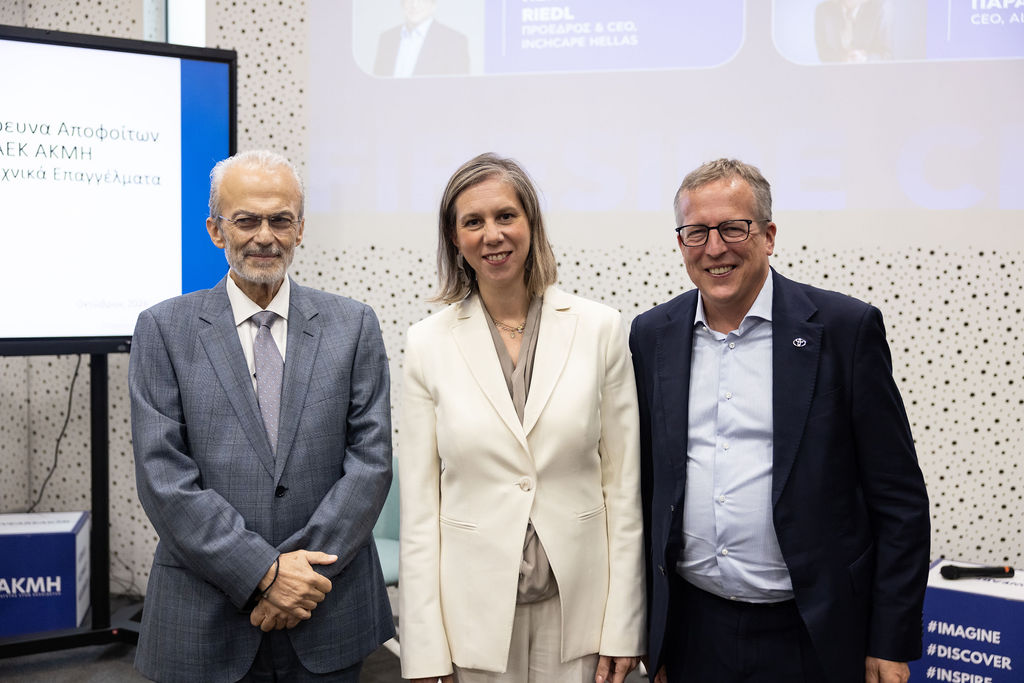
The results of an MRB research study were presented at an event hosted by AKMI Vocational Training Institute. Alphabet Education CEO Christina Paraskevopoulou and Inchcape Hellas President & CEO Hermann Riedl discussed how vocational education and the labor market are jointly addressing new challenges, with a focus on the skills of the future. Eight out of ten graduates from AKMI’s technical and vocational programs are already employed — a finding drawn from a large-scale, nationally certified MRB survey covering graduates from the past three years across specializations including Automotive Mechanic, Electrician, Refrigeration Technician, and Plumber/HVAC Technician. The results were unveiled at the event titled “Vocational Education Works — What the Data Says. What the Market Says.”, held at AKMI’s central facilities in Athens.
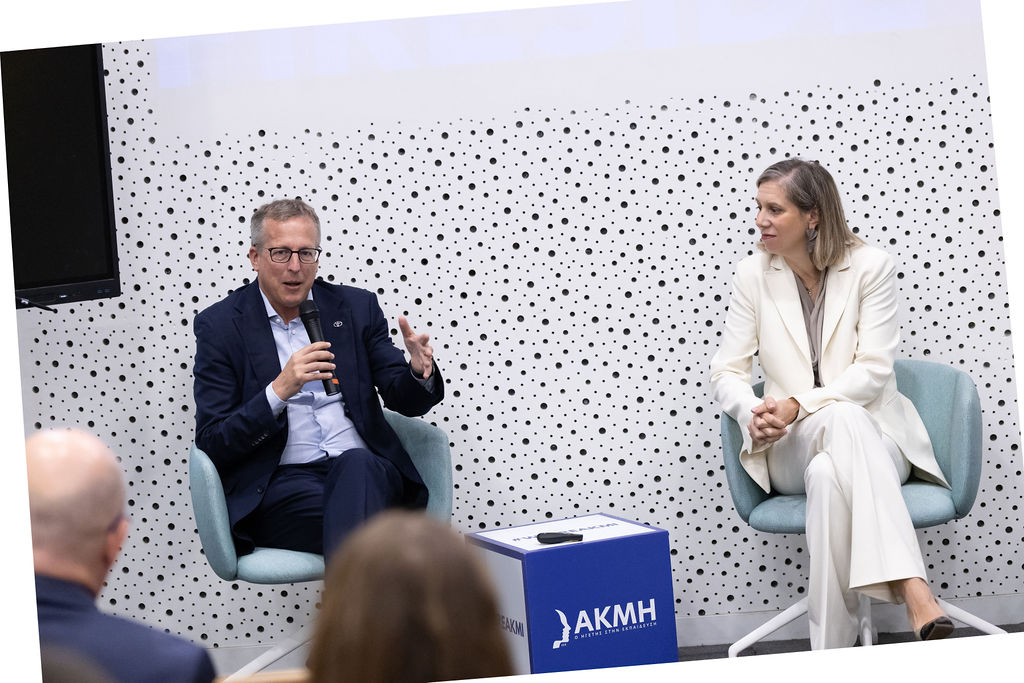
At the heart of the event was a discussion between the leaders of the two organizations that have already joined forces in hybrid technology: Alphabet Education CEO Christina Paraskevopoulou and Inchcape Hellas President & CEO Hermann Riedl (official distributor of Toyota, Lexus, and GAC Aion). The event was opened with welcoming remarks by the Vice President of the European Vocational Training Association (EVBB) and Group Founder, Konstantinos Rodopoulos, who framed the discussion within a broader European context.
Entering the job market before graduation
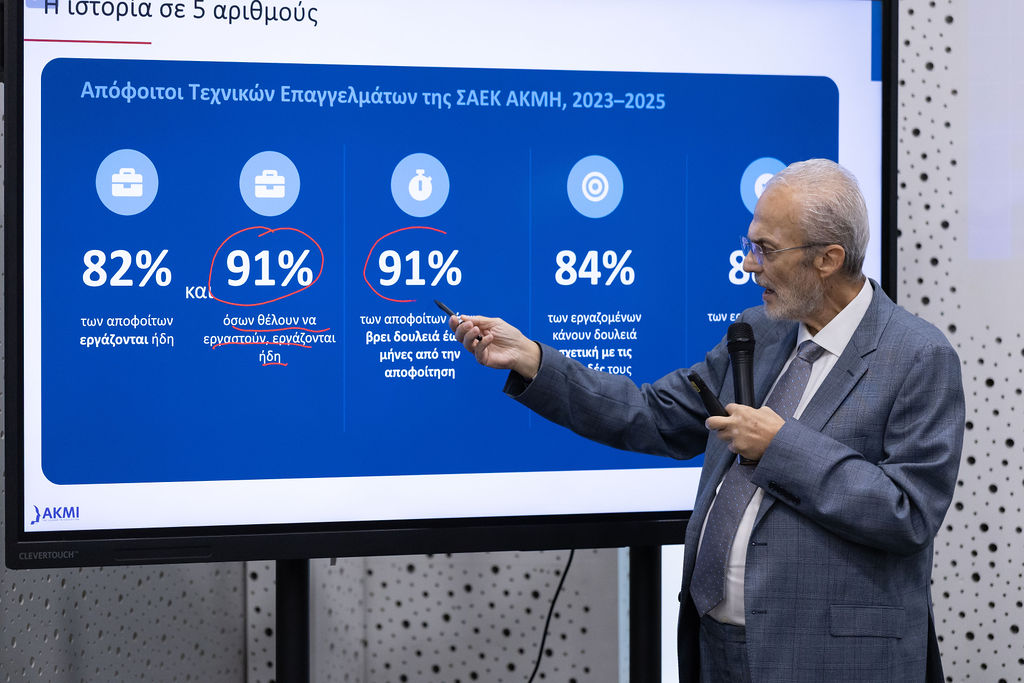
According to the research presented by MRB General Director Dimitris Mavros, 82% of graduates are already employed — a figure that rises to 91% among those actively seeking work. An impressive 68% had secured a job before even completing their studies, and among those who found employment, 9 out of 10 did so within six months. The quality of that employment is equally noteworthy: 84% are working in a field directly related to their studies, 85% of salaried employees hold permanent contracts, and 88% report satisfaction with their jobs — a figure that climbs to 95% among those working in their area of specialization. Practical training proves to be a decisive factor, with 2 in 3 graduates who completed an internship receiving a job offer from the company where they trained.
Europe: 1 in 2 young people in vocational education
EVBB Vice President and AKMI founder Konstantinos Rodopoulos highlighted that Greece continues to place its bets almost exclusively on university education: approximately 25% of young people pursue vocational and technical training, compared to around 50% across Europe. In countries such as Germany and Switzerland, career guidance begins early and is tailored to each individual’s skills and strengths. Without a shift in this direction, he warned, the country will continue producing graduates in fields with little market demand — even as digital and hybrid-technology professions are actively shaping the future of work.
Vocational education as a bridge to the labor market
Mr. Riedl described the modern automotive technician as a professional far removed from the traditional image of a mechanic: one who combines mechanical and electronics knowledge while handling high-voltage batteries and advanced diagnostic systems. He noted that hybrid vehicles now account for approximately 61% of new car sales in Greece, while the average age of the national vehicle fleet stands at 17.8 years. This means, according to Riedl, that technicians will need to be proficient in both conventional systems and emerging technologies for many years to come. Strong demand for specialized technical personnel is already among the sector’s most pressing challenges. As a telling example, the Toyota and Lexus network in Greece — with approximately 75 service points nationwide — is currently seeking around 100 technicians, underscoring the growing gap between market needs and the availability of adequately trained professionals.
“Vocational education must take on a different role. Not merely an educational one — a developmental one,” said Ms. Paraskevopoulou. “It has a different mission: specific skills, specialization, and an on-the-job approach within the workshop, with a direct connection to the market. And it has one advantage we need now more than ever: speed.” As she explained, the green and digital transitions are simultaneously a transition in skills. “Behind every charging station, every hybrid vehicle, every new energy investment, there is a very practical question: who will know how to operate it, maintain it, repair it?”
Industry in the classroom: the Toyota partnership model
“For us, a partnership with industry isn’t just another collaboration. It’s the way the market itself enters education,” said Ms. Paraskevopoulou. “You don’t wait for the market to change and then train people. You prepare them for the change that’s coming. That’s why we invested early in electric mobility, and this year we moved forward with hybrid technology specialization together with Toyota.” In the “Hybrid Vehicle Technician” program, Inchcape Hellas actively participates in curriculum design, starting from what the market actually needs. Students are trained on the technologies currently in use on the road today: hybrid and electric vehicle diagnostics, battery systems, high-voltage safety, and charging systems. They complete their training with internships at network workshops, which serve as a direct bridge to employment. The first generation of hybrid technology technicians is already being trained under this model.
As the Alphabet Education CEO noted, the same approach is applied in partnership with Honda and the Sarakakis Group in modern motorcycle technology, and with Suzuki Marine in recreational watercraft. “For us, this is what innovation in education means: how quickly market technology reaches the classroom.”
Technical professions: the front line of the green and digital transition
“The workshop of 2026 looks nothing like the one we remember. It has diagnostic laptops, high-voltage systems, batteries, software,” noted Ms. Paraskevopoulou. “The modern technician combines mechanical engineering, electronics, and IT. We’re talking about a technology profession. And this applies across the board: in a modern hotel with automation and energy management systems, on a boat, in a hospital.” That is why, she stressed, technical education “is not a second choice. It is the choice.”
She described technical professions as the front line of both the green and digital transitions: electricians for photovoltaic systems and charging infrastructure, refrigeration technicians for heat pumps and energy efficiency, automation technicians for industry and modern buildings, and medical equipment technicians for healthcare.
The next step: skills at every stage of a career
“A 35- or 45-year-old worker doesn’t need to start from scratch. They can add a new skill on top of what they’re already doing,” said Ms. Paraskevopoulou, referring to AKMI’s next steps. AKMI is designing its new specializations in close collaboration with businesses, starting from the skills that are hardest to find in the market, and placing particular emphasis on the retraining and upskilling of those already in the workforce. The same logic applies to artificial intelligence: “The goal is not for everyone to become AI specialists, but for them to be able to use it within the profession they already practice.”