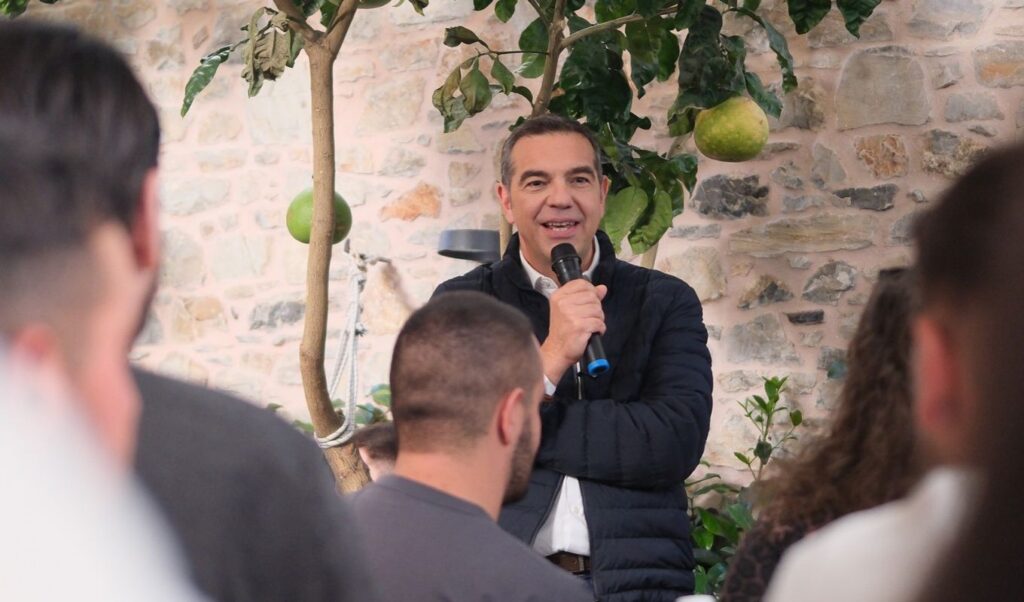
While Alexis Tsipras prepares for his next regional tour, his two-day visit to Thessaly generated considerable optimism at SYRIZA headquarters, as the former prime minister’s contact with local citizens was notably warm. His associates also drew several key conclusions from his conversations with farmers, young people, and professionals — conclusions that will feed directly into the party’s upcoming policy congress scheduled for early next year.
According to party insiders, the visit made it more apparent than ever that there are effectively two Greeces: the Greece of hard work and the Greece of corruption and cronyism. Characteristically, in addressing the OPEKEPE subsidy scandal, the SYRIZA leader spoke of a “Mitsotakis system” that essentially feeds off the labor of ordinary citizens.
Once again, the contrast between the Tsipras era of governance and the current Mitsotakis administration was brought into sharp focus. Under Tsipras, party officials argue, every last euro went into the public treasury — not into the pockets of party loyalists through direct contracts, closed tenders, and kickbacks.
The same sources back their claims with hard numbers: when Alexis Tsipras left office, the average Greek salary was nearly 80% higher than the average Bulgarian salary. Today, Greece has French supermarket prices paired with Bulgarian wages — a comparison Tsipras himself frequently makes. The current account deficit left behind by his government stood at €2 billion; today it has ballooned to €9.5 billion. This means that despite the significant opportunities available to the Mitsotakis government — pandemic recovery funds, the EU Recovery Fund, and other financial instruments — domestic production was left unsupported and critical infrastructure was never built. This reality, party insiders note, has had a direct impact on job prospects for young people: if you’re not a member of New Democracy or its youth wing ONNED, your career prospects are limited.
At the same time, SYRIZA officials are keen to stress that “we are not all the same.” This is a phrase the former prime minister has repeated consistently. “He governed for four and a half years and not a single corruption scandal was pinned on him,” party officials at Amalias Avenue note, adding that under Mitsotakis, Greece has become the top client of the European Public Prosecutor’s Office.
In recent years, political vocabulary has been enriched with terms like “Frappe drinkers,” “Butchers,” “blue-blooded kids,” “Lamborghini,” and “Porsche.” Meanwhile, as Tsipras revealed yesterday from Palamas in Karditsa, 82,000 producers nationwide claim to own livestock and receive subsidies, yet only 40,000 of them can actually prove they produce meat, milk, or dairy products. According to SYRIZA’s assessment, this is precisely why livestock vaccinations against pox were never carried out — because doing so would have exposed the real number of farmers and animals involved.
SYRIZA’s central message is that there is another way. The reality citizens are living under the Mitsotakis government is not inevitable, and the great “blue” feast of the past seven years will come to an end the moment Tsipras and SYRIZA take the reins of the country — that is the signal coming from Amalias Avenue.
The same officials are also highlighting the concrete economic cost of corruption, stressing it is far from a theoretical concern. “Under Tsipras, consulting firms received €20 million in public contracts. Under Mitsotakis, that figure reached €600 million. Over the last six years, direct contracts and closed tenders have amounted to €20 billion. But for every euro that walks out the door of a public project, a euro is lost from public schools, hospitals, farmers, and the welfare state as a whole,” SYRIZA representatives stated.
Tsipras’s associates could not overlook the ongoing unrest in France, which they say is exposing the political bankruptcy of President Macron. Within the EU, they argue, no leader is a bigger devotee of Macronism than Kyriakos Mitsotakis. “Those who are rising up, demanding, expressing outrage and anger are not doing so without cause. They are rebelling, fuming, and protesting because there are policies that are driving them to despair,” Tsipras declared yesterday. He added that the French president “came as a supposedly liberal hope but ended up rolling out the red carpet for the far right and Marine Le Pen.” As Greece’s own far right re-emerges from the shadows — particularly following the release of Ilias Kasidiaris — SYRIZA and its leader position themselves as the democratic bulwark against the rapid rise of extremism, as well as the political firewall against the country’s deeply entrenched corruption.
Finally, party insiders note that the most emphatic announcement made by the former prime minister was, without doubt, his pledge regarding a 13th pension payment. Tsipras urged citizens not to trust those who make vague and non-committal promises. He clarified that what is needed is a genuine wealth redistribution policy, combined with progressive taxation of the very wealthy, in order to support the younger generation, public schools, hospitals — and, of course, to fund the 13th pension. SYRIZA’s proposal for fair taxation and a patriotic contribution from the wealthiest 1% of the country moves precisely in that direction, the same sources conclude.