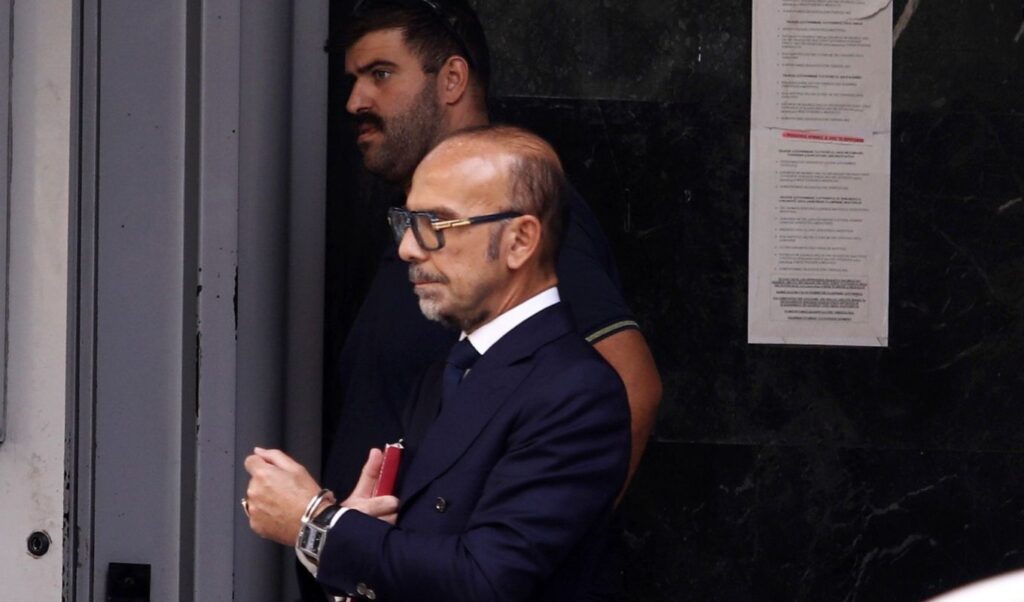
The detained doctor implicated in the death of Giorgos Mazonakis has submitted a new memorandum to the examining magistrate, in which he appears to distance himself from his equally detained wife. In the new filing, the 58-year-old internist from the ill-fated Karneadou Street clinic claims he had no involvement whatsoever in the practices of the 56-year-old doctor, drawing a clear line between his own professional activity and that of his wife. As revealed by a Mega TV programme covering the singer’s death case, he stressed that he had no part in either the examination or the treatment of Mazonakis.
The Mazonakis case: The 58-year-old’s defence strategy and two key medical documents
Furthermore, the 58-year-old doctor claims that at the critical time he was examining his own patient at his practice, which shared premises with his wife’s clinic on Karneadou Street in Kolonaki. According to him, this claim is supported by two medical documents that sit at the heart of his defence strategy. He is also requesting that a specific patient be called as a defence witness in order to corroborate, in his words, the circumstances of his presence at and departure from the clinic.
According to the memorandum, the 58-year-old is presenting a cardiological examination and an electrocardiogram dated 4 September 2026, as well as a handwritten referral for further tests, including a scintigraphy and a CT coronary angiography. The defendant argues that these documents reflect the nature of his medical activity on the day of the incident and support his claim that he had nothing to do with Giorgos Mazonakis’s appointment with his wife.
He states that the patient he is asking the magistrate to examine was at his practice before the singer arrived. According to him, he examined the patient, reviewed the ECG results together with him, and recommended further tests. He then claims that both he and the patient left at roughly the same time, after which he headed to the “Le Rose” restaurant. The 58-year-old also cites another witness statement that has already been taken, as well as CCTV footage from the restaurant, requesting that all this evidence be considered alongside the testimony of his proposed witness in order to clarify the timeline of his presence at and departure from the clinic.
“I neither knew the deceased nor had I ever spoken to him”
Regarding his relationship with Giorgos Mazonakis, the 58-year-old insists in his memorandum that he had never met the artist, had never communicated with him, and had played no part at any stage of the treatment the singer had arranged with his wife.
“I neither knew the deceased nor had I ever spoken to him, nor had I ever so much as mentioned him to anyone or on my mobile phone,” he states pointedly, adding that he has requested the Criminal Investigation Division to examine the data on his device. He maintains that he did not examine the singer, did not recommend or administer any treatment to him, and had no involvement in the planning or execution of the therapeutic procedure arranged with his wife.
“I never examined him, never recommended or provided any treatment to him, and never participated in the planning or implementation of the treatment he had arranged with the 56-year-old,” he notes. He further argues that his professional activity falls within the field of internal medicine and that the tests he prescribes to his patients are entirely within the scope of conventional medical practice. With this argument, he seeks to clearly separate his own medical conduct from the practices he attributes to his wife.
“My separate — albeit co-located — practice and I as a physician are neither connected to nor responsible for what happened to the deceased patient,” he states in the memorandum, contesting the notion that his marital relationship can serve as a basis for attributing liability to him.
What the doctors’ 19-year-old daughter said
Notably, the doctors’ 19-year-old daughter stated: “My father and mother had disagreements about sharing the clinic premises, and they had been discussing separating them since 2022. They also disagreed about my mother’s interventional treatments. My father had been looking into hiring an anaesthesiologist. My mother wanted to help people. More specifically, she believed that her treatments helped people detoxify their bodies. She wanted to perform plasmapheresis on me too, as I had some health issues, believing it would help eliminate toxins. She informed my father that she intended to perform plasmapheresis on me before the treatment took place.
My mother believes in the holistic approach; my father is an internist but he also has a holistic approach. My father knew I was going to have the treatment, but I didn’t discuss it with him.
On 26 August, my first treatment took place. They applied an anaesthetic cream. The treatment lasted 2.5 hours. I was asleep for two of those hours. After the treatment, my face was swollen. The second treatment took place on 30 August. Four days had passed due to our schedules. Before the treatment began, I had run several kilometres. It started at 9 o’clock in the evening.
The most difficult part was the venipuncture. My veins collapsed three times. I became distressed and was saying I didn’t want to continue. I asked my mother what she had put in the drip. She told me to relax. The treatment ended at midnight. When I asked again what substance she had administered, she told me it was the substance used in colonoscopies. I didn’t notice her adding anything to the drip during the treatment, nor could I have imagined she would do something outside the bounds of standard medical practice.”