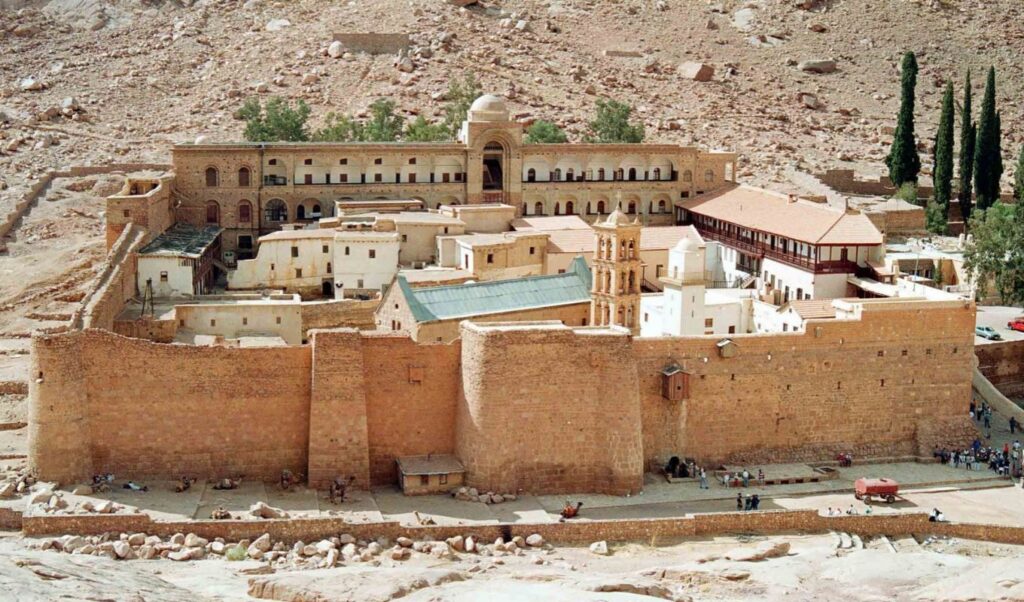
With the agreement on the ownership status of the Holy Monastery of Sinai finalized and on the table — and the clock ticking — the Sinaite Community is being called upon to sign, yet the resistance it continues to display suggests no such outcome is imminent. The issue also appears to have featured prominently in yesterday’s talks between Foreign Minister Giorgos Gerapetritis and his Egyptian counterpart, Badr Abdelatty, as well as with Patriarch Theophilos of Jerusalem.
Authoritative sources closely monitoring the situation have told parapolitika.gr that Ecumenical Patriarch Bartholomew, Patriarch Theophilos of Jerusalem, and Archbishop Ieronymos of Athens have each been in contact with the Archbishop of Sinai over this thorny issue. As they characteristically noted to parapolitika.gr, “all three have conveyed to Symeon, following a very detailed briefing they received, that the agreement is very favorable for the Monastery and that they will fully support him once he signs it. But the decision is his alone.” Church sources speaking to parapolitika.gr also confirmed that Archbishop Symeon has been in contact with all three Primates of the Orthodox Churches in recent weeks, assuring him of their unwavering support.
Regarding the agreement itself — the details of which have not yet been made public — the same authoritative sources maintain that it has been fully finalized and is ready to be signed. “The agreement is done. What remained to be worked out were procedural matters relating to its implementation after signing, which were then opened up for negotiation between the Monastery and the Egyptian state,” they noted. Nevertheless, Archbishop Symeon is refusing to sign, while the Sinaite Community itself appears deeply fragmented — effectively split into three factions. The most hardline group consists of monks who insist “there is no court case at all, because all of this is fabricated.” A second group acknowledges the court proceedings but argues that “just as it has happened before, another postponement will be granted, so there’s no rush.” A third faction opposes the agreement not on its merits, but to prevent former Archbishop Damianos from claiming any credit for it.
As the October 24 deadline approaches — when Egypt’s Supreme Court of Cassation is expected, barring unforeseen developments, to issue its ruling on the ownership status of the Holy Monastery of Saint Catherine of Sinai — there is no sign of consensus within the monastic community on moving forward with any agreement. All indications suggest that Athens and Cairo have aligned their positions on the matter. However, according to very well-informed sources, neither government is prepared to take any initiative unless the Sinaite Community first reaches a unanimous decision. Behind the scenes, diplomatic activity has been intensifying: yesterday, Foreign Minister Giorgos Gerapetritis held telephone conversations with Egyptian Foreign Minister Badr Abdelatty and with Patriarch Theophilos of Jerusalem. It is also worth noting that the Secretary General for Religious Affairs, Giorgos Kalatzis, had been in Jerusalem in the days prior, meeting with Patriarch Theophilos, who maintains an open line of communication with Archbishop Symeon.
The Monastery of Sinai falls under the spiritual jurisdiction of the Patriarchate of Jerusalem, to which each newly elected Archbishop traditionally renders the prescribed Declaration. Church sources observe, however, that at this particular moment — when Egypt-Israel relations are severely strained — any intervention by the Patriarchate of Jerusalem on behalf of Sinai Monastery would be seen as a red flag by Cairo. Although the Greek government has been handling the matter with appropriate discretion — given that concluding an agreement is fundamentally the responsibility of the monastic community and the Egyptian state — the situation appears to be heading toward a dead end. Tellingly, one monk told parapolitika.gr that the court will not convene, and that even if it does, it will not issue a ruling that turns the international community against Egypt — a country that would then face accusations of desecrating a monument of global significance and unique standing in the history of Orthodoxy.
Sources continue to insist, however, that Egypt’s Supreme Court of Cassation will indeed convene on October 24, and that for this reason the agreement must be signed within the coming days. Dismissing the monks’ objections, authoritative sources told parapolitika.gr that despite four previous postponements having been granted, the Egyptian authorities have no intention of granting another extension. Official talks between the Monastery and the Egyptian state have remained “frozen” since August, the same source told parapolitika.gr, while a group of monks continues to remain in Athens, close to former abbot Damianos. Meanwhile, the prevailing sentiment among the dissenting monks can be summed up in a single position: “no deal is better than a bad deal.”