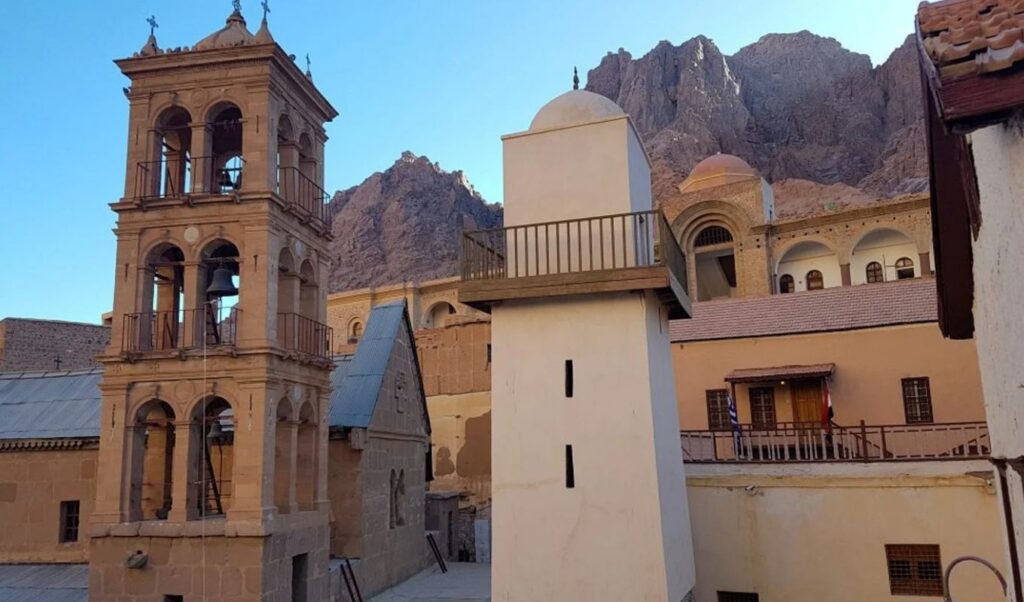
Saint Catherine’s Monastery of Sinai finds itself at one of the most critical crossroads in its modern history, as the Sinaite brotherhood must reach a definitive decision next week on whether to conclude an agreement with the Egyptian state. According to information received by parapolitika.gr, Egypt’s Supreme Court of Cassation is expected to issue its final ruling on October 24 — unless an out-of-court settlement is reached over the legal framework that will govern the monastic community of the Sinai Peninsula going forward. The ruling would bring a definitive end to a months-long legal thriller that has kept the global Orthodox world on edge.
Read also: Sinai Monastery: Property ownership dispute complicates final agreement with Egypt as monks push back — Full behind-the-scenes account
Four postponements and a breakdown in talks with the Egyptian state
To date, Cairo’s Supreme Court of Cassation has postponed its ruling four times, a fact that had lulled the monks into a sense of security. This time, however, nothing can be taken for granted, as credible sources report to parapolitika.gr that negotiations between the monastic community and the Egyptian state have been suspended since August.
The Egyptian government has made it unequivocally clear that there will be no further postponements. The four delays granted in the past — all aimed at reaching a mutually acceptable agreement — are now considered a closed chapter. The judicial process has reached its limit, and the issuance of a ruling is now all but inevitable.
Church sources speaking to parapolitika.gr, however, strike a more reassuring tone, arguing that Egypt will not take any action that would set the entire international community against it — particularly one that would be seen as running counter to the monastery’s interests.
Scenarios of property loss and uncertainty over the monastery’s legal status
Nevertheless, information leaking from Cairo regarding the content of the imminent ruling is causing serious alarm. According to what is being described as the “best-case scenario” — based on the prosecutor’s recommendations — the monastery risks immediately losing an additional 10 properties, while the religious character of another 28 assets will be subject to review. Any properties deemed not to be used exclusively for religious purposes would be permanently transferred to the Egyptian state. Well-informed sources further indicate that the nightmare scenario — in which the monastery is stripped of all its rights — cannot be ruled out entirely. While this outcome may seem extreme, the threat remains on the table.
The legal vacuum and the search for an agreement to safeguard the holy sites
The core of the problem lies in the fact that, under Egyptian law, religious communities do not possess recognized legal personality. Saint Catherine’s Monastery, in effect, does not exist within the country’s legal framework. The only viable path to protecting it is through the preservation of its Greek Christian character via a formal legal agreement with the state. Such an agreement would not confer ownership or property transfer rights, but would permanently secure the monastery’s status as the exclusive user of all religious spaces, hermitages, and pilgrimage sites — without any obligation to pay rent. This prospect, however, does not sit well with the monastic community, the majority of which maintains that “no agreement is better than a bad agreement.”
The Sinaite brotherhood remains divided — Archbishop Symeon at the center
Negotiations have effectively been frozen on the brotherhood’s side, which remains deeply divided. Archbishop Symeon, who is currently in Athens, appears to have overcome the serious health issues he was facing. With the support of all the Primates who have stood by his side throughout this ordeal, he may be in a position as early as next week to brief the Sinaites on the contents of the proposed agreement.
Window for a settlement narrows ahead of the critical court ruling
What is clear, however, is that even now, circles both inside and outside Saint Catherine’s Monastery continue to place obstacles in the Archbishop’s path — with unknown intentions, but with a very real impact on efforts to resolve the matter.
Time is running out. From next week onwards, Archbishop Symeon is expected to be able to chair the brotherhood’s sessions. This is the moment of reckoning for the monastery’s leadership, which must act decisively and without delay. Should Egypt’s Supreme Court of Cassation issue its ruling on October 24 as scheduled, every window for negotiation will close — triggering a fundamental change in the existing status of this historic Greek Orthodox monastery.