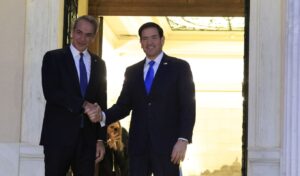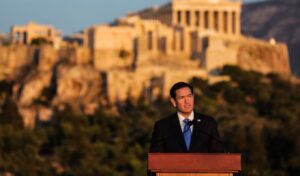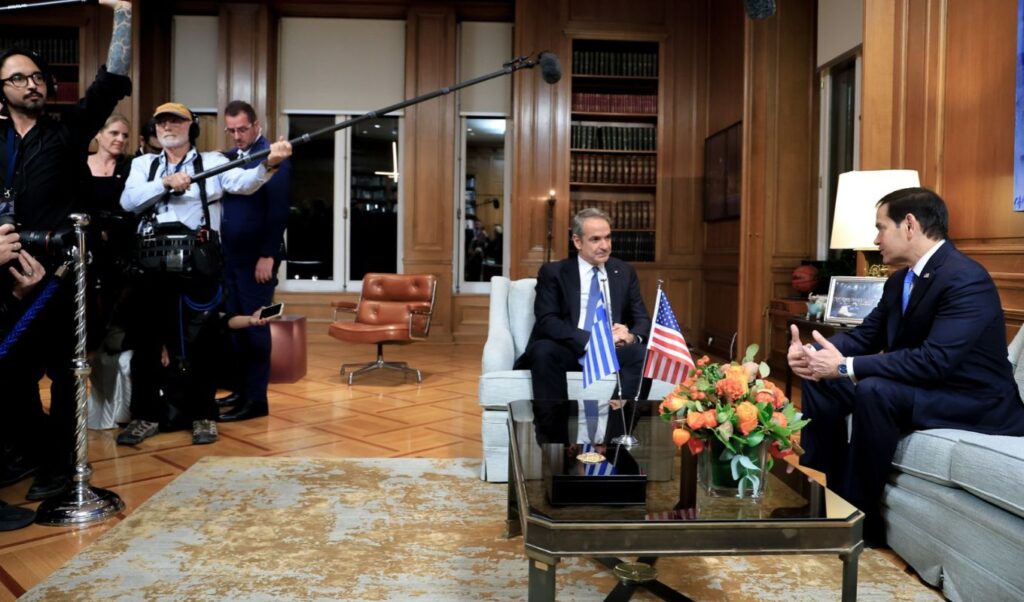
US Secretary of State Marco Rubio‘s visit to Athens concluded with concrete agreements and a clear imprint across critical sectors. His meetings with Greek Foreign Minister Giorgos Gerapetritis, Prime Minister Kyriakos Mitsotakis, and his participation in the 6th Round of the Greece–US Strategic Dialogue highlighted the breadth and depth of the bilateral relationship. At the forefront were defense and security, energy, emerging technologies, economic security, shipping, counterterrorism, irregular migration, and the protection of cultural heritage.
$4 billion defense cooperation agreement
According to the Joint Statement, Greece and the United States announced military equipment sales through the Foreign Military Sales (FMS) program totaling $4 billion. The agreement is part of Greece’s long-term defense planning and aims to further strengthen interoperability between the two countries, while also opening the door to new opportunities for cooperation between their defense industries, with particular emphasis on innovative technologies.
Additionally, Greece’s participation in the State Partnership Program of the US National Guard Bureau was finalized through a partnership with the State of Florida. In the same context, the transfer of Stryker armored vehicles to Greece was confirmed, further enhancing military interoperability. Both sides reaffirmed the strategic importance of their defense cooperation, both for achieving bilateral security objectives and for strengthening collective defense within NATO. They also agreed to expand cooperation in law enforcement and counterterrorism, while reiterating their commitment to addressing irregular migration.
Technology and Pax Silica take center stage
Significant emphasis was also placed on technological cooperation. With Greece’s participation in the Pax Silica initiative as a foundation, Athens and Washington welcomed the strengthening of collaboration in the fields of superintelligence, high-performance computing, cybersecurity, and advanced technologies. This is a domain of growing geopolitical and economic importance, as technological superiority is now directly linked to national security, economic resilience, and global competitiveness.
Strong support for the Vertical Gas Corridor
On the energy front, both governments highlighted the momentum building in their bilateral relationship, drawing on the dynamics of the November 2025 Partnership for Transatlantic Energy Cooperation (P-TEC) Ministerial, the development of the Vertical Natural Gas Corridor, and hydrocarbon exploration and exploitation.
Secretary Rubio placed particular emphasis on Greece’s role as an energy hub for Europe, linking the expansion of the Vertical Corridor with increased US LNG exports to the European market. “Our energy relationship is reaching new levels and continues to expand and grow,” Rubio said, noting that the expansion of the Vertical Corridor has established Greece as a “secure energy hub.” Significant attention was also given to maritime cooperation, with both sides signing an agreement on the certification of American sailors aboard Greek vessels.
New agreement on cultural heritage
Cultural heritage protection also featured prominently on the agenda. The two governments signed a renewal of the Memorandum of Understanding on Cultural Heritage, reaffirming their commitment to protecting cultural property and combating international networks involved in its illicit trafficking. It was also announced that the first project in Greece under the US Ambassadors Fund for Cultural Preservation (AFCP) will be launched, aimed at highlighting the shared democratic traditions of both nations.
Rubio: “Greece is an indispensable NATO ally”
During his meeting with Foreign Minister Giorgos Gerapetritis, Marco Rubio placed strong emphasis on Greece’s strategic role, describing it as an “indispensable partner” and an “indispensable NATO Ally.” “Greece is a pillar of stability in this region, a pillar of the United States’ presence in the region, and a pillar of how we ensure both our national interest and Greece’s interest in the region,” he stated.
Rubio also referenced the US–Greece Joint Statement on Economic Security, underscoring both countries’ commitment to working with like-minded allies to build secure and resilient supply chains. He made particular mention of critical minerals production, noting that it represents yet another area where the interests of Athens and Washington are aligned and being translated into concrete action.
Mitsotakis – Rubio: “There are many opportunities ahead of us”
At his meeting with Prime Minister Kyriakos Mitsotakis, Marco Rubio emphasized that Greece is a strong and reliable partner in a region marked by multiple sources of instability.
“There are many sources of insecurity around you in this region. Yet the fact that we have you here as such a strong partner, and that we continue to build on this relationship in a mutually beneficial way,” he said, adding that there are significant opportunities for cooperation in the economy, energy, and trade. He also underscored the deeper dimension of the Greek-American relationship, noting that the alliance between the two countries goes far beyond a formal diplomatic arrangement. “We agree that we face the same problems that concern us and, most of the time, we also agree on the right solution,” he remarked, while highlighting the strong historical bonds that form the foundation of the Greece–US relationship.
Rubio’s message to Guilfoyle and the reference to Iran
Marco Rubio sent a message of support to US Ambassador to Athens Kimberly Guilfoyle during his responses to reporters’ questions following his meeting with Foreign Minister Gerapetritis. Responding to a question from CBS News about the Ambassador’s role, Rubio stated that “our ambassador is doing an excellent job.”
Rubio’s sharp response to a WSJ report
In response to a second question from an American journalist regarding US interference in other countries and a Wall Street Journal report, Marco Rubio replied in notably sharp terms. “Just because you publish something doesn’t mean it’s true. I don’t know how to respond to such reports,” he said, effectively dismissing the credibility of the article in question.