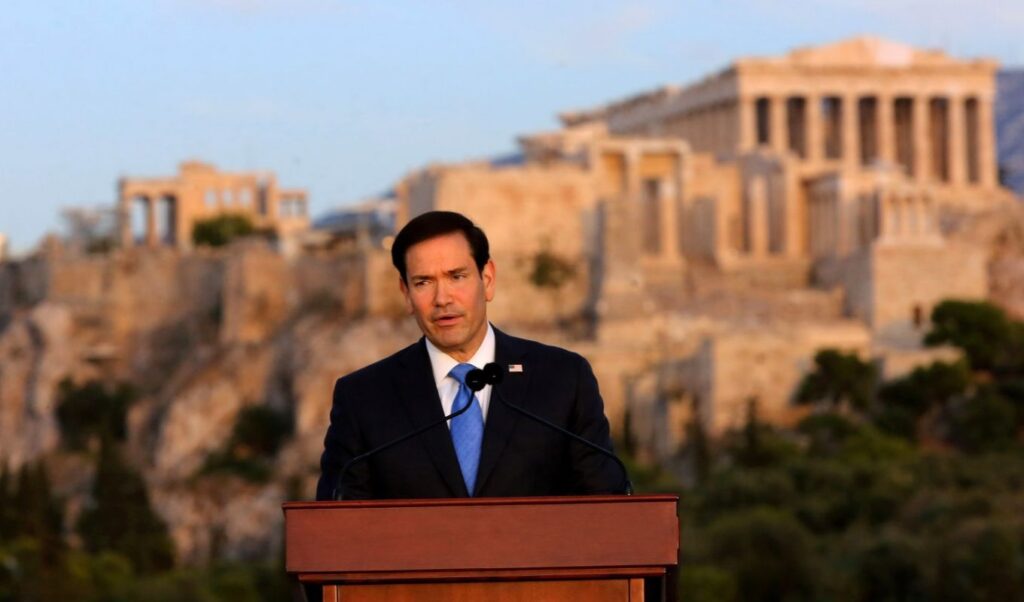
Marco Rubio‘s speech delivered from the Pnyx, with the Acropolis as its backdrop, drew extensive analysis from both Bloomberg and the Washington Post — particularly its sweeping message about Western values. According to Bloomberg’s analysis, the U.S. Secretary of State stopped short of naming any specific country in his address, yet his warnings to Europe closely echoed criticisms that the Trump administration has repeatedly voiced — criticisms that have repeatedly unsettled America’s European allies. These center primarily on mass immigration, questions of cultural identity, and Europe’s approach to climate policy.
Washington Post: Rubio’s pointed message to Europe and comparisons with Vance
Bloomberg further noted that over the past two years, the Trump administration has actively sought to steer Europe’s political direction. As part of that effort, it has pressured close NATO allies to boost their defense spending while calling on them to reassert Christian values and reconnect with their historical heritage. Rubio articulated this vision plainly in Athens, expressing his conviction that “Europe can awaken from its long slumber and rekindle the flame that was lit here millennia ago.” Compared to Vice President JD Vance, however, Rubio is widely regarded as the more measured voice.
The ambitions behind the speech
The Washington Post, for its part, zeroed in on the broader ambitions underlying Rubio’s address — namely, a potential run for the U.S. presidency ahead of the 2028 election. The paper noted that the speech felt less like a diplomatic address and more like the declaration of a politician eager to claim the political legacy of the MAGA movement.
In his remarks, Rubio sought to frame Donald Trump’s “America First” agenda within a wider Western tradition of national ambition and renewal. He observed that “we have much still to learn from the men of ancient Greece,” who “knew there was nothing selfish or shameful about devotion to your nation, nothing selfish or shameful about fighting to put its interests above all else.”
The newspaper noted that the speech was mounted as a major production, with four State Department cameras — one of which was positioned on a crane.
The speech comes at a moment when JD Vance is laying the groundwork for a potential 2028 presidential bid, while Rubio continues to deflect questions about his own political ambitions.
In his address, the Secretary of State not only defended the foreign policy of the Trump administration but also looked ahead, sketching out how the United States must evolve. “The path we choose will determine whether the West retains its place at the top of the world or resigns itself to a future of decay, subservience, and decline,” he said, among other remarks.
Rubio praised the civic life of ancient Greece, which he described as organized “around competition, ambition, and striving.” He also appeared to take aim at the excesses of liberalism, arguing that they had driven down standards “to ensure that no one would ever lose.”
He further criticized political Islam and “the radical mullahs of Iran, whose death cult glorifies child suicide bombers as national heroes and presents martyrdom as an end in itself.” “Our heroes may be willing to die for their cause,” he said, “but our heroes do not worship death.”
What Marco Rubio said in his speech
Among other things, the U.S. Secretary of State invoked iconic figures from ancient Greece, laid out an American vision of sovereignty and renewal, and criticized other Western nations for allowing their armed forces to weaken and for ceding sovereignty to international institutions.
The West stands “at a crossroads,” Rubio declared, stressing that the coming decade will determine whether the West “retains its place at the top of the world or settles for a future of decay, subservience, and decline.”
As for the United States, he said, “we are choosing to strengthen our nation’s power, unapologetically — to reclaim control of our critical supply chains, to reindustrialize our economy, to rebuild our defenses, and to compete for dominance in the technologies and industries of the future.”