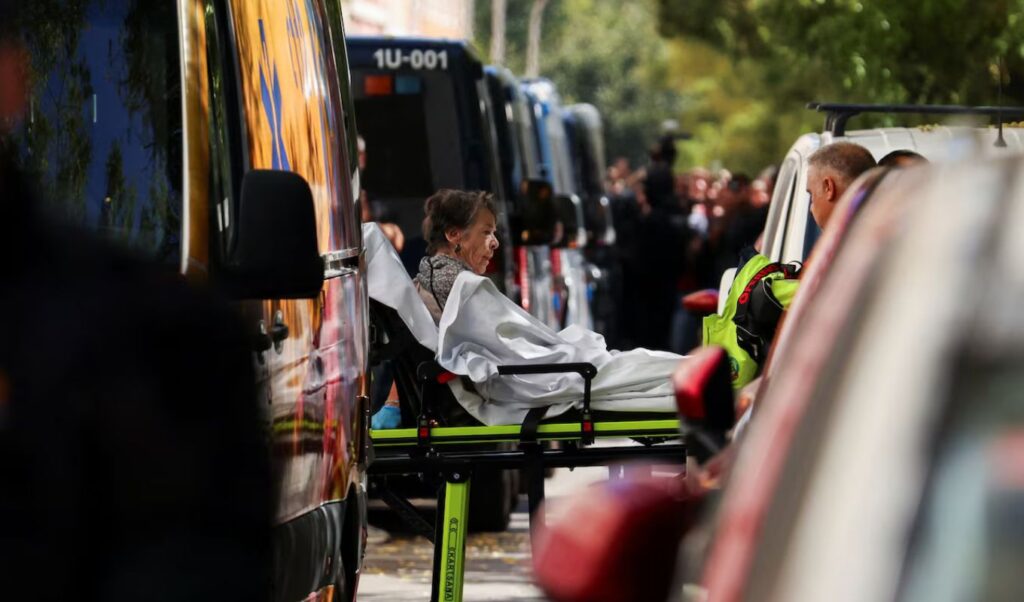
Maricamen Abascal, the woman who ignited Spain’s anti-eviction movement, passed away on Wednesday in hospital at the age of 87. She became a symbol across Spain when she was forced out of her home on September 23rd, in Madrid’s Retiro district — a place she had lived in for seven decades. Six years earlier, a company had purchased her apartment at an outrageously low price for the area, precisely because she was living in it. Living on a pension of €1,400 a month, she had never missed a single rent payment, which was based on an old tenancy agreement. Including utility bills, she paid a total of around €500 per month.
Read also: Spain: The housing crisis tightens its grip on Sánchez — protests continue as parliament rejects rent and eviction measures
Spain: “Fight on, keep fighting for what is yours”
In 2020, her landlords told her she had to leave the apartment because the tenancy had already been transferred twice — first to her mother, who was not listed as the tenant due to Franco-era legislation, and then to Maricamen herself. According to El País, the landlords attempted to evict her four times, and she rejected every offer put to her — whether to pay the difference in rent, which amounted to €1,600, or to purchase the apartment outright.
Following her eviction, Maricamen remained in hospital, where she ultimately died. “While a historic agreement had been reached that would have allowed her to return to her home, this solution came too late,” read a statement from her family and lawyer. They described the mass protests in public squares, the calls for snap elections, and the general strike call as “a turning point in the history of this country,” warning that “the price we paid to get here was far too high.” They echoed her rallying cry: “Fight on, keep fighting for what is yours.”
Thanks to an outpouring of public support, for the first time in Spain, a person facing eviction came close to returning home after the landlord agreed to a new lease. However, Maricamen’s health had deteriorated severely due to the trauma she had suffered.
“I am no longer myself”
She used a wheelchair, needed daily assistance, and had spent nearly seven years in a legal battle to remain in her home. In her final months, she had lost muscle mass, struggled to eat, and said that even her voice had changed. “It has affected me in every way. I am no longer myself,” she said just two days before she was forced to leave her home.
Who was 87-year-old Maricamen
Maricamen became a symbol in Spain and far beyond its borders. Even from her hospital bed, she addressed the protesters: “Fight, defend what is yours and, please, be careful. Keep camping out until your bodies give out.”
Thousands took to the streets in Madrid and later in other Spanish cities, while videos of her spread widely across social media. She asked them to persist — and they did.
Her full name was María del Carmen Abascal. In 1956, her father rented the apartment in the Ibiza neighbourhood, where she lived nearly her entire life alongside her mother and brother. She studied shorthand and secretarial skills, worked for 34 years as secretary to the board of directors of a pharmaceutical company, and retired in 1998.
“I worked my whole life,” she would say with pride, while her home was filled with paintings, collectibles, porcelain pieces, and black-and-white family photographs.
“I will fight until the very end,” she repeated time and again. Right up until her final days, she asked the Tenants’ Union — her “family,” as she called them — to carry on the struggle.
Two days before her eviction, she said through tears that she hoped to serve as a beacon of hope in the fight for dignified housing. She ultimately became a symbol, with the slogan “We are all Maricamen” appearing on posters and T-shirts alike.
Her dream had been to die in the very room where her parents had died — the room she had called home since 1956.
“All my memories are here. My father died very young, in 1960, at 51. And my mother died in 2005, in this home. I have lived here from 1956 until today.”