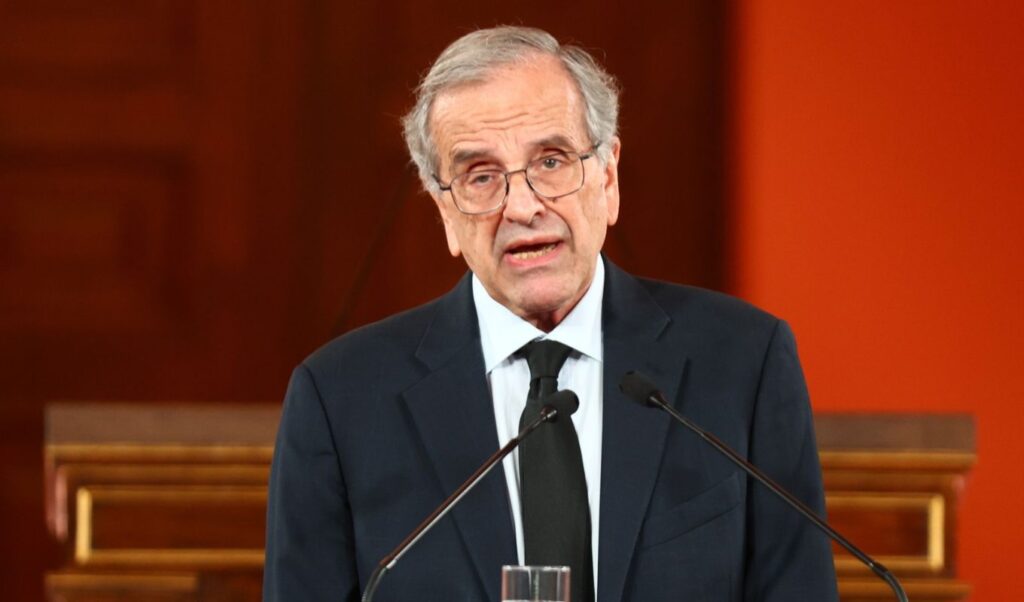
Antonis Samaras obliged the organizers of a two-day conference titled “Dialogues for Athens: From Myth to Modern City,” hosted by the newspaper “To Vima.” Before diving into his stories — some of which took him all the way back to 1978 — he noted that he had been asked to recall old, previously untold tales. The former prime minister spoke about the negotiations surrounding the 72 prerequisites required to unlock a €52 billion loan tranche, about Greece’s first bailout memorandum in 2010, and about a behind-the-scenes story involving the very first time he ever spoke with Konstantinos Karamanlis.
Read also: Samaras strikes again: “In Greece, the cradle of Western civilization, I see signs of decline”
Antonis Samaras: The “Putin” and the hardest signature
Antonis Samaras vividly described how he tracked down the civil servant whose signature was needed to complete the final one of 72 prerequisites required to unlock a €52 billion loan tranche. He recalled that a single signature was still missing and that, once the responsible official had been identified, he called him on the phone.
One of the most memorable stories Samaras shared involved the final hours before the deadline to fulfill all 72 prerequisites expired. “Good evening, this is Antonis Samaras,” he told the official, only to be met with the reply: “Sure, and I’m Putin.” Samaras noted that the civil servant hung up — and did the same thing a second time. Security forces were then deployed, and a motorcycle escort was sent to bring the official to the Maximos Mansion, practically, as the former prime minister put it with a laugh, “in his pajamas.” “I told you, Vladimir — I am Antonis Samaras,” he quipped. The official signed the document, and by 6:00 a.m. that same morning — the incident having taken place at 1:30 a.m. — the plane of then-Bank of Greece Governor Yannis Stournaras was already departing for Brussels, carrying the necessary documents in time.
“We were right about the first memorandum”
Samaras stressed that when he took office as prime minister, the state coffers were empty. Regarding his negotiations with Angela Merkel, he claimed that the German chancellor asked him, during a meeting in Berlin, to consider the possibility of Greece exiting the euro. He refused, telling her that Greece would manage.
The former prime minister also addressed the first memorandum, remaining consistent — as events later proved — in his position on the program’s economic projections. He recalled that when he studied it in 2010, both he and his advisers identified a serious problem with the so-called fiscal multipliers. In his view, the real recessionary impact of the program would be far greater than initially estimated — a miscalculation that, he argued, would make achieving the targets for primary surpluses and growth extremely difficult.
Samaras said he presented his objections to the Troika, but they were not initially accepted. A comprehensive study was subsequently prepared for the renegotiation of the terms, which formed the basis of what became known as “Zappeion I.” He also recalled the ridicule he faced at the time, having been mockingly dubbed “Harry Potter.”
He went on to speak about Olivier Blanchard, then chief economist of the IMF, who — as Samaras noted — publicly admitted two years later that the estimates for the fiscal multiplier had been wrong. “We were right,” Samaras said emphatically, arguing that his original objections to the first memorandum had been vindicated.
The “global surprise” of 2013
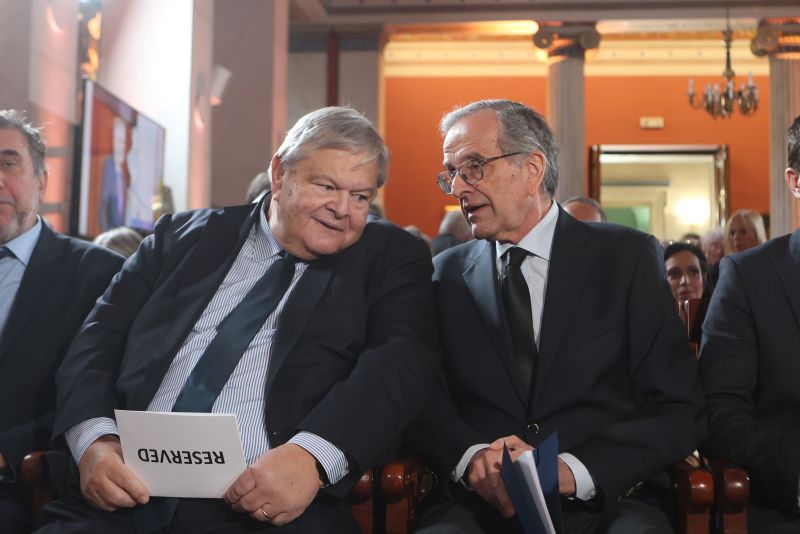
With Evangelos Venizelos present at the conference, Antonis Samaras thanked him for their cooperation during the second memorandum. Despite the enormous sacrifices, he said, the country managed to move toward exiting the economic crisis. He made particular mention of the primary surplus achieved in 2013, describing it as a “global surprise.” He also reminded the audience that the Eurogroup had committed back in 2012 that, should Greece achieve a primary surplus, it would proceed with measures to reduce Greek debt.
Kanellopoulos’s broken-down car
The former prime minister shared yet another personal story, this time from the early years of his parliamentary career, illustrating how, in his view, luck can play a decisive role in politics. Antonis Samaras recalled that he had first been elected to parliament in November 1977. In 1978, when Thanasis Kanellopoulos became Minister of Finance, he summoned the economist MPs of New Democracy to assist with the preparation of the state budget. Samaras, as he recounted, took on the task of presenting the revenue section after correctly answering a question from Kanellopoulos about “tax elasticity.”
When the budget debate came before parliament — with Konstantinos Karamanlis and Andreas Papandreou both present — Kanellopoulos was nowhere to be found in the chamber. According to Samaras, his car had broken down outside Rafina. Parliament Speaker Papaspirou therefore gave the floor to the then-young Antonis Samaras, as the designated “specialist speaker on revenues.”
After his speech, Konstantinos Karamanlis called him over and asked, in his characteristic accent from Serres: “Was that your debut?” Samaras replied “yes,” and Karamanlis shook his hand and told him: “You did very well.” The former prime minister described those words as “a great honor for a member of parliament,” especially coming from a political leader who, as he noted, rarely expressed such sentiments. He concluded: “And yet, Karamanlis would never have heard me that day if Kanellopoulos’s car hadn’t broken down. So you need luck too.”
“Politics is a duty”
“I didn’t get everything right,” Antonis Samaras admitted when reflecting on his political career, but he said he “tried hard, honestly, consciously, and with a compass” guided by his own ideas and convictions. The former prime minister stressed that he sees “signs of decline,” which is why he continues to speak out publicly. “Politics is not a profession — it is a duty, it is a matter of conscience,” he said, adding: “I firmly prefer the cost of conscience over the benefit of any round of applause.”
“We must put an end to vain, leveling, neoliberal governance”
Beyond his personal anecdotes, Antonis Samaras used the podium to launch a sharp attack on New Democracy, warning that institutions — and even the very foundations of democratic governance — are under threat. “I am sounding the alarm for democracy,” he said pointedly, linking public disillusionment to both the low turnout in the recent European elections and the strong showing of “none of the above” in opinion polls.
“People are exhausted, and the society of fatigue is real. You see the anxiety, you see the rush, you see verbal and physical violence, you see antisocial behavior, you see despair,” he said. He paid particular attention to the state of the Greek regions, noting that the sense of abandonment extends far beyond the major cities. “I have been an MP for a provincial constituency for almost 50 years, and you feel like crying when you see the deserted villages. Above all, you see the empty gaze of many young people,” he remarked.
“We must put an end to hollow, vain, and leveling neoliberal governance,” he declared — a statement widely interpreted as sharp opposition rhetoric. The former prime minister argued that it is impossible, as he put it, to “feed a materialistic and selfish view of life” while simultaneously “undermining and ridiculing spirituality and collective values.”
In the same vein, he spoke about national identity, the abandonment of rural areas, and “political correctness,” arguing that the country needs a change in political direction. He called for a “return to a politics of ideas and visions,” insisting that this is essential not only for democracy, but also for social cohesion and what he described as “national survival.”