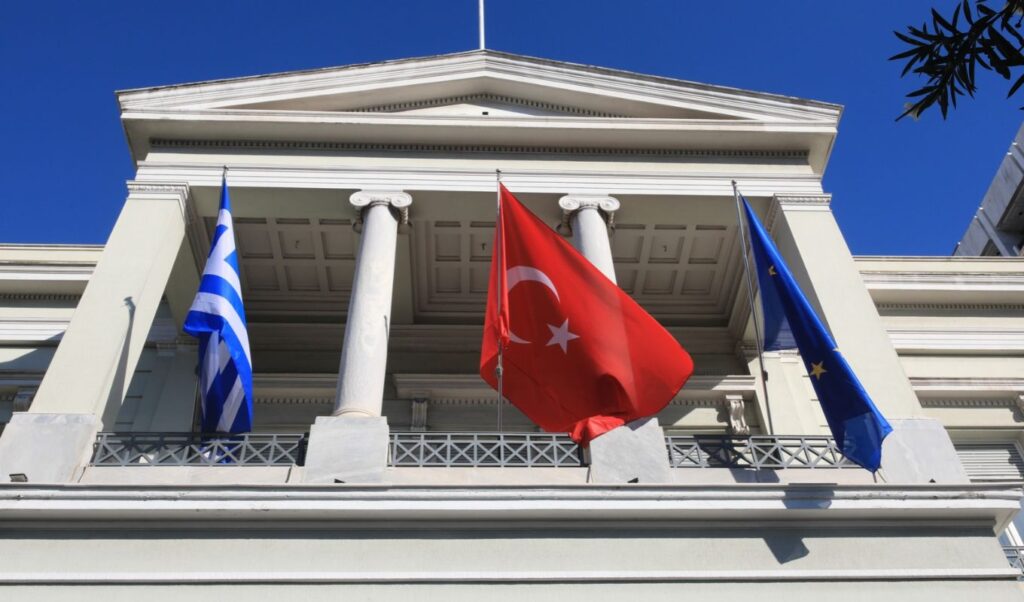
Turkey continues to push with persistence and intensity its demand for the demilitarization of the Aegean islands, while simultaneously maintaining its casus belli, repositioning troops along its western coastline — all while knowing full well that Greece’s island fortifications rely on purely defensive weapons systems. In the past 24 hours, both Foreign Minister Hakan Fidan, through two separate public statements, and Turkish Defense Ministry spokesman Zeki Atatürk have called on Greece to withdraw its forces from the islands. The systematic revival of Turkey’s demand for the disarmament of Greece’s Aegean islands is neither sudden nor unpredictable. On the contrary, it represents a long-standing and carefully structured strategic choice by Ankara — one that is closely tied to revisionist ideological roots, legal maneuvering aimed at creating facts on the ground, reactions to Athens’ defense alliances (particularly with Israel), and calculated domestic political objectives, as Dimitris Stathakopoulos — Doctor of Law at Panteion University and expert in Ottoman legal history — explains to parapolitika.gr.
Stathakopoulos: Turkey wants to become a “central power”
According to the scholar, at the core of Turkey’s argumentation lies a timeless narrative rooted in the “National Oath” of the Kemalist era — the claim that Turkey has been historically wronged by international treaties (Lausanne, Montreux, Paris). As he argues, the projection of the “Heartland” and “Blue Homeland” doctrines — which extend far beyond Turkey’s current maritime territorial waters — reflects Turkish ambitions to be recognized not merely as a regional, but as a central power, with a decisive say in Eastern Mediterranean affairs. He states emphatically: “In Greece, we say Turkey wants to be a regional power. No — in its own narrative, Turkey wants to be a central power. It believes it must have a say in everything that happens in the Eastern Mediterranean. And not just a say, but active participation. Not proportional participation — a third, a quarter, a fifth share in a public works project, an energy venture, or a military alliance — but the lion’s share, a leonine agreement in its favor, by virtue of its territorial and demographic size. Turkey is not just some small country. Moreover, it sees itself as the successor state of the Ottoman Empire and believes it can impose all of this.”
The tool of “creeping jurisdiction”
The challenge to the militarization of the Greek islands is not new. It dates back to 1976, when Greece reinforced its island defenses following the Turkish invasion of Cyprus and the establishment of the Aegean Army. Since then, Ankara has systematically exercised what is known as “creeping jurisdiction,” asserting rights not granted to it under international law. Its goal is to demonstrate consistent and long-standing objection, so that in any future international arbitration, it can claim it never accepted the existing status quo — effectively converting de facto situations into de jure rights, following the historical precedent of Alexandretta in 1939.
The Alexandretta precedent of 1939
Stathakopoulos further argues that Turkey is attempting to impose on occupied Cyprus the same tactics it used in Alexandretta, Syria. He explains: “In 1939, Turkey sent settlers to Alexandretta, then requested that the French — who administered the region — hold a referendum. The French agreed, and given the Turkish settlers already present, the vote resulted in Alexandretta being incorporated into Turkey. Syria never accepted that referendum, even to this day, 87 years later — yet Alexandretta remains part of Turkey. Where does Turkey want to apply this same playbook? In the occupied territories of Cyprus, the Eastern Mediterranean, and the Aegean, at the very least.”
The sabotage scenario: Could an unknown underwater drone target the GSI cable?
But how ready is Turkey to impose its designs? As the scholar explains: “Erdoğan operates on a logic not of attack, but of siege and constant protest — using time and patience as his allies, much like General Kutuzov in Tolstoy’s War and Peace. He will protest, he may deploy frigates and conduct overflights. But what he has already activated — and will intensify — is a fleet of fishing vessels that will challenge and obstruct any right Greece attempts to exercise. Why will they cause problems? Because this won’t be a military fleet that Greece can protest as an armed violation — it will be an unarmed fleet of fishermen creating disputes and challenges to Greek sovereignty across the Aegean and Eastern Mediterranean. I am deeply concerned that when the time comes to lay the GSI cable — running from Crete to Cyprus — it cannot be ruled out that an underwater drone of unknown origin will carry out an act of sabotage. Turkey will naturally deny it, but it will buy time to sabotage the project it has been excluded from, forcing Meridian — the French consortium in this case — to bring Turkey into the joint venture. Turkey would then benefit on two fronts: first and foremost, by having its sovereignty claims acknowledged, and secondarily by extracting some tangible gain or compensation.”
This strategy of deliberate escalation also serves President Erdoğan’s domestic agenda. Ahead of the next elections, invoking external threats from Greece, Israel, or the economy serves to activate Article 116 of the Turkish Constitution regarding “overriding national interest.” Through early elections, Erdoğan aims to circumvent the constitutional two-term limit and seek the presidency once again.