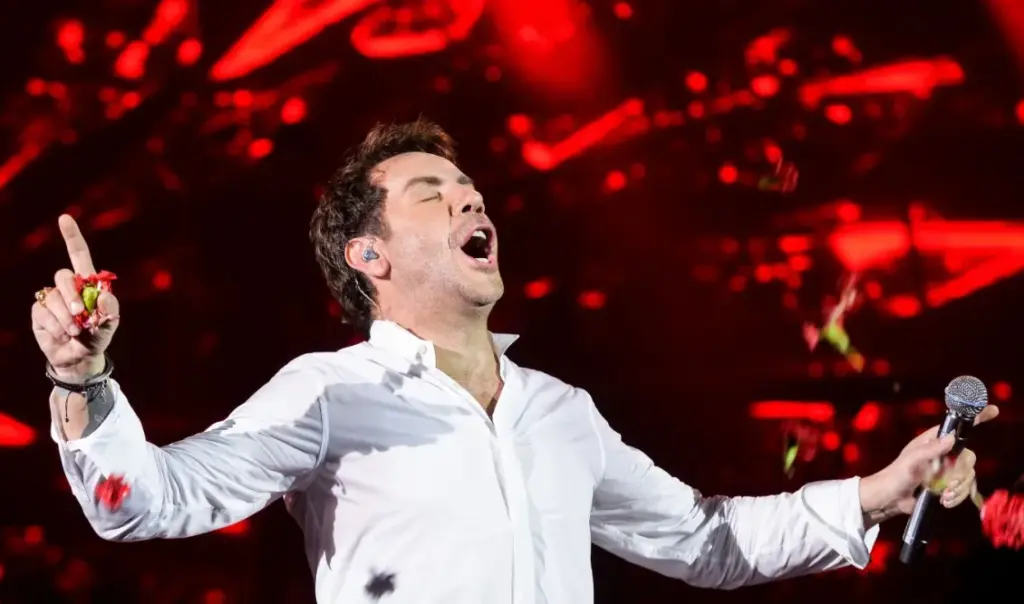
Choreographer and theater director Konstantinos Rigos spoke with Parapolitika 90.1 on the show “Aerologies” with Giorgos Lambiris about his long and creative collaboration with Giorgos Mazonakis, his artistic journey, and his new production “The Dreamers,” which makes its world premiere at the Synchrono Theatre on October 3rd.
With decades of creative work behind him, Rigos admitted that the creative process still manages to surprise him. The more he searches for new directions, the more questions arise. “Creation is an endless question mark. The more you search, the more you discover,” he said, explaining that each new project presents a different creative puzzle and an opportunity to understand what draws him to such varied artistic choices.
Meeting and collaborating with Giorgos Mazonakis
Rigos spoke at length about his relationship with Giorgos Mazonakis, with whom he collaborated from 2008 through the post-pandemic period. Their professional relationship gradually evolved into a long-lasting friendship. He recalled that their first contact came at the initiative of the singer’s manager at the time. Rigos knew Mazonakis as an artist, though without deep familiarity with his work. Their personal acquaintance quickly sparked a unique artistic chemistry.
“We connected in a certain way, and from that point on there was a friendship that lasted many years. It was quite creative and very unconventional,” he said. For Rigos, Mazonakis never simply accepted a creative proposal — he had the ability to transform it into something entirely his own.
“Giorgos was a canvas on which I could create new images, but he could also not just accept them — he could recreate them and make them completely his own.” Rigos described him as a subversive and truly sui generis artist, noting that it would be difficult to find a comparable figure in Greece. He particularly emphasized Mazonakis’s ability to read the pulse of an audience while simultaneously transforming the creative input of his collaborators in imaginative ways.
Their work together spanned musical shows, concerts, music videos, and a wide range of artistic projects. A standout moment was Mazonakis’s involvement in the “Rocky Horror Show,” an experience that, according to Rigos, revealed an entirely different side of the singer. “He transformed from a singer into a student and an actor who wanted to learn and put in the work,” he noted, adding that Mazonakis had a deep love for theater and cinema and a genuine enthusiasm for exploring different art forms.
Although the two had not collaborated or met frequently in recent years, Rigos made it clear that the end of a professional chapter does not erase what came before. “Neither my opinion, nor my thinking, nor the affection I have had all these years for him as a person has changed,” he said pointedly. As he noted, professional cycles sometimes come to a close — but that does not mean feelings change toward someone with whom you have shared such an intense creative journey.
“The Dreamers” and its world premiere in Athens
Konstantinos Rigos’s next artistic challenge is “The Dreamers,” opening October 3rd at the Synchrono Theatre and running through the end of November.
The production is directly connected to Bernardo Bertolucci’s acclaimed film of the same name, one of Rigos’s personal favorites. The stage adaptation was written by the same creator who penned the film’s screenplay — itself based on a literary work — and is being presented for the very first time anywhere in the world in Greece.
According to Rigos, the work continues to evolve throughout rehearsals. Questions and observations from him and the cast are relayed to the writer, who makes revisions and sends new material back to the Greek team.
The theatrical version consciously moves away from simply reproducing the film on stage. Rigos believes that attempting a direct transfer of cinematic imagery to the stage would result in little more than “classic illustrated reproductions.”
Instead, the production focuses exclusively on the three central characters. The parents and all secondary figures are absent, and the action is confined to the apartment where the three protagonists retreat after the Cinémathèque closes its doors. Outside lies the Paris of May ’68.
The tension between “inside” and “outside” forms the backbone of the production. Built on this contrast are the characters’ relationships, their conflict and acceptance, the cultural divide between the American and French protagonists, and the love triangle that develops among them.
The same philosophy extends to the set design. Rather than being descriptive or realistic, it is visual and conceptual — capable of suggesting a large bed, a floor, or a table, depending on how the characters interact with it.
The ending also differs from that of the film, following instead the logic of the original literary source.
For Konstantinos Rigos, adapting cinematic works for the stage is a creative territory he returns to consistently. What interests him is not the reproduction of film imagery, but the discovery of the theatricality hidden within it — and the creation of a new, autonomous world on stage.