A significant portion of capital flowing into the Greek hotel market is following a different development path. Rather than building new properties from scratch, major groups are investing in the complete transformation of existing hotels, capitalizing on established locations, permits, and infrastructure that are already on the tourism map.
These projects go far beyond standard renovations. They encompass new wings, additional rooms and villas, spas, upgraded dining, energy modernization, and — frequently — a category upgrade or integration into an international brand. The common thread is the pursuit of higher-spending guests and an extended operating season.
On the “Island of the Knights”
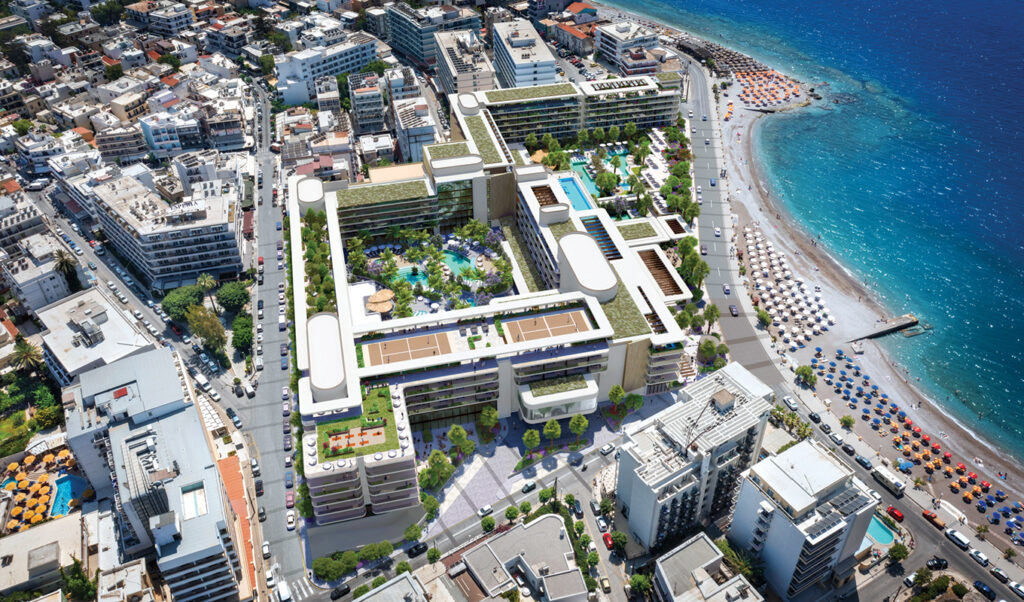
At the Leonardo Kolymbia Resort, a two-year, €20 million program has been completed. In 2025, a new building with 30 rooms was added and wellness facilities were upgraded, while in 2026 the older rooms were renovated, the swim-up pool was refreshed, and two à la carte restaurants were created. The intervention at the Mitsis Grand Hotel is even more substantial. The historic hotel is being fully reconstructed with an investment that has grown from an initial budget of €80 million to an estimated €100 million. Reopening is scheduled for 2027, with 327 rooms and suites and 12 private residences. A food hall, retail outlets, rooftop spaces, a spa, and sports facilities will support its new identity as a year-round luxury destination.
Electra Hotels is also investing on the island, having allocated €13 million for the renovation of Electra Palace Rhodes in 2024, and now planning a further expansion and infrastructure upgrade. Meanwhile, in Athens, the Electra Palace Athens is undergoing a phased renovation without interruption to operations. The first phase was completed in April 2026, with the full program expected to conclude in April 2027.
On the “Great Island”
Candia Park Village, operated by Bluegr Hotels & Resorts, is being transformed into a five-star resort. The first phase, budgeted at €30 million, begins in autumn 2026 and will last approximately two years. A subsequent €50 million expansion will add 100 additional rooms and 12 villas, with the entire project set for completion by 2030. This project forms part of Bluegr’s €125 million investment program across its Crete portfolio.
In Macedonia
The largest investment in this category is Ikos Kassandra. The Sani/Ikos Group will deploy more than €400 million to merge and redevelop the former Athos Palace, Pallini Beach, and Theophano Imperial hotels in Kallithea, Halkidiki. The first Ikos Grand Resort is scheduled to open in April 2029, featuring nearly 750 rooms, suites, and villas across 400 acres with 600 metres of beachfront. The plans include pools, a spa, sports and family facilities, and more than 30 restaurants and bars.
Smaller in scale but equally representative of the same trend is Medite Kassandra in Halkidiki. Bulgarian group Medite invested approximately €15 million in the former Kassandra Mare hotel, along the Nea Moudania–Nea Potidea corridor, relaunching it as a five-star resort. The goal was not to increase capacity — which remains at 132 beds — but to elevate the value of the product. The property features 89 rooms and suites, pools with swim-up options, dining venues, a private beach, a spa, and wellness services. It has been welcoming guests since July, with 2026 serving as a soft opening and the first full season planned for 2027.
Medite’s experience from Sandanski, a well-known Bulgarian wellness destination, is thus being transferred to a coastal setting. In Halkidiki, wellness complements the core sun-and-sea product, broadening the range of available experiences and increasing in-resort spending.
Mountain tourism
In the mountain tourism segment, LAMYSA is moving forward with the complete regeneration of Elatos Resort & Spa on Mount Parnassus. The budget has risen from approximately €25 million to nearly €35 million, with an opening targeted for late 2027. The complex will join Accor’s Emblems Collection and is being designed as an international destination for wellness, outdoor activities, and year-round hospitality.
This shift is driven both by the age of many Greek hotels and by the demands of international market expectations. An existing property can offer a mature location and ready-made infrastructure, but transforming it requires substantial capital, complex permitting processes, and often a temporary closure. The goal is not simply more beds — it is the creation of products featuring larger rooms, villas, wellness offerings, gastronomy, and activities that increase the value of every stay. Investments exceeding €600 million across these projects signal that the next chapter of Greek hospitality will be written primarily through the regeneration of the existing hotel stock.
Published in MoneyPro by Parapolitika